
News
Does Time Exist? Maybe Not, But That’s OK

Does time exist? The answer to this question may seem obvious -- Of course it does. Just look at a calendar or a clock. But developments in physics suggest that time may not exist and we should start to take that possibility seriously. But trying to get by in a world without time seems positively disastrous. Our lives are built around time. We plan for the future, in light of what we know about the past. For example, we hold people accountable for their past actions, with an eye to holding them to account later on, in the future. But what’s the point of acting to bring about a change in the future when, in a very real sense, there is no future to act for? Also, what’s the point of holding someone to account for a past action, when there was no past and so, apparently, no such action? It’s easy for philosophers and physicists to twist themselves into a pretzel when trying to think this through, but that doesn’t stop them from trying.
Astronauts Grissom and Young Kickoff the Gemini Program – 60 Years Ago Today

Sixty years ago today, on March 23, 1965, a Titan 2 rocket launched into space NASA astronauts Virgil "Gus" Grissom and John Young inside their Gemini III capsule, kicking off the first two-manned, Earth-orbiting spaceflight of the Gemini Program. Gemini III (GT-3 or Gemini Titan 3) was the first US capsule launched with two astronauts onboard. The Gemini Program was conceived as an intermediate step between the one-manned Mercury and three-manned Apollo Programs. The program was developed to determine astronauts’ reaction to long duration flights, to develop the rendezvous and docking methods that would later be used in the Apollo Program, and to establish and perfect landing and reentry techniques. Gus Grissom had piloted the second Mercury flight “Liberty Bell 7” on July 21, 1961 and would later be named to serve as command pilot for the Apollo 1 mission, the first 3-manned Apollo flight. Tragically, Grissom and fellow crew members Ed White and Roger Chaffee perished in a flash fire inside the Apollo capsule during ground testing on January 27, 1967.
Alexei Leonov Becomes the First Man to Walk in Space - 60 Years Ago Today
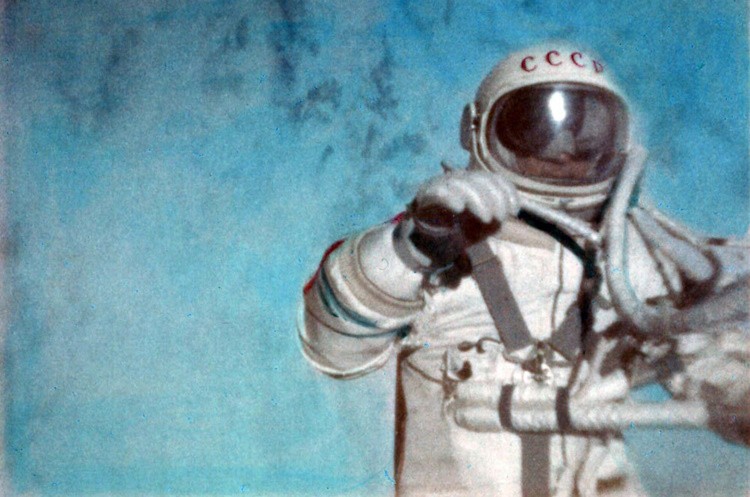
Sixty years ago today, on March 18, 1965, Alexei Leonov became the first person to float freely outside a spacecraft in Earth orbit when he ventured from Voskhod 2. Famously, Alexei displayed nerves of steel when his spacesuit expanded in the vacuum of space so much that he was unable to squeeze back into the spacecraft. Making a hair-raising decision (and without permission from ground control), he opened a valve on his suit to let enough air escape for him to enter the airlock. His spacewalk lasted only 12 minutes but proved that astronauts could work outside a spacecraft. Alexei Leonov passed away in 2019 at age 85.
Webb Space Telescope Studies the Atmosphere of an Isolated Free Floating Planetary Mass Object That is Not Tied to a Host Star

An isolated free-floating planetary mass is an object that has the mass of a planet, but does not orbit a star. Some isolated planetary-mass objects are probably brown dwarfs, while others could be free-floating super-Jupiter sized planets. Getting a nice, clear look at such an object outside of our Solar System can be tricky. Some exoplanets are way too cool and dim to observe. Others are virtually invisible in the blinding glare of their host stars. This is where a stand-in like SIMP 0136, a hot, bright, planet-sized object with a thick atmosphere, extremely fast rotation rate, with no star to spoil the view, and only 20 light-years from Earth, comes in handy. Using NASA's James Webb Space Telescope to monitor SIMP 0136 directly as different parts of the object rotated into view, researchers have been able to disentangle the brightness patterns of hundreds of colors of infrared light coming from different parts of the object’s atmosphere. The results reveal variations in cloud cover, temperature, and chemistry that provide insight into the three-dimensional complexity of these gas giants beyond our Solar System.
Firefly Aerospace’s Blue Ghost Lunar Lander Softly Touches-Down in Mare Crisium

Yesterday, March 2, 2025, Firefly Aerospace’s Blue Ghost Mission 1 successfully delivered 10 science and technology instruments to the lunar surface as part of NASA’s Commercial Lunar Payload Services (CLPS) initiative. Upon launching on January 15, 2025, Blue Ghost spent 45 days traveling to the Moon, allowing ample time to conduct health checks on each subsystem and begin payload science. Yesterday, Blue Ghost landed in Mare Crisium (near Mons Latreille) and will operate payloads for a complete lunar day (about 14 Earth days). On March 14th, Firefly expects to capture high-definition imagery of a total eclipse when the Earth blocks the sun above the Moon’s horizon. Blue Ghost will then capture the lunar sunset on March 16th, providing data on how lunar dust levitates due to solar influences and creates a lunar horizon glow first documented by Eugene Cernan on Apollo 17. Following sunset, Blue Ghost will operate several hours into the lunar night. Blue Ghost lunar landers will be flying annual missions to the Moon with payload services customized to the technology and exploration goals of each customer.
Excuse Me While I Kiss the Sky -- Month of March 2025

Welcome to the night sky report for March 2025 -- Your guide to the constellations, deep sky objects, planets, and celestial events that are observable during the month. Mercury is visible beneath Venus for the first week and a half of March, Mars is high in the east following sunset, and Jupiter is visible high in the west after dark – Not very spectacular. However, to make up for the limited planet viewing this month, there is a total lunar eclipse on the way that is visible in the Americas on the night of March 13th. During March, look for the constellations Gemini and Cancer to spot interesting celestial features like star clusters M35, the Beehive Cluster (M44), and NGC 3923 -- an oblong elliptical galaxy with an interesting ripple pattern. Find the Y-shaped constellation Taurus, the bull, high in the southwest. The Hyades star cluster forms the bull's face. The night sky is truly a celestial showcase. Get outside and explore its wonders from your own backyard.
Ancient Beach Sediments Found on Mars Support the Idea That Oceans Once Covered the Planet

Mars today is a cold, dry, dusty planet with its only obvious water locked up in frozen polar ice caps. But billions of years ago, it appears to have had sandy beaches lapped by waves along the shoreline of a vast ocean. The latest evidence for beaches on Mars comes from a Chinese Zhurong rover that landed on the planet in 2021. During its short life it detected evidence of underground beach deposits in an area thought to have once been the site of an ancient sea, bolstering the idea that the planet long ago had large bodies of water.
NASA’s SPHEREx Space Telescope to Launch Soon

Shaped like a megaphone, the upcoming SPHEREx mission will map the entire sky in infrared light to answer big questions about the universe. Expected to launch during the first half of this year from Vandenberg Space Force Base in California, NASA’s SPHEREx space telescope will provide astronomers with a big-picture view of the cosmos like none before by creating an all-sky spectral survey. Over its two-year planned mission, SPHEREx will collect data on more than 450 million galaxies and more than 100 million stars in the Milky Way. SPHEREx will map the entire celestial sky in 102 infrared colors to learn more about the origins of our universe, the galaxies within it, and life’s key ingredients in our own galaxy.
ESA’s Planetary Defense Office Closely Monitoring Newly Discovered Asteroid 2024 YR4 -- Has a 2.2% Chance of Impacting Earth in 2032

The European Space Agency is closely monitoring asteroid 2024 YR4, which has a very small chance of impacting Earth in 2032. It should safely pass Earth on December 22, 2032, but a possible impact cannot yet be ruled out. The asteroid is estimated to be between 40 and 100 meters wide.
Excuse Me While I Kiss the Sky -- Month of February 2025

Welcome to the night sky report for February 2025 -- Your guide to the constellations, deep sky objects, planets, and celestial events that are observable during the month. Venus blazes at its brightest for the year just after sunset, then Mars and Jupiter rule the night amid the menagerie of bright winter stars. Little Mercury pops up just above the horizon in late February, looking relatively bright as the sunset fades. In February, the Winter Triangle is your guide to the night sky. The northern hemisphere is treated to views of the stars Procyon, Sirius, and Betelgeuse, as well as awe-inspiring views of the Great Orion Nebula (M42, NGC 1976), sculpted by the stellar winds of central bright stars. The night sky is truly a celestial showcase. Get outside and explore its wonders from your own backyard.
Words of Wisdom -– Some are Deep… Others Not So Much

Let's start off the New Year with some words of wisdom. Here is an update to my collection of quotable quotes. Some are deep. Others not so much... "Nothing can stop the man with the right mental attitude from achieving his goal... Nothing on earth can help the man with the wrong mental attitude." - Thomas Jefferson “Why shouldn't truth be stranger than fiction? Fiction, after all, has to make sense.” - Samuel Clemens (aka Mark Twain) “The pure and simple truth is rarely pure… And never simple.” - Oscar Wilde "Talent hits a target no one else can hit... Genius hits a target no one else can see." - Arthur Schopenhauer “Good judgment comes from experience… And a lot of that comes from bad judgment.” - Will Rogers “Sometimes the questions are complicated and the answers are simple.” - Theodor Seuss Geisel (aka Dr. Seuss) "Artificial intelligence is no match for natural stupidity." - Anonymous
Excuse Me While I Kiss the Sky -- Month of January 2025

Happy New Year and welcome to the night sky report for January 2025 -- Your guide to the constellations, deep sky objects, planets, and celestial events that are observable during the month. Each evening this month, enjoy a sweeping view of six planets at once (Venus, Mars, Jupiter, and Saturn with the naked eye and Uranus and Neptune with a telescope). Also look for a close approach of Venus and Saturn, Mars occulted by the Moon, and the Quadrantid meteors. The January sky is also filled with bright stars in the constellations Orion, Taurus, Gemini, Canis Major, and Canis Minor. Find these cosmic gems by looking toward the southeast in the first few hours after it gets dark. The northern hemisphere also features beautiful views of Capella - a pair of giant yellow stars, Aldebaran - a red giant star, two star clusters [the Hyades (Caldwell 41) and the Pleiades (M45)], and the Crab Nebula (M1, NGC 1952). The night sky is truly a celestial showcase. Get outside and explore its wonders from your own backyard.


Funding Member