Well, the day finally came last Saturday. After purchasing a slightly chipped 16-inch f/5 Swayze mirror five or six years ago, I completed the truss dob scope to house it and I celebrated first light!!
Construction was pretty much by-the-book (Kreig and Barry that is) except for some minor modifications for cosmetic purposes. Modifications such as the use of exotic woods in the focuser board and as edge banding on the top of the altitude bearings, and applying fasteners from inside the mirror box and biscuit joinery to create a clean exterior appearance. Disassembled, the scope just barely fits into the back seat of my Accord.
The mirror is reported to be one of Swayze’s better ones as described in its provenance. To maintain the optical train’s tip-top performance I obtained a 2.6-inch 1/30 wave secondary.
Saturday night was very transparent for my area (30 miles west of Philadelphia) but quite unstable following the recent arctic cold front that came through. I had the scope aligned and cooling with a single rear fan two hours before dark. At observing time I looked at a greatly defocused Polaris and could tell there was some high speed turbulence flying by and I still had a warm boundary layer on the mirror; probably because of the rapidly cooling air (daytime high in the mid 60s to a low of 29). I clearly didn’t have the right conditions to star test so I started my night’s viewing. The Milky Way was faintly visible; about as good as it gets in my light-polluted neighborhood.
The scope was moving well with no binding except for a little initial sticking that probably means my ebony star could use a good cleaning with some solvent. The combination of Telrad and 50mm finder scope worked great for locating objects quickly and accurately. I was usually able to go directly to my barlowed 10mm UO orthoscopic (404 power with 40-degree AFOV) and with only a little bit of fishing, could find the object quickly.
Views were the best I could hope for! Starting with the bright objects while the skies darkened I tested the high power with the 10mm on Uranus. A clear disk at 202X degraded to mush at 404X, but by the end of the session around midnight it held up well at 404X with a clearly defined edge to the disk. The double cluster looked great showing some color variation not visible in my smaller scopes. M13 was a little pile of diamond dust, with the fine optics showing lots (100+?) individual stars. My first view of the Andromeda galaxy was disappointing… until I shifted the scope and realized I was looking at M110 and not M31! M32 even showed more than the core with its slightly eliptical axis faintly visible. The sky was too light to get more than a hint of the dust lanes. Encouraged, I tried to push through the local sky glow to find some fainter galaxies, but no luck. I guess there is only so much that aperture can do for you. The ring and dumbbell nebulas looked great through a nebular filter as I expected from having seen them through my club’s 17 inch Coulter (focuses stars to perfect triangles at moderate powers; and no, the optics are not pinched). But the real star, pardon the pun, of the evening was the veil nebula viewed through my nebular filter. Without the filter it was barely discernable through the light pollution, but with the filter I could see the filaments within the nebula and could trace both sides quite far; things I couldn’t remember seeing in the 17” Coulter. Without the aperture the nebula looks more like a glowing fingerprint smear on a window but with the 16” it looked more like a glowing cobweb.
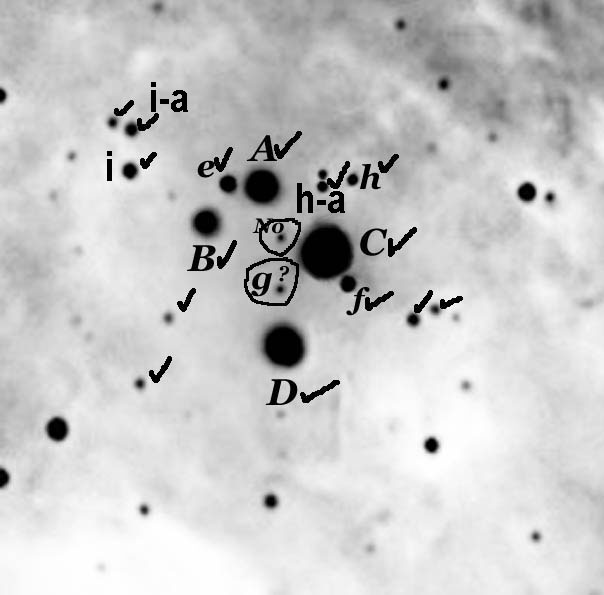
After catching a little sleep, I went back out to the scope before dawn. Polaris out of focus still showed the passing high altitude turbulence, but the mirror only showed a mild lazy roiling of a warm boundary layer. Orion was well placed for viewing in my narrow tree-challenged yard. Under a waning quarter moon the heart of M42 looked like the wool on a sheep’s back and the fifth and sixth stars (my first viewing ever for #6) in the trapezium were a snap at 126X with a 16mm Nagler and showed a nice black separation from there brighter companions when barlowed at 252X. I was hoping to catch Saturn but it only cleared the pine trees after the sky was growing a nice pale blue so I’ll have to save that one for a few weeks down the road.
Final Analysis:
Performance was very enjoyable;
Views can only improve with planned blackening, flocking, and baffling;
I have to get my front surface fan wired;
I have to get out under some dark skies!! (Closest official dark sky site is Cherry Springs Park, about 4 hours drive)
QUALITY APERTURE RULES!! …or is that ROCKS!! Is my age showing???
Mark Eschbacher
Attached Image:


 I had a 15" Swayze mirror and it produced fantastic images. He does some nice work.
 Keep looking and I bet you will find the H and I stars too and if your real luck the G.