If the lenses were to cause any vignetting, it would be very difficult to calculate it without details on the prescription, but in this case I am just going by the barrel geometry. I was actually fudging a little since the result depends on the focal length of the scope. Specifically, if you let
b = Distance from the open end of the barrel to the field stop in mm.
c = Distance from the field stop to the top edge of the barrel in mm.
d = Barrel ID.
s = Diameter of the field stop.
L = Focal length of the scope in mm.
Then the fastest f-ratio where the edge of the objective can "see" the nearest edge of the field stop is
f-ratio = L / ( s + L*(d-s)/b )
and the fastest f-ratio that can see the lenses beyond the field stop from the opposite side of the objective is
f-ratio = L / ( L*(d-s)/c - s )
So the fastest f-ratio at which there is no vignetting for a telescope of this focal length is the larger of these two f-ratios.
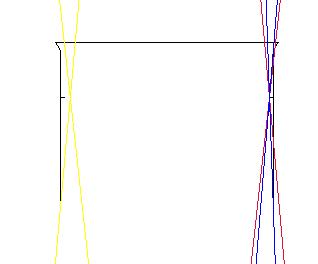
I can't remember details of the barrel geometry of the 24mm Panoptic, but I did measure with digital calipers and report some specific results once. I think this picture is proportional to the actual geometry and illustrates a the edge-of-field light cone for my 10" f/5. On the left in yellow, IIRC, is the unvignetted cone farthest off-axis. On the right is a light cone at the edge of the field stop that gets clipped a little on both sides from the red down to the blue.
--
Mike
Attached Image: