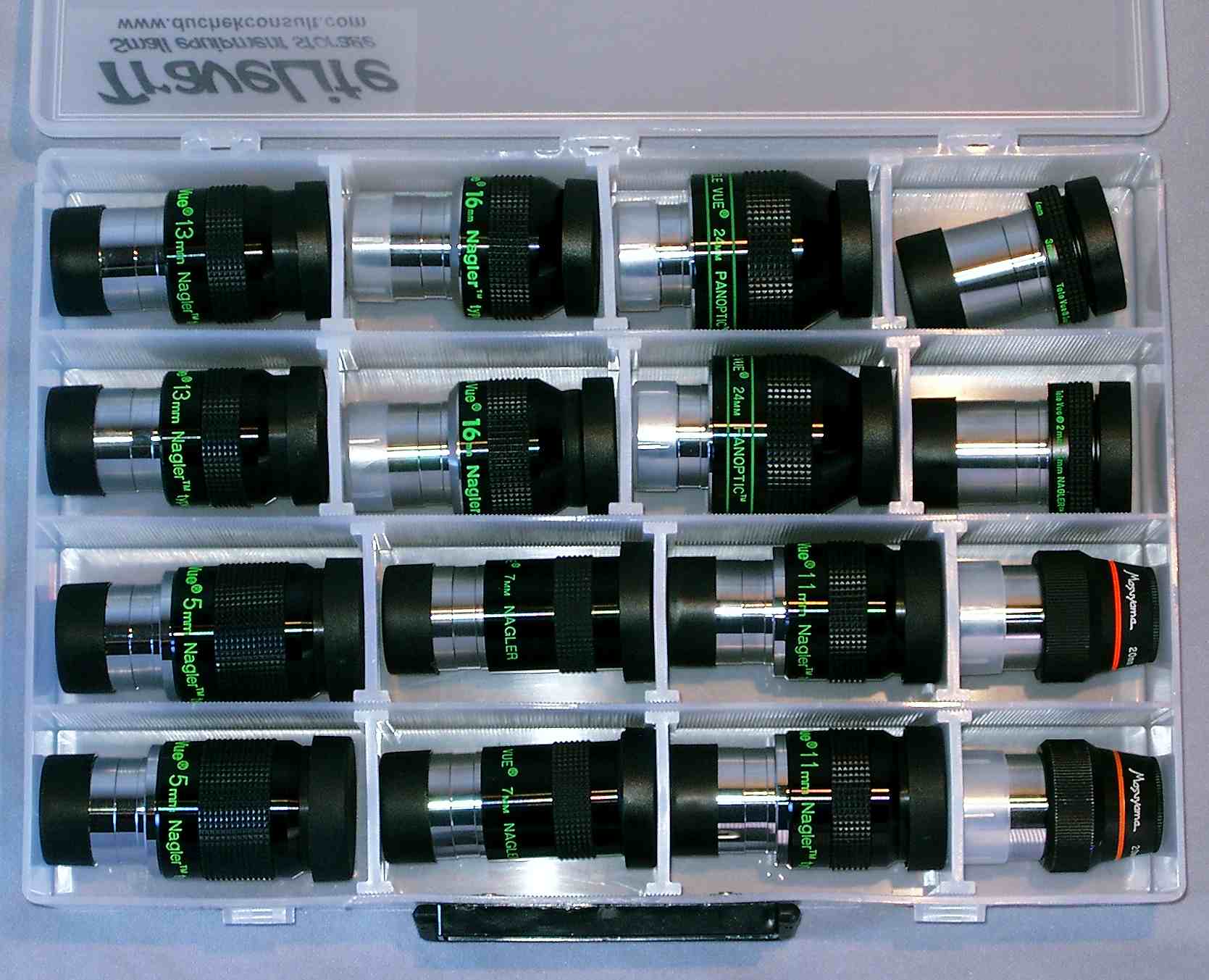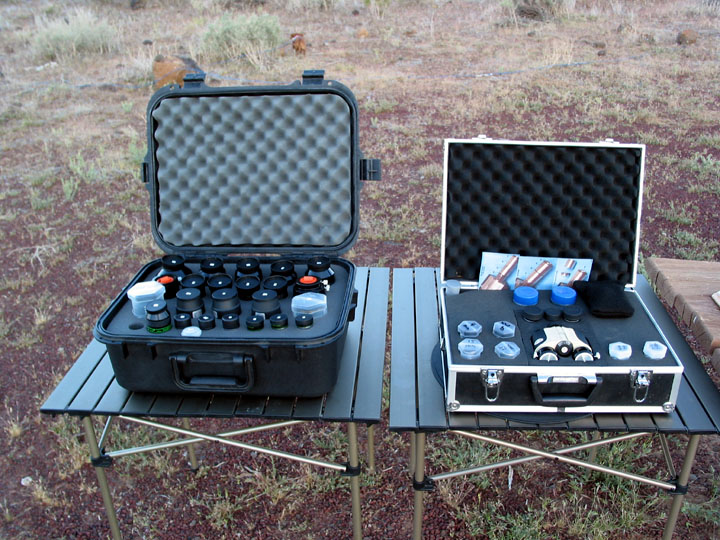

As you may know from Floyd's earlier "ocularholic" thread, my name is Jim and I too am an ocularholic.
For years the addiction manifested as a penchant for good "value-priced" eyepieces. Plossls, Ultimas, Orthoscopics, etc. During this time I was convinced that there really wasn't any reason to spring for pricier glass. For the price of one Panoptic (the "P" word) I could get three Ultimas afterall, and besides Todd Gross says that Ultimas are one of the best deals in eyepieces.
But as I got older, my tastes matured a bit too. I still loved my Plossls and Ultimas, but re-aquaintance with an old 20mm Meade research Grade Wide Angle (Erfle) tempted me to branch out. It's contrasty 70 degree field of view hinted at the mystic transcendence from merely "looking at" to "going there" promised by the uber-glass. Not a spacewalk, mind you, but rather a window rather than aisle seat. I mean one or two wide angle eyepieces couldn't hurt, right?
Now open to the possibility of more modern, better corrected wide field eyepieces, still that old frugality intruded. I reasoned that one did not need to buy the most expensive wide field eyepieces to get the big picture. Panoptics and NAGLERS (the "N" word) be cursed! So I dabbled. A Meade Super Wide Angle here, and a University Optics MK-70 there. Oh, and an Ultima Wide Angle (later Axiom) thrown into the mix for good measure. A notch or two up the price ladder from my beloved Plossls and Ultimas, but definitely not in the price stratosphere occupied by the dreaded, overrated, marketing invention, the Nagler. I mean, who in their right mind needs 82 degrees? 65-70 degrees is wide enough for any sane individual, right?
But then there was that damned Pentax XL 21mm. I wish I had never laid eyes on her. Sitting there in the store, rainbow multicoatings agleam and build quality like a battleship. I couldn't resist, so I promised myself that I would buy "just one." Just one premium eyepiece. One eyepiece at nearly twice the price of my elite Axioms and Super Wide Angles, and I would be satisfied. Or so I thought.
Then it happened. "Panoptic". There. I said it. I can now say "Panoptic" without even blinking. I bought one. A 2" 27mm Panoptic to be precise. The agony of the small fortune paid to the merchant was replaced the very night of the acquisition with the ecstasy of more nebular detail than I has seen in my life. The little elves at the Televue factories worldwide put a lot of photon-o-philic pixie dust in the multi-coating vats. There's no other rational explanation. The throughput and subtle details visible with the "Fish's Mouth" of M42 centered was pure magic. Panoptic, Panoptic, Panoptic! I am even willing to overlook the less than perfect edge correction at f4.9.
But the Panoptics are so good, never would I want ot need to buy a Nagler. Still, maybe I could dip a toe in the water, so to speak. Those aging Meade Series 4000 Ultra Wide Angles are knock offs of an earlier generation of Uncle Al's Nefarious Naglers. So I bought one. 84 degrees rather than that anemic 82 degrees promised by Televue's priciest creations. I bought a 14mm. Boy is it tall. Heavy too. And looking through it was more like wading in a star-filled pool than looking through a piece of glass. No match for the black-magic coatings on the Panoptic in the contrast and subtle detail department, but W-I-D-E A-N-G-L-E heaven nonetheless. It is one of those "wow" eyepieces. I doesn't matter what aperture you are using or what object you are viewing. Anyone looking through the eyepiece will involuntarily say "wow". Very cool.
Then a few weeks ago it struck me. Maybe I do understand the Nagler after all. Marry the 80+ degree "bowl of night" effect to the supernatural coatings from the Panoptic, shoe horn the result into a physics-defying moderately sized Type 6 package, and you might have something.
So I bought one. A 7mm Type 6. And used it last week for the first time. Simply sublime. A time machine. Galaxies like M51, M104 and M82 screaming "Look at me! Look at my mottling. Leave your averted vision at the door." M3 looking like a well-aimed photon snowball on its way to my front yard. Jupiter giving up belts and festoons aplenty, moon discs, transit shadows. Unbelievable. Saturn's ring system (ring system; not rings mind you) daring you to say "spoke" or "Enkce". And I thought Naglers were for faint DSOs only. P'shah.
I'm not saying chuck your Ultimas, Televue Plossls, Ultrascopics or University Orthos. Nor am I advocating eschewing TMB Monocentrics or Zeiss Orthoscopics in favor of Naglers for the moon and planets. What I am saying is that the Naglers are really, truly amazing. Don't let your skepticism exclude you from the experience as I did for many years.
Okay, with that as background, I have a question. Certain of the older Naglers (*cough* 20mm Type 2 *cough*) are quite collectible and often raved about. Various reviews tout the coatings on the newer Type 5s and 6s as being superior to the coating son the older units, and the better size efficiency of the Type 6 in particular is undeniable. There is no comparison in contrast and throughput between my old Nagler knock off 14mm UWA and my new 7mm Type 6. How do the newer Naglers stack up against the old favorites? Is there any reason other than sentamentality to own the older designs?

- Jim
For years the addiction manifested as a penchant for good "value-priced" eyepieces. Plossls, Ultimas, Orthoscopics, etc. During this time I was convinced that there really wasn't any reason to spring for pricier glass. For the price of one Panoptic (the "P" word) I could get three Ultimas afterall, and besides Todd Gross says that Ultimas are one of the best deals in eyepieces.
But as I got older, my tastes matured a bit too. I still loved my Plossls and Ultimas, but re-aquaintance with an old 20mm Meade research Grade Wide Angle (Erfle) tempted me to branch out. It's contrasty 70 degree field of view hinted at the mystic transcendence from merely "looking at" to "going there" promised by the uber-glass. Not a spacewalk, mind you, but rather a window rather than aisle seat. I mean one or two wide angle eyepieces couldn't hurt, right?
Now open to the possibility of more modern, better corrected wide field eyepieces, still that old frugality intruded. I reasoned that one did not need to buy the most expensive wide field eyepieces to get the big picture. Panoptics and NAGLERS (the "N" word) be cursed! So I dabbled. A Meade Super Wide Angle here, and a University Optics MK-70 there. Oh, and an Ultima Wide Angle (later Axiom) thrown into the mix for good measure. A notch or two up the price ladder from my beloved Plossls and Ultimas, but definitely not in the price stratosphere occupied by the dreaded, overrated, marketing invention, the Nagler. I mean, who in their right mind needs 82 degrees? 65-70 degrees is wide enough for any sane individual, right?
But then there was that damned Pentax XL 21mm. I wish I had never laid eyes on her. Sitting there in the store, rainbow multicoatings agleam and build quality like a battleship. I couldn't resist, so I promised myself that I would buy "just one." Just one premium eyepiece. One eyepiece at nearly twice the price of my elite Axioms and Super Wide Angles, and I would be satisfied. Or so I thought.
Then it happened. "Panoptic". There. I said it. I can now say "Panoptic" without even blinking. I bought one. A 2" 27mm Panoptic to be precise. The agony of the small fortune paid to the merchant was replaced the very night of the acquisition with the ecstasy of more nebular detail than I has seen in my life. The little elves at the Televue factories worldwide put a lot of photon-o-philic pixie dust in the multi-coating vats. There's no other rational explanation. The throughput and subtle details visible with the "Fish's Mouth" of M42 centered was pure magic. Panoptic, Panoptic, Panoptic! I am even willing to overlook the less than perfect edge correction at f4.9.
But the Panoptics are so good, never would I want ot need to buy a Nagler. Still, maybe I could dip a toe in the water, so to speak. Those aging Meade Series 4000 Ultra Wide Angles are knock offs of an earlier generation of Uncle Al's Nefarious Naglers. So I bought one. 84 degrees rather than that anemic 82 degrees promised by Televue's priciest creations. I bought a 14mm. Boy is it tall. Heavy too. And looking through it was more like wading in a star-filled pool than looking through a piece of glass. No match for the black-magic coatings on the Panoptic in the contrast and subtle detail department, but W-I-D-E A-N-G-L-E heaven nonetheless. It is one of those "wow" eyepieces. I doesn't matter what aperture you are using or what object you are viewing. Anyone looking through the eyepiece will involuntarily say "wow". Very cool.
Then a few weeks ago it struck me. Maybe I do understand the Nagler after all. Marry the 80+ degree "bowl of night" effect to the supernatural coatings from the Panoptic, shoe horn the result into a physics-defying moderately sized Type 6 package, and you might have something.
So I bought one. A 7mm Type 6. And used it last week for the first time. Simply sublime. A time machine. Galaxies like M51, M104 and M82 screaming "Look at me! Look at my mottling. Leave your averted vision at the door." M3 looking like a well-aimed photon snowball on its way to my front yard. Jupiter giving up belts and festoons aplenty, moon discs, transit shadows. Unbelievable. Saturn's ring system (ring system; not rings mind you) daring you to say "spoke" or "Enkce". And I thought Naglers were for faint DSOs only. P'shah.
I'm not saying chuck your Ultimas, Televue Plossls, Ultrascopics or University Orthos. Nor am I advocating eschewing TMB Monocentrics or Zeiss Orthoscopics in favor of Naglers for the moon and planets. What I am saying is that the Naglers are really, truly amazing. Don't let your skepticism exclude you from the experience as I did for many years.
Okay, with that as background, I have a question. Certain of the older Naglers (*cough* 20mm Type 2 *cough*) are quite collectible and often raved about. Various reviews tout the coatings on the newer Type 5s and 6s as being superior to the coating son the older units, and the better size efficiency of the Type 6 in particular is undeniable. There is no comparison in contrast and throughput between my old Nagler knock off 14mm UWA and my new 7mm Type 6. How do the newer Naglers stack up against the old favorites? Is there any reason other than sentamentality to own the older designs?
- Jim