Image of the day

Captured by
Lawrence Parchman

Eastern Veil Nebula

My Account

New to Astromart?

Register an account...

Need Help?

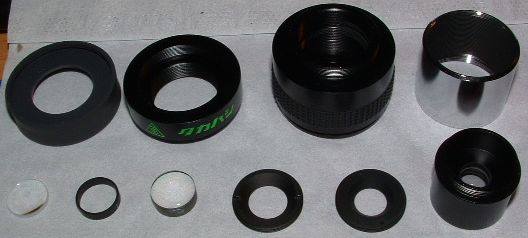
5mm Tak LE apart

Started by mhosea, 12/28/2005 03:33AM
Posted 12/28/2005 03:33AM | Edited 12/28/2005 07:13AM Opening Post
I got Clyde's 5mm Tak LE today and disassembled it. As the Anacortes web site says, it is indeed 5 elements in 3 groups. From telescope to eye, a negative doublet, a 10mm internal field stop, a plano-convex doublet (i.e. plano facing the field end), and a convex-plano (i.e. convex facing the field end) singlet. As I look closely at it, the eye lens surface does seem to be ever so slightly convex, so the eye lens might be DCX, but that top surface is relatively flat.
--
Mike
Attached Image:

mhosea's attachment for post 28845
Posted 12/28/2005 03:33AM #1
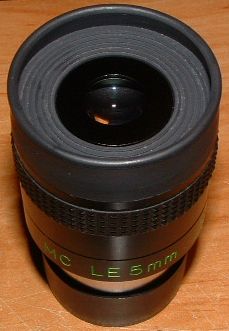
and 5mm Tak LE back together...

Attached Image:

mhosea's attachment for post 99339
Posted 12/28/2005 04:05AM | Edited 12/28/2005 04:08AM #2
Wow, that was very education, Mike. Why I used to have the very same eyepiece! I'm so glad Clyde volunteered the "patient" and you're the surgeon wink.

This is so interesting. Can you give us some more info? Like all elements are coated? Spacing between the elements? What special tool did you have to employ? Finally how does the view look like after you've put it back together ;-);-);-)? Say, I might be inspired by you to try to disassemble my 30mm Ultima to see what make it tick wink.

Thanks,
Ron B[ee]

PS - Oh by the way, some guy is looking for a 5mm Tak LE ;-). Don't know if he wants it in assembled or "kit" form ;-).
http://www.astromart.com/classifieds/details.asp?classified_id=398543
Posted 12/28/2005 06:15PM #3
The design is basically a simple Ortho fed by a Barlow (i.e. a Barlowed Ortho). You can do the same with any ordinary Ortho and 1.25" barlow lens.

The Barlow presents a relatively long focal ratio to the Ortho elements, and thus they will have correspondingly better off-axis performance. This is the trick behind every new short focus eyepiece available today. If you want 50 - 55 degree apparent field, a simple Ortho will do. If you want 60 - 70 degree, then an Erfle variation is used in the positive set. The Barlow serves to clean up the otherwise horrible off-axis performance of a standard Erfle. The Barlow is nothing special, and any good quality lens will work.

Roland Christen
Posted 12/29/2005 03:19AM | Edited 12/29/2005 03:20AM #4
Good work, Mike! You have nerves of steel to have dismembered and reassembled a delicate thing like an eyepiece! I know you've mentioned your belief in the five element construction of the Tak LE in the past, and I always doubted that assertion, and I apologize for ever doubting you. Thanks for setting me straight!

Walter Locke
"The Fearless Spectator"

There are 10^11 stars in the galaxy. That used to be a huge number. But it's only a hundred billion. It's less than the national deficit! We used to call them astronomical numbers. Now we should call them economical numbers.
Richard Feynman
US educator & physicist (1918 - 1988)


Posted 12/29/2005 03:31AM | Edited 12/29/2005 05:53AM #5
I want to share some more tidbits that I've found out about this eyepiece.

Owing possibly to the reuse of tooling for the casing for the 7.5mm Tak LE, you can actually use this particular 5mm Tak LE (and presumably all the other 5mm Tak LEs out there) in 3 different configurations:

1. The intended 5mm configuration.

The following two configurations are achieved without the spacer ring, which is the ring with the lettering on it. When you remove this ring, it exposes female threads that accept the Barlow lens cell and male threads that accept the barrel.

2. Without the Barlow and spacer ring. I haven't measured the focal length of the resulting 3-element eyepiece, but based on the AFoV and field stop it's probably around 11mm. It shows some astigmatism at the edge in my little 120mm f/8.3 Newtonian, but still seems pretty decent at that f-ratio. Note that I said "without the Barlow" rather than "without the Smyth lens". The reason is that I tested the 2-1 positive assembly for field curvature and found nothing significant.

3. Without the spacer ring but with the Barlow. This shaves about 9.4mm off the separation between the field stop and Barlow lenses. Here again I haven't measured the focal length directly, but I think the resulting eyepiece has focal length in the neighborhood of 6mm. I just tested it briefly on a star (lots of clouds out right now), but as you might expect it seems pretty well-corrected in the 120mm f/8.3 Newtonian.

Just thought you might find that interesting.
--
Mike