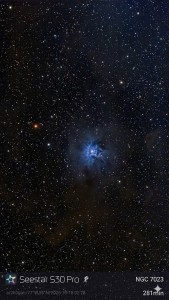
Image of the day

Captured by
Arthur Hogan

Iris Nebula

My Account

New to Astromart?

Register an account...

Need Help?

Time for Another Dumb Question.....

Started by brucebev, 09/13/2003 09:00PM
Posted 09/13/2003 09:00PM Opening Post
I'm a newbie at this and am gradually learning bit by bit about eyepieces, my EQ mount on the Orion Skyview Pro 120, not to mention sky charts, etc. Thanks to everyone in the past for their help and suggestions. Once again, I'm posting another baffling question I'm facing.

From my backyard location, I have no problem spotting Polaris and Cassiopia (the big "W") without my telescope. A couple other major bright stars are easily seen, but things like the "teapot" are "Lost in Space." Once I get my scope set up (I have a 9 x 50 finderscope on it), using a 25 or 32 eyepiece, I'm then completely lost. I see tons of stars and twinkling lights through the finderscope and the telescope itself, but haven't a clue exactly what I'm looking at or exactly where my telescope is pointed. For example, looking at Polaris, I see it and a couple stars around it when viewing naked eye. But once I use my scope, I see at least a dozen stars or more around it. Everything starts to look alike. I know the general direction my scope is pointed, but I still don't know exactly where in the sky it's aimed. This is making it a bit difficult and frustrating to find other stars and deep space objects.

Is there a special trick you all use to figure out what you're looking at? I'm in the city of Pittsburgh and do have light pollution to a certain point. However, there's a park behind my house and I have more "dark sky" in that direction. I've heard about the green laser pointers but wasn't sure exactly how effective they are. Any comments on them or other laser pointers? Are they helpful in finding where you are pointing to? Any tricks, methods, techniques, etc. you all use to sort these stars out would be very much appreciated. Thanks in advance to everyone for their help!

Posted 09/13/2003 09:10PM #1
A 0 magnification finder helps with this, like a telrad.
Floyd. You can also make a tube with a cross hair in it to get you to the right area.
Floyd

[SIZE="Large"][/SIZE][COLOR="Blue"][/COLOR] Floyd Blue grin
Amateur Imager
Posted 09/13/2003 11:06PM #2
Bruce,
As I live in NYC, I know about your light pollution/gray skies issues...What I would recommend that hasn't been mentioned is that you buy a pair of binoculars and a Mag5 or Mag 6 star chart. Bring it along with you whenever you view. It's true that you can get disoriented when looking through an optical finder, but not once you know a larger number of stars in the sky. I never view without my binoculars and it's paying off. It's also very helpful to have an optical finder on your scope-red dot/unity finders are a limited pointing device when there are so few bright stars to guide you.
Good luck,
-Curtis
--
--
--
--
--
--
--
-
Posted 09/14/2003 03:36PM #3
A local club, or a knowledgeable buddy will be a big help in getting started. It's easy to lose one's confidence and get lost without it.
Posted 09/15/2003 12:06PM #4
Bruce,
The breakthrough for me was the red-dot finder. The icing on the cake is the optical Right-Angle Correct Image finder. A scope with both is a joy to use:
-get in the neighborhood with the red-dot
-zero in with the optical finder
-observe with the main scope
-look for other potentially interesting targets (double stars?) in the field of the optical finder

However, all finders must be zeroed to the main scope if they are to be of any use. Before it gets dark, line up the main scope on a local prominent object at least a few hundred yards away. Church steeple, transmitting tower, or water tower will do. Make sure you see the object in the visual field of the main scope and center the most prominent feature on the object(like the top of the tower) in the field. With axes locked and drives off, adjust the red-dot finder to center on the target at the same location as the main scope. Recheck both main scope and finder several times to make sure nothing's moved and that both are centered on the same spot.

If you've also got the optical RACI finder, repeat the process with that, making sure that all three devices are pointing to the same spot on the same object when you finish. I've found that the Losmandy rings used with my optical finder will return to zero very well following removal and replacement. So, other than minor tweaks, I've only had to do this once.

The Stellarvue red-dot finder is one of the best and one of the least expensive. I've bought one for each scope and leave it attached whenever possible. Return to zero following remove/replace isn't guaranteed, but if the finder was zeroed on the scope before removal it won't be too far out when replaced.

To my mind the red-dot finder should be standard equipment for every beginners telescope. Only Stellarvue understood this from the get-go. Everybody else supplied reversed image straight through finders that are a challenge to use even when you're familiar with the sky. To a beginner these things are as discouraging as the Hubble photos on the box.

As noted above, the last thing a beginner needs is upside down, backward images, especially when he's fighting poor seeing in a light polluted environment. Add a touch of dyslexia to the mix and it rapidly gets hopeless.
Hope this helps.
Bob Young
Posted 09/15/2003 03:28PM #5
It sounds to me that you are in the same place I was when I started. Just figuring out where these eye candy's are to begin with can be a challenge. I used (use) a program, Starry Night, to locate these items. You can even print out a star chart with the Telrad circles and different bino views incorporated into the chart. There are even some charts out there that have Telrad circles on them already, don’t know who makes them, I’m sure someone here does. It’s a good way to learn the constellations. Once you know where the constellations are, it’ll make it easier to know what part of the sky certain objects are. Star parties are a great venue to learn as well. I just came back from the Oregon Star Party and learned a lot. Join a club as previously mentioned is also a great help. I find that getting others involved like kids, neighbors, or work mates to get a peak at something in your scope and get a “oh wow” is a real treat. I use Cassiopeia to find the Andromeda galaxy (M31), on a clear dark sky, you can almost see it with a naked eye. In my polluted Portland sky, I can pick it up with my 10 x 50 binoculars. Good luck and clear skies, Dave
Posted 09/15/2003 05:32PM #6
The unity finder advice is right on.

A few of comments to add to its usefulness. Get a planetarium program (Starry Night, etc.) and look up the views you are going to experience before you go out. Pay close attention to scale and geometry. Use the measuring tool to figure out how far things are from each other, and note bright objects which are in simple geometric relationships with your target: i.e. M3 (globular cluster) is midway on a line connecting Arcturus and Cor Caroli.

Use the planetarium program to learn a list of all-purpose signposts: Polaris; the Big Dipper; the "W" in Cassiopiea; the Keystone in Hercules; the Teapot in Saggitarius; Scorpius; the Summer Triangle; Leo; Gemini; Orion; Taurus; Cor Caroli (an unusually useful star); Arcturus; Spica; Procyon; Capella. Add others to taste.

That is not a long list, and you learn an object or two at a time as the seasons change. You will be amazed at the neat things you can find with just that much knowledge of the sky, and a quick reference to your planetarium program to see how your target relates geometrically to something you know.

Hope this helps,

Steve
