Vixen VMC200LDG Catadioptric

Vixen VMC200LDG Catadioptric - The exotic particle of telescopes
Years ago, when I was taking the freshman physics course at the University of Buffalo, I became fascinated with the arcane field of sub-atomic particles, especially the rare variety with questionable, unproven existence. In some ways the Vixen VMC200LDG catadioptric telescope strikes a parallel. The telescope definitely DOES exist, though it is quite rare and more than a bit exotic. But does “rare” translate into “good”? Is this Higgs Boson of telescopes superior to garden variety Schmidt-Cassegrainians of similar aperture?
The optical configuration of this compact eight-incher is that of a modified Maksutov-Cassegrainian, often referred to as a Klevtsov, as it uses a sub-diameter corrector lens to offset the spherical aberration generated by the short-focus spherical primary and secondary mirrors. The meniscus corrector sits in front of the convex secondary, neatly housed in a baffle to reduce stray light. The whole assembly is rigidly fixed in position by four thick and very strong spider vanes. The 200mm, f/2.5, primary mirror is ensconced in an adjustable cell with recessed push-pull hex screws for adjustment, and a well-blackened light baffle protrudes from its perforated center. (This scope is NOT the same as the f/9 Vixen VC200L which uses an aspheric primary mirror and a multi-lens corrector in the drawtube.) Focus is accomplished by means of a 2-inch rack and pinion focuser, as the primary mirror does not move as it does in most SCT’s. However, the VMC200L’s larger brothers, the VMC260L and VMC330L, do use the moving primary system. For control freaks, the secondary mirror AND focuser are also adjustable, but neither of these needed to be touched in the case of my particular telescope.
With an effective focal length of 1950mm and an f/ratio of 9.75, the telescope is optimized for medium and high power viewing, but the whopping 40 percent central obstruction is hardly an ideal configuration, the large secondary baffle expanding the 72mm secondary mirror to 80mm of blockage.
In physical appearance, the VMC200 is arguably attractive and certainly a bit unusual. The main tube is finished in a medium dark green metallic, reminiscent of the football helmets worn by the Michigan State University Spartans, while the mirror cell and finder bracket sport a uniform creamy white hue. A matching carrying handle at the top of the optical tube doubles as a ¼-20 mounting point for a camera or light accessory. On the bottom, the Vixen utilizes a full-length Vixen/CG dovetail rail to permit attachment to a plethora of standard mounts. A neat chrome strip protects the rail from being gouged or disfigured. Overall fit and finish is very good – a notch up from the “acceptable” level found on most commercial SCT’s. The paint is uniform and glossy with no noticeable defects, and the hardware is of top quality. The interior of the Vixen is coated in the flattest black paint I’ve ever seen – it has no sheen whatsoever and absorbs light from any angle like a voracious black hole.
Standard accessories for the Vixen include a very fine 7x50mm finder mounted in a quick-release dovetail bracket. The tube of the finder matches the dark green of the main telescope tube with a bracket trim of complementing cream white. In optical quality, the finder is very close to that of the legendary Takahashi 50mm, but it benefits from better eye relief.
The “flip mirror” star diagonal provided is a neat and potentially very useful item. Unfortunately, mine arrived with the rectangular mirror completely detached from its metal backing and flopping aimlessly around the interior of the thin metal housing. Not good. A bit of carefully applied silicone cement fixed the problem, and no evident ill effects were noticeable. Optical quality of the diagonal could be described as decent, but not up to the level of the numerous premium dielectric units available from several manufacturers.
With two 1.25” ports, this Vixen diagonal can accommodate one eyepiece for straight-through viewing and a second at a 90 degree angle. Even better, the “direct “ port can serve as a camera/ccd attachment point while the other serves to line up photographic targets with an appropriate eyepiece.
The telescope’s 2-inch rack and pinion focuser is a mixed bag: it’s very smooth and creates no image shift, but it takes too much force to turn the cheap-looking plastic knobs, and the “in-focus” is probably insufficient to accommodate most bino-viewers. However, with both 2-inch and 1.25” star diagonals, I could reach focus with all of my eyepieces: everything from Type 6 Naglers to generic plossls. For photographic applications, the focuser can be locked down to freeze focal movement.
With a weight of just over 13 pounds and a tube length of 525mm, this compact CAT just about mirrors the ubiquitous Celestron 8 in heft and overall size. It’s light enough to allow excellent stability on a Vixen GP, Sphinx, CG, or even a moderately solid alt-azimuth mount. I used an inexpensive Celestron CG 5 equatorial for my tests of the scope, and it provided solid support with a damping time of less than two seconds. The entire scope and mount assembly was light enough to be carried significant distances with ease – a real plus for “grab-and-go” applications.
OPTICAL TESTING
When I pointed the VMC200 at a second-magnitude star to do a preliminary optical evaluation, I immediately found that the optical train was well out of alignment, continuing the plague that has haunted me through my last dozen or so catadioptric scopes. Fixing the collimation, however, proved to be fairly simple. Assuming that the secondary mirror and focuser were properly aligned, I worked the recessed push-pull hex screws in the primary mirror cell to achieve “dead-on”collimation in about 15 minutes. Judging by the robust nature of the cell and its adjustment system, the telescope should hold perfect alignment in normal handling and transportation.
In star testing, with the scope settling to thermal equilibrium, out-of-focus stellar images displayed near textbook Fresnel rings for an instrument with a fairly large central obstruction. Despite the intrusion of the massive spider vanes, the rings were crisp, well-defined, and devoid of astigmatism or noticeable spherical aberration. In theory, at least, this promises a telescope with all the hallmarks of an excellent performer.
OBSERVATION TESTS: LUNAR and PLANETARY
And perform it does. With Jupiter sinking into the southwestern sky and seeing conditions being a mediocre 5 on a scale of 10, the Vixen displayed a sharp, high contrast image of the giant planet. Using an Astrotech dielectric star diagonal and a TeleVue 13mm Nagler Type 6 yielding 150x, the scope easily revealed fine detail in Jupiter’s Equatorial Zone and numerous irregularities in both equatorial belts. The Red Spot Hollow and Great Red Spot were easy to pick up, and the tiny shadow of Europa was rendered black and clearly defined. Even the dusky polar regions showed strong hints of minor belts and accurate color saturation. Aside from the prismatic effect caused by atmosphere refraction, there was no hint of false color. Most impressive, however, was the “snap to focus” that reminded me of that expected with a long-focus Newtonian reflector or APO refractor – clearly superior to the “soft” and wandering focus found in many SCT’s. During this twilight observation, I couldn’t notice diffraction spikes from the massive spider vanes, but in truly dark skies, they did become noticeable on any object brighter than about 4th magnitude.
With the dearth of readily available bright planets, I turned the scope to distant Uranus and Neptune. Here, the 200mm aperture of the Vixen aided in producing solid, if unspectacular, views. At 279x, with a Burgess/TMB 7mm planetary eyepiece, the pale greenish disc of the seventh planet was well defined and solid, but also featureless save for the expected limb darkening. A Collins I3 Piece image intensifier at slightly lower effective magnification afforded glimpses of Titania and Oberon.
Neptune, its slightly bluer color apparent at 390x with an Orion 5mm Ultrascopic, was also sharply defined. Straining my eyeball to the limit with extreme averted vision, I was able to pick up Triton and a star of inconveniently similar magnitude close to the planet’s position. Certainly, the Vixen was more than capable of sustaining high magnifications without image deterioration.
Several nights of observing the moon in various phases reinforced the perceived high quality of the Vixen’s optics. With a fine Takahashi FS-128 and a Celestron 11 on hand for direct comparison, I found that the sharpness of the VMC200’s optics kept it in the game. With resolution of approximately .6 arc-seconds, the compact CAT revealed some minute lunar detail that challenged the other telescopes. Surprisingly, the image brightness with the Vixen was no greater than that of the 5” Tak, but it did display a touch more fine detail when the air became steady. For example, the coalesced chain of tiny craterlets near Copernicus revealed more individual shape in the Vixen at about 290x, but they were rendered sharper in the Takahashi.
The small rill Rima Birt near the Straight Wall produced the same effect. The C-11, somewhat hampered by its sensitivity to atmospheric conditions, showed a brighter image and similar level of detail, but it floated in and out of focus with changes in seeing. To be honest, the 5” APO provided the sharpest and most satisfying image quality. While some advertisers pronounce that their compound telescopes deliver “refractor-like” images, I’ve found that the only truly refractor-like images are generated by…well…refractors. However, this Vixen CAT comes about as close as one might reasonably expect, bested perhaps only by a quality Maksutov-Newtonian.
STELLAR TARGETS
With access to a half-dozen fairly clear and steady nights spread over some two months, I was able to appraise the VMC200’s ability to resolve multiple stars. It performed well. Immediately noticeable when observing stars of any magnitude was the pinpoint tightness of the image. Epsilon Lyrae, a favorite target, displayed four tiny, sharp airy discs with symmetrical first diffraction rings at 150x. There was no “spillover” or sloppiness to the image, and the dark sky between stellar components made for a striking view. However, as is the case with most 8-inch scopes, the Vixen was susceptible to changes in seeing conditions, and the “perfect picture” quickly deteriorated during moments of atmospheric turbulence.
More difficult optical tests, such as Delta Cygni and Zeta Aquarii were passed with little difficulty. At 291x, using a Meade 6.7mm UWA eyepiece, the close, faint companion of Delta Cyg was easy to pick out, though the thick first diffraction ring generated by the scope’s large central obstruction compromised the aesthetics somewhat.
At the same power, the two bright components of Zeta Aquarii looked like twin car headlights: well defined and punctuated by prominent diffraction spikes from the thick spider vanes. To many observers, the spikes might create an attractive bonus to the image, but for those who find them an annoying artifact on anything brighter than about 4th magnitude, it might be better to stick with a conventional SCT or Mak-Cass. However, the thickness of the spider vanes actually REDUCES their prominence, so those used to a conventional thin spider might not be at all bothered.
A quick look at Albireo, Alpha Herculis, and Iota Cassiopeiae confirmed the scope’s ability to generate tight, pinpoint stellar images with accurate color rendition. The images were close in quality to those afforded by the somewhat larger (and excellent) Takahashi CN 212 at its Cassegrainian focus.
Unfortunately, I’ve never had the opportunity to look through the Tak Mewlon 180 or Mewlon 210 Dall-Kirkham instruments, so comparison with their reputedly fine optics would be speculation.
DEEP-SKY OBSERVING
The VMC200 delivered the deep-sky vistas one would expect from an 8-inch telescope. There were no surprises here, and the dark field-of-view created by the long f/ratio, effective baffling, and stygian tube interior resulted in good magnitude penetration and high contrast. However, the large central obstruction, meniscus corrector lens, and (seemingly) less-than-optimum reflectivity of the mirrors resulted in an image that was less bright than that of a Celestron 8 with XLT coatings. The difference was not large, but it did show up in identical-power views of M 13 and the Double Cluster in Perseus. But the Vixen made up for this slight gap in the in its tight, hard images of fainter stars.
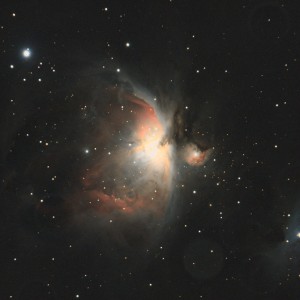
Getting low power on the scope required a 2-inch star diagonal and an Orion Optiluxe 40mm eyepiece, the combination creating a magnification of 49x and an actual field-of-view of 1.25 degrees. A 4 A.M. foray into the chilly morning air confirmed the effectiveness of this set-up. The Orion Nebula easily revealed its “bat wing” structure, a tinge of green, and some intricate detail in its outer portions – a very impressive sight, made even better by the Vixen’s good contrast and dark sky background rendition. With the power boosted to 141x using a Meade 13.8mm SWA eyepiece, the Trapezium quartet stood out boldly, with the “E” and “F” stars fairly easy to discern.
Certainly, even at its lowest magnification, the VMC200 is no rich-field scope, but the expanse of sky taken in just enough to squeeze in the Pleiades, or a good chunk of the Andromeda Galaxy, with little or no coma spoiling the image at the edges. Nearly 8 inches of aperture in a very tidy and light package has its advantages in ease of transport to a dark site and, very probably, frequent use.
IN SUMMARY: PRO’S & CON’S
Overall, the Vixen VMC200LDG is a rather impressive offering; it features excellent optical quality in a light, highly portable tube assembly. Its unique appearance, optical configuration, and rarity should make it a natural hit at star parties. The rack and pinion focuser provides solid control without image shift or wandering. Further, the open tube pretty well eliminates the possibility of dew ruining an observing session. The scope has a shorter “cool down” time than its closed-tube competitors, thermal equilibrium being reached more quickly as warmer air rises expeditiously from the truncated cylinder. Performance-wise, the Vixen delivers a sharper image than the common Schmidt-Cass, and it has a satisfying “snap” to focus that most other catadioptrics lack.
On the down side, the scope (at $1398) is considerably more expensive than an 8-inch Celestron or Meade SCT optical tube assembly. It has a larger central obstruction, and the spider diffraction may be irritating to some observers. Light grasp falls a bit short of the C 8 with the latest XLT coatings, and the versatility of the Vixen is hampered by its inability to use a focal reducer or the plethora of SCT-compatible accessories.
Aesthetically, personal preference will dictate whether the scope appears to be attractive or just plain strange, but Michigan State alumni will probably love the color.
As for me, I like the scope: its uniqueness is akin to having to having a Strange Pentaquark in the fridge or a couple of neutrinos stuck in a bottle of Clorox. Rare and different in this case really does equate with good.
Clear and steady skies,
Larry Carlino
Click here for more about this subject. -Ed.
Years ago, when I was taking the freshman physics course at the University of Buffalo, I became fascinated with the arcane field of sub-atomic particles, especially the rare variety with questionable, unproven existence. In some ways the Vixen VMC200LDG catadioptric telescope strikes a parallel. The telescope definitely DOES exist, though it is quite rare and more than a bit exotic. But does “rare” translate into “good”? Is this Higgs Boson of telescopes superior to garden variety Schmidt-Cassegrainians of similar aperture?
The optical configuration of this compact eight-incher is that of a modified Maksutov-Cassegrainian, often referred to as a Klevtsov, as it uses a sub-diameter corrector lens to offset the spherical aberration generated by the short-focus spherical primary and secondary mirrors. The meniscus corrector sits in front of the convex secondary, neatly housed in a baffle to reduce stray light. The whole assembly is rigidly fixed in position by four thick and very strong spider vanes. The 200mm, f/2.5, primary mirror is ensconced in an adjustable cell with recessed push-pull hex screws for adjustment, and a well-blackened light baffle protrudes from its perforated center. (This scope is NOT the same as the f/9 Vixen VC200L which uses an aspheric primary mirror and a multi-lens corrector in the drawtube.) Focus is accomplished by means of a 2-inch rack and pinion focuser, as the primary mirror does not move as it does in most SCT’s. However, the VMC200L’s larger brothers, the VMC260L and VMC330L, do use the moving primary system. For control freaks, the secondary mirror AND focuser are also adjustable, but neither of these needed to be touched in the case of my particular telescope.
With an effective focal length of 1950mm and an f/ratio of 9.75, the telescope is optimized for medium and high power viewing, but the whopping 40 percent central obstruction is hardly an ideal configuration, the large secondary baffle expanding the 72mm secondary mirror to 80mm of blockage.
In physical appearance, the VMC200 is arguably attractive and certainly a bit unusual. The main tube is finished in a medium dark green metallic, reminiscent of the football helmets worn by the Michigan State University Spartans, while the mirror cell and finder bracket sport a uniform creamy white hue. A matching carrying handle at the top of the optical tube doubles as a ¼-20 mounting point for a camera or light accessory. On the bottom, the Vixen utilizes a full-length Vixen/CG dovetail rail to permit attachment to a plethora of standard mounts. A neat chrome strip protects the rail from being gouged or disfigured. Overall fit and finish is very good – a notch up from the “acceptable” level found on most commercial SCT’s. The paint is uniform and glossy with no noticeable defects, and the hardware is of top quality. The interior of the Vixen is coated in the flattest black paint I’ve ever seen – it has no sheen whatsoever and absorbs light from any angle like a voracious black hole.
Standard accessories for the Vixen include a very fine 7x50mm finder mounted in a quick-release dovetail bracket. The tube of the finder matches the dark green of the main telescope tube with a bracket trim of complementing cream white. In optical quality, the finder is very close to that of the legendary Takahashi 50mm, but it benefits from better eye relief.
The “flip mirror” star diagonal provided is a neat and potentially very useful item. Unfortunately, mine arrived with the rectangular mirror completely detached from its metal backing and flopping aimlessly around the interior of the thin metal housing. Not good. A bit of carefully applied silicone cement fixed the problem, and no evident ill effects were noticeable. Optical quality of the diagonal could be described as decent, but not up to the level of the numerous premium dielectric units available from several manufacturers.
With two 1.25” ports, this Vixen diagonal can accommodate one eyepiece for straight-through viewing and a second at a 90 degree angle. Even better, the “direct “ port can serve as a camera/ccd attachment point while the other serves to line up photographic targets with an appropriate eyepiece.
The telescope’s 2-inch rack and pinion focuser is a mixed bag: it’s very smooth and creates no image shift, but it takes too much force to turn the cheap-looking plastic knobs, and the “in-focus” is probably insufficient to accommodate most bino-viewers. However, with both 2-inch and 1.25” star diagonals, I could reach focus with all of my eyepieces: everything from Type 6 Naglers to generic plossls. For photographic applications, the focuser can be locked down to freeze focal movement.
With a weight of just over 13 pounds and a tube length of 525mm, this compact CAT just about mirrors the ubiquitous Celestron 8 in heft and overall size. It’s light enough to allow excellent stability on a Vixen GP, Sphinx, CG, or even a moderately solid alt-azimuth mount. I used an inexpensive Celestron CG 5 equatorial for my tests of the scope, and it provided solid support with a damping time of less than two seconds. The entire scope and mount assembly was light enough to be carried significant distances with ease – a real plus for “grab-and-go” applications.
OPTICAL TESTING
When I pointed the VMC200 at a second-magnitude star to do a preliminary optical evaluation, I immediately found that the optical train was well out of alignment, continuing the plague that has haunted me through my last dozen or so catadioptric scopes. Fixing the collimation, however, proved to be fairly simple. Assuming that the secondary mirror and focuser were properly aligned, I worked the recessed push-pull hex screws in the primary mirror cell to achieve “dead-on”collimation in about 15 minutes. Judging by the robust nature of the cell and its adjustment system, the telescope should hold perfect alignment in normal handling and transportation.
In star testing, with the scope settling to thermal equilibrium, out-of-focus stellar images displayed near textbook Fresnel rings for an instrument with a fairly large central obstruction. Despite the intrusion of the massive spider vanes, the rings were crisp, well-defined, and devoid of astigmatism or noticeable spherical aberration. In theory, at least, this promises a telescope with all the hallmarks of an excellent performer.
OBSERVATION TESTS: LUNAR and PLANETARY
And perform it does. With Jupiter sinking into the southwestern sky and seeing conditions being a mediocre 5 on a scale of 10, the Vixen displayed a sharp, high contrast image of the giant planet. Using an Astrotech dielectric star diagonal and a TeleVue 13mm Nagler Type 6 yielding 150x, the scope easily revealed fine detail in Jupiter’s Equatorial Zone and numerous irregularities in both equatorial belts. The Red Spot Hollow and Great Red Spot were easy to pick up, and the tiny shadow of Europa was rendered black and clearly defined. Even the dusky polar regions showed strong hints of minor belts and accurate color saturation. Aside from the prismatic effect caused by atmosphere refraction, there was no hint of false color. Most impressive, however, was the “snap to focus” that reminded me of that expected with a long-focus Newtonian reflector or APO refractor – clearly superior to the “soft” and wandering focus found in many SCT’s. During this twilight observation, I couldn’t notice diffraction spikes from the massive spider vanes, but in truly dark skies, they did become noticeable on any object brighter than about 4th magnitude.
With the dearth of readily available bright planets, I turned the scope to distant Uranus and Neptune. Here, the 200mm aperture of the Vixen aided in producing solid, if unspectacular, views. At 279x, with a Burgess/TMB 7mm planetary eyepiece, the pale greenish disc of the seventh planet was well defined and solid, but also featureless save for the expected limb darkening. A Collins I3 Piece image intensifier at slightly lower effective magnification afforded glimpses of Titania and Oberon.
Neptune, its slightly bluer color apparent at 390x with an Orion 5mm Ultrascopic, was also sharply defined. Straining my eyeball to the limit with extreme averted vision, I was able to pick up Triton and a star of inconveniently similar magnitude close to the planet’s position. Certainly, the Vixen was more than capable of sustaining high magnifications without image deterioration.
Several nights of observing the moon in various phases reinforced the perceived high quality of the Vixen’s optics. With a fine Takahashi FS-128 and a Celestron 11 on hand for direct comparison, I found that the sharpness of the VMC200’s optics kept it in the game. With resolution of approximately .6 arc-seconds, the compact CAT revealed some minute lunar detail that challenged the other telescopes. Surprisingly, the image brightness with the Vixen was no greater than that of the 5” Tak, but it did display a touch more fine detail when the air became steady. For example, the coalesced chain of tiny craterlets near Copernicus revealed more individual shape in the Vixen at about 290x, but they were rendered sharper in the Takahashi.
The small rill Rima Birt near the Straight Wall produced the same effect. The C-11, somewhat hampered by its sensitivity to atmospheric conditions, showed a brighter image and similar level of detail, but it floated in and out of focus with changes in seeing. To be honest, the 5” APO provided the sharpest and most satisfying image quality. While some advertisers pronounce that their compound telescopes deliver “refractor-like” images, I’ve found that the only truly refractor-like images are generated by…well…refractors. However, this Vixen CAT comes about as close as one might reasonably expect, bested perhaps only by a quality Maksutov-Newtonian.
STELLAR TARGETS
With access to a half-dozen fairly clear and steady nights spread over some two months, I was able to appraise the VMC200’s ability to resolve multiple stars. It performed well. Immediately noticeable when observing stars of any magnitude was the pinpoint tightness of the image. Epsilon Lyrae, a favorite target, displayed four tiny, sharp airy discs with symmetrical first diffraction rings at 150x. There was no “spillover” or sloppiness to the image, and the dark sky between stellar components made for a striking view. However, as is the case with most 8-inch scopes, the Vixen was susceptible to changes in seeing conditions, and the “perfect picture” quickly deteriorated during moments of atmospheric turbulence.
More difficult optical tests, such as Delta Cygni and Zeta Aquarii were passed with little difficulty. At 291x, using a Meade 6.7mm UWA eyepiece, the close, faint companion of Delta Cyg was easy to pick out, though the thick first diffraction ring generated by the scope’s large central obstruction compromised the aesthetics somewhat.
At the same power, the two bright components of Zeta Aquarii looked like twin car headlights: well defined and punctuated by prominent diffraction spikes from the thick spider vanes. To many observers, the spikes might create an attractive bonus to the image, but for those who find them an annoying artifact on anything brighter than about 4th magnitude, it might be better to stick with a conventional SCT or Mak-Cass. However, the thickness of the spider vanes actually REDUCES their prominence, so those used to a conventional thin spider might not be at all bothered.
A quick look at Albireo, Alpha Herculis, and Iota Cassiopeiae confirmed the scope’s ability to generate tight, pinpoint stellar images with accurate color rendition. The images were close in quality to those afforded by the somewhat larger (and excellent) Takahashi CN 212 at its Cassegrainian focus.
Unfortunately, I’ve never had the opportunity to look through the Tak Mewlon 180 or Mewlon 210 Dall-Kirkham instruments, so comparison with their reputedly fine optics would be speculation.
DEEP-SKY OBSERVING
The VMC200 delivered the deep-sky vistas one would expect from an 8-inch telescope. There were no surprises here, and the dark field-of-view created by the long f/ratio, effective baffling, and stygian tube interior resulted in good magnitude penetration and high contrast. However, the large central obstruction, meniscus corrector lens, and (seemingly) less-than-optimum reflectivity of the mirrors resulted in an image that was less bright than that of a Celestron 8 with XLT coatings. The difference was not large, but it did show up in identical-power views of M 13 and the Double Cluster in Perseus. But the Vixen made up for this slight gap in the in its tight, hard images of fainter stars.
Getting low power on the scope required a 2-inch star diagonal and an Orion Optiluxe 40mm eyepiece, the combination creating a magnification of 49x and an actual field-of-view of 1.25 degrees. A 4 A.M. foray into the chilly morning air confirmed the effectiveness of this set-up. The Orion Nebula easily revealed its “bat wing” structure, a tinge of green, and some intricate detail in its outer portions – a very impressive sight, made even better by the Vixen’s good contrast and dark sky background rendition. With the power boosted to 141x using a Meade 13.8mm SWA eyepiece, the Trapezium quartet stood out boldly, with the “E” and “F” stars fairly easy to discern.
Certainly, even at its lowest magnification, the VMC200 is no rich-field scope, but the expanse of sky taken in just enough to squeeze in the Pleiades, or a good chunk of the Andromeda Galaxy, with little or no coma spoiling the image at the edges. Nearly 8 inches of aperture in a very tidy and light package has its advantages in ease of transport to a dark site and, very probably, frequent use.
IN SUMMARY: PRO’S & CON’S
Overall, the Vixen VMC200LDG is a rather impressive offering; it features excellent optical quality in a light, highly portable tube assembly. Its unique appearance, optical configuration, and rarity should make it a natural hit at star parties. The rack and pinion focuser provides solid control without image shift or wandering. Further, the open tube pretty well eliminates the possibility of dew ruining an observing session. The scope has a shorter “cool down” time than its closed-tube competitors, thermal equilibrium being reached more quickly as warmer air rises expeditiously from the truncated cylinder. Performance-wise, the Vixen delivers a sharper image than the common Schmidt-Cass, and it has a satisfying “snap” to focus that most other catadioptrics lack.
On the down side, the scope (at $1398) is considerably more expensive than an 8-inch Celestron or Meade SCT optical tube assembly. It has a larger central obstruction, and the spider diffraction may be irritating to some observers. Light grasp falls a bit short of the C 8 with the latest XLT coatings, and the versatility of the Vixen is hampered by its inability to use a focal reducer or the plethora of SCT-compatible accessories.
Aesthetically, personal preference will dictate whether the scope appears to be attractive or just plain strange, but Michigan State alumni will probably love the color.
As for me, I like the scope: its uniqueness is akin to having to having a Strange Pentaquark in the fridge or a couple of neutrinos stuck in a bottle of Clorox. Rare and different in this case really does equate with good.
Clear and steady skies,
Larry Carlino
Click here for more about this subject. -Ed.
Funding Member