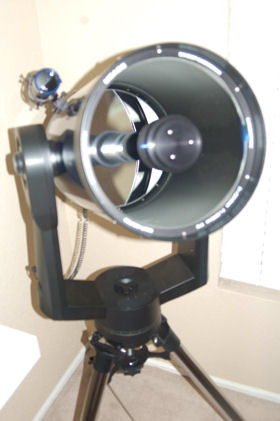
Meade 12” LX90 LNT SCT Review.
I started stargazing about 10 years ago, the first years with just a 60mm refractor. I live In Phoenix, Arizona, where we get clear skies most of the year and transparency is usually good, but light pollution is an ever-growing problem. In the last 5 years I have owned and used on a regular basis several telescopes ranging in size from 80mm to 8 inches. I currently own a 80mm apochromatic refractor and a recently-acquired a Meade 12” LX90 LNT SCT with UHTC, the object of this review. I bought this scope through normal commercial channels and I have no affiliation with Meade Instruments or any other manufacturer or dealer named in this piece. I have no specialized knowledge of optics, so I won’t get into technical details like star testing, but rather describe the practical advantages and disadvantages that I perceive in the product reviewed.
For the past 2 years, my main telescope was a Meade LXD75 SN8. I was very pleased with that telescope; it delivered good images of both deep sky and planetary objects. However, my main interest is deep sky observation, so I started to feel the need for a larger aperture telescope. To move up in size, several factors were taken in account:
1) I wanted a noticeable increase in the detail and brightness of the faint objects that I observe most of the time, while still being able to get pleasing planetary views.
2) I wanted GOTO capability right out of the box, without the need for add-ons or aftermarket products.
3) The weight and size of the scope must be reasonably easy to handle by one person, so I can take it out to remote observing sites by myself.
4) I wanted a telescope that offered a comfortable viewing position, i.e. no need to climb on ladders or lower my head to the ground to reach the eyepiece.
5) Obtain all the above at a price that won’t leave me bankrupt.
Factor 1 required a scope larger than 10”, while price and size ruled out refractors. The GOTO requirement ruled out the affordable Dobsonians while high end catadioptrics are beyond my budget. The preceding left me only SCT choices: the equatorially mounted 11” Orion Atlas GT, the fork mounted Celestron CPC 1100 and the fork mounted Meade 12” LX90. The extra inch of aperture and positive experiences with my previous Meade telescopes tilted the decision towards the LX90.
I had read some not-so-flattering reviews about SCTs, in particular regarding the amount of focus backslash and mirror shift. Still, I decided to take my chances and find out by myself. My expectations for this scope were, I think, reasonable:
1) To be able to use magnifications up to 280X on nights of average seeing from my light-polluted backyard on the planets, brighter globular clusters and planetary nebulas with visibly improved resolution over the 8” scope.
2) To see fine detail at magnifications of up to 360X on the moon on nights of average seeing.
3) To be able to discern detail on the brighter galaxies and nebulas when observing from a dark site, as well as to observe fainter objects such as galaxy clusters.
After checking many websites and inquiring with a couple of dealers, I found a new 12” LNT with UHTC coatings available at Woodland Hills telescopes. The telescope arrived in good condition shortly after placing the order. The telescope and tripod came well packed in double boxes and the OTA nested in protective Styrofoam. Inspecting the components revealed good finish and solid construction, except for the outer fork arm covers, which are plastic. As for the accessories, the finder scope is a good quality straight through achromatic 8X50 with helical focuser. The “smart finder”/LNT module looks like a plastic toy, but as long as it perform its function, I am OK with it The provided 26mm super plössl, while optically good, offers a narrow field of view with this scope. The provided 1.25” diagonal prism is not on par with a telescope of this size and price. I substituted them with a Meade 26mm QX wide angle and an Astro-Tech dielectric SCT diagonal. Assembling the telescope was a 30 minute process following the detailed instructions on the manual. When I lifted the OTA from the box, I was pleasantly surprised to find the weight manageable. Mounting the OTA on the tripod in my well-lit living room was not difficult either.
The first night out was merely to test the mount, as the sky was hazy and the moon was shining. I leveled the tripod and placed the OTA on it. Attaching the OTA to the tripod in the dark was not so easy, though. I had to carefully move the base around with one hand while gently pushing the mounting screw up until I felt it engaged the base’s thread, all the while feeling afraid of losing control of the OTA. A mounting aid of some kind is recommended with this scope. After aligning the viewfinders, I performed the initialization process and proceeded with auto align. I noticed that the alignment stars were not even within the viewfinder FOV. I performed a GOTO to M31 and the scope was off by several of degrees. Following the instruction manual recommendations, I performed the calibrate sensors routine three times and performed the auto align again. This time M31 was at the edge of the field of view. Next I went to Polaris and de-focused the telescope. The there were several concentric rings of even thickness, but they were a bit off center, suggesting the scope was mildly out of collimation. The next night the sky was clear and the moon made a good target. I pointed the scope at Vega and collimated it using one of the wrenches that came with the scope, which took about 20 minutes. Next I pointed the scope at the moon. The view through the QX 26mm eyepiece was blindingly bright. I moved to shorter focal length eyepieces, down to a 6.4mm 4K super plössl (476 X). The image was very sharp and a lot of detail was visible. I put an 11mm TeleVue plössl with a 2X Barlow (554X). At this magnification the image softened to some extent, but still offered a pleasant view during moments of good seeing. I spent a long time looking at craters along the terminator. Trenches and peaks were visible within the craters, casting black shadows against the surface. Outside the craters I could see fine riles and small impact features. Two of the main concerns I had when I bought this telescope were: is the standard field tripod adequate to handle the 12” OTA? would focus be difficult due to mirror shift? This observing session dispelled both, as the vibrations were minimal and settled down quickly even at high magnifications. As for mirror shift, it is barely noticeable and focusing only becomes critical at powers above 300X. I suspect the scope does have a minor amount of mirror flop, though, because after performing a long slew, the image at the new position is sometimes out of focus.
A week later, with the moon rising past midnight, I took the scope out again. I had performed the “train the drive” routine earlier in the day and I wanted to see the effect on the GOTO performance. I let the scope align itself, pointed the scope to the Ring Nebula and WOW! The ring stood out bright just off the center of my 26mm QX eyepiece, much bigger that I remembered it with my 8” scope. I changed to a Meade 5K 14mm Plössl eyepiece. At 217X the ring was magnificent with the star near the edge clearly visible. I went on to M27, M15 and M31; they were all impressive at different magnifications. I had never been able to see M33 from my back yard with any of my previous scopes. I set AutoStar to high precision pointing and instructed it to go to M33. The scope first slewed to Mirach to synchronize. To my surprise, there was a galaxy next to Mirach: NGC 404. I proceeded to M33 and there it was, although only the core could be seen. Last, I went to the Cat’s Eye nebula and started cranking up the power. At 277X (TeleVue 11mm Plössl) the oval-within-the-oval shape that earned it its name was visible. Using a Meade 4K 9.7mm super plössl (314X) made the image dim and difficult to focus. I called it a night because the moon was starting to show on the eastern horizon. Not bad for a highly obstructed scope from a light polluted location. Additional nights of observing from my back yard and from a nearby camping site reinforced my conviction that this telescope is an excellent value. But, as the song goes, the best was yet to come.

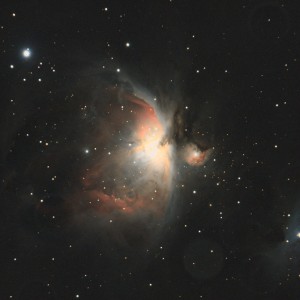
I recently had the opportunity to test this scope under dark skies, at the All Arizona Star Party. The coordinates provided in the organizing club’s webpage came in handy for aligning the telescope at the party site. I started with a survey of Nebulas along the Milky Way: The Lagoon was bright, with its dark alley sharply defined against the glowing gas in the background. The Trifid, Swan, Eagle, Dumbbell, Ring, Veil, Crescent, North America and Crab Nebulae were all likewise impressive and in some cases they resembled monochrome CCD images. I also got to see the Bubble Nebula in Cassiopeia. Next I observed globular clusters M22, M13, M94 and M15. They were all resolved way into their cores and I could see the colors of some of the stars within the clusters. The next target category was galaxies. In spite of its low altitude over the southern horizon, I was able to observe the Fornax cluster of galaxies. Towards the center of the cluster, I was able to count about 6 galaxies in the 0.8º field of view of a Meade 36mm QX. On the northern sky, the view of edge-on spiral NGC891 in Cassiopeia was simply amazing, the dust lane that halves it clearly visible, as well as mottled detail at both sides of the lane. Moving on to M31, I was able to tell two wide dust lanes between the core and the outer arms. I wished I had a field of view wide enough to encompass the central region of M31 and its 2 satellite galaxies in one single FOV, which must be quite a sight from this location. Next, I spent about 20 minutes looking at M33. While the view can hardly be described as “bright”, a good amount of detail was visible. Besides the core and brighter inner arm sections, I was able to observe directly regions NGC 604, NGC 592 and IC136. Later, towards the early morning hours, I observed galaxy groups M81/M82/NGC3077 in Ursa Major and M65/M66/NGC3628 in Leo. To close the night of observing, I went to the Great Orion Nebula, which was by then high up in the sky. Scanning around, tendrils of glowing gas extended almost all the way to the star formations north and south of it. At the center, the brighter part looked like a big cavern lit by the trapezium. The E and F stars of the trapezium were bright and steady and I could see 2 other stars going in and out as seeing varied. Moving to the north, the Flame Nebula (NGC2024) was prominent when Alnitak was placed out of the field of view. Reflection nebulas NGC2023 and M78 were clearly visible too. As for the Horse Head nebula, it was not visible at all. Next time I will try an H-beta filter. Throughout the night, the GOTO system placed every selected object at or near the center of the field of view, without the need to use the high precision pointing feature or having to synchronize or realign the telescope.
By way of comparison, I have looked through some premium Dobsonians of similar aperture and found the image to be a bit sharper, with tighter stellar disks, due perhaps to their smaller central obstruction. However, when I consider that a GOTO equipped 12.5” Obsession costs twice what I paid for this scope, that difference in optic performance does not seem so impressive. Another important factor to consider is that the LX90 achieves a very respectable optical performance using inexpensive Erfle and Plössl eyepieces, while fast focal ratio reflectors usually require premium eyepieces to reach their optical potential (I know this from my previous f/4 telescope). Also, the LX90 breaks down to only main 2 parts and assembles back with a single hand-tighten knob, with no counter weights or battery packs to carry around. At this point I am able to setup and align the scope in about 15 minutes in my backyard or 20 minutes at a remote place where I need to calibrate the sensors. Finally, a piece of information that I was not able to find anywhere while shopping for this telescope is the clearance from the back of the scope to the base of the forks when pointing at the zenith. The total clearance is 6.5” without any accessories and 3” with the SCT diagonal installed. This means there is still some room left for other accessories.
In conclusion, this telescope has more than fulfilled my expectations for deep sky and lunar observing. As for the planetary performance, I will have to wait until either Saturn or Jupiter is well positioned in the sky to find out. Specifications and advantages & disadvantages (that I perceive)are as follows:
Specifications:
Clear aperture: 12” (304.8 mm)
Focal length (nominal): 120” (3048 mm).
Focal Ratio (nominal): f/10.
Limiting magnitude: 15 (visual), 17.5 (photographic).
Total weight: 80 lbs., heaviest component: 60 lbs.
Standard accessories: Meade standard field tripod, 8X50 achromatic viewfinder, red dot viewfinder/level-north module, 1.25” visual back, 1.25” prism star diagonal, 1.25” 26mm plössl eyepiece, AutoStar hand controller, controller mounting bracket, OTA end caps.
Price $3295.00 (including shipping).
Advantages:
Generous aperture at reasonable price.
Good optics, especially for deep sky observing.
Well integrated GOTO mechanism.
Works well with moderately priced eyepieces.
Disadvantages:
Requires some effort to transport and setup, not exactly “grab-and-go”.
Some of the provided accessories require upgrade.
Narrow maximum field of view (can be improved using a focal reducer).
Cool down time may be an issue in cold climates.
If you are looking for a medium size telescope for deep sky observing and lifting a 60 lb OTA is an acceptable prospect for you, I recommend that you consider this telescope among your choices.
Click here for more about this subject. -Ed.
For the past 2 years, my main telescope was a Meade LXD75 SN8. I was very pleased with that telescope; it delivered good images of both deep sky and planetary objects. However, my main interest is deep sky observation, so I started to feel the need for a larger aperture telescope. To move up in size, several factors were taken in account:
1) I wanted a noticeable increase in the detail and brightness of the faint objects that I observe most of the time, while still being able to get pleasing planetary views.
2) I wanted GOTO capability right out of the box, without the need for add-ons or aftermarket products.
3) The weight and size of the scope must be reasonably easy to handle by one person, so I can take it out to remote observing sites by myself.
4) I wanted a telescope that offered a comfortable viewing position, i.e. no need to climb on ladders or lower my head to the ground to reach the eyepiece.
5) Obtain all the above at a price that won’t leave me bankrupt.
Factor 1 required a scope larger than 10”, while price and size ruled out refractors. The GOTO requirement ruled out the affordable Dobsonians while high end catadioptrics are beyond my budget. The preceding left me only SCT choices: the equatorially mounted 11” Orion Atlas GT, the fork mounted Celestron CPC 1100 and the fork mounted Meade 12” LX90. The extra inch of aperture and positive experiences with my previous Meade telescopes tilted the decision towards the LX90.
I had read some not-so-flattering reviews about SCTs, in particular regarding the amount of focus backslash and mirror shift. Still, I decided to take my chances and find out by myself. My expectations for this scope were, I think, reasonable:
1) To be able to use magnifications up to 280X on nights of average seeing from my light-polluted backyard on the planets, brighter globular clusters and planetary nebulas with visibly improved resolution over the 8” scope.
2) To see fine detail at magnifications of up to 360X on the moon on nights of average seeing.
3) To be able to discern detail on the brighter galaxies and nebulas when observing from a dark site, as well as to observe fainter objects such as galaxy clusters.
After checking many websites and inquiring with a couple of dealers, I found a new 12” LNT with UHTC coatings available at Woodland Hills telescopes. The telescope arrived in good condition shortly after placing the order. The telescope and tripod came well packed in double boxes and the OTA nested in protective Styrofoam. Inspecting the components revealed good finish and solid construction, except for the outer fork arm covers, which are plastic. As for the accessories, the finder scope is a good quality straight through achromatic 8X50 with helical focuser. The “smart finder”/LNT module looks like a plastic toy, but as long as it perform its function, I am OK with it The provided 26mm super plössl, while optically good, offers a narrow field of view with this scope. The provided 1.25” diagonal prism is not on par with a telescope of this size and price. I substituted them with a Meade 26mm QX wide angle and an Astro-Tech dielectric SCT diagonal. Assembling the telescope was a 30 minute process following the detailed instructions on the manual. When I lifted the OTA from the box, I was pleasantly surprised to find the weight manageable. Mounting the OTA on the tripod in my well-lit living room was not difficult either.
The first night out was merely to test the mount, as the sky was hazy and the moon was shining. I leveled the tripod and placed the OTA on it. Attaching the OTA to the tripod in the dark was not so easy, though. I had to carefully move the base around with one hand while gently pushing the mounting screw up until I felt it engaged the base’s thread, all the while feeling afraid of losing control of the OTA. A mounting aid of some kind is recommended with this scope. After aligning the viewfinders, I performed the initialization process and proceeded with auto align. I noticed that the alignment stars were not even within the viewfinder FOV. I performed a GOTO to M31 and the scope was off by several of degrees. Following the instruction manual recommendations, I performed the calibrate sensors routine three times and performed the auto align again. This time M31 was at the edge of the field of view. Next I went to Polaris and de-focused the telescope. The there were several concentric rings of even thickness, but they were a bit off center, suggesting the scope was mildly out of collimation. The next night the sky was clear and the moon made a good target. I pointed the scope at Vega and collimated it using one of the wrenches that came with the scope, which took about 20 minutes. Next I pointed the scope at the moon. The view through the QX 26mm eyepiece was blindingly bright. I moved to shorter focal length eyepieces, down to a 6.4mm 4K super plössl (476 X). The image was very sharp and a lot of detail was visible. I put an 11mm TeleVue plössl with a 2X Barlow (554X). At this magnification the image softened to some extent, but still offered a pleasant view during moments of good seeing. I spent a long time looking at craters along the terminator. Trenches and peaks were visible within the craters, casting black shadows against the surface. Outside the craters I could see fine riles and small impact features. Two of the main concerns I had when I bought this telescope were: is the standard field tripod adequate to handle the 12” OTA? would focus be difficult due to mirror shift? This observing session dispelled both, as the vibrations were minimal and settled down quickly even at high magnifications. As for mirror shift, it is barely noticeable and focusing only becomes critical at powers above 300X. I suspect the scope does have a minor amount of mirror flop, though, because after performing a long slew, the image at the new position is sometimes out of focus.
A week later, with the moon rising past midnight, I took the scope out again. I had performed the “train the drive” routine earlier in the day and I wanted to see the effect on the GOTO performance. I let the scope align itself, pointed the scope to the Ring Nebula and WOW! The ring stood out bright just off the center of my 26mm QX eyepiece, much bigger that I remembered it with my 8” scope. I changed to a Meade 5K 14mm Plössl eyepiece. At 217X the ring was magnificent with the star near the edge clearly visible. I went on to M27, M15 and M31; they were all impressive at different magnifications. I had never been able to see M33 from my back yard with any of my previous scopes. I set AutoStar to high precision pointing and instructed it to go to M33. The scope first slewed to Mirach to synchronize. To my surprise, there was a galaxy next to Mirach: NGC 404. I proceeded to M33 and there it was, although only the core could be seen. Last, I went to the Cat’s Eye nebula and started cranking up the power. At 277X (TeleVue 11mm Plössl) the oval-within-the-oval shape that earned it its name was visible. Using a Meade 4K 9.7mm super plössl (314X) made the image dim and difficult to focus. I called it a night because the moon was starting to show on the eastern horizon. Not bad for a highly obstructed scope from a light polluted location. Additional nights of observing from my back yard and from a nearby camping site reinforced my conviction that this telescope is an excellent value. But, as the song goes, the best was yet to come.
I recently had the opportunity to test this scope under dark skies, at the All Arizona Star Party. The coordinates provided in the organizing club’s webpage came in handy for aligning the telescope at the party site. I started with a survey of Nebulas along the Milky Way: The Lagoon was bright, with its dark alley sharply defined against the glowing gas in the background. The Trifid, Swan, Eagle, Dumbbell, Ring, Veil, Crescent, North America and Crab Nebulae were all likewise impressive and in some cases they resembled monochrome CCD images. I also got to see the Bubble Nebula in Cassiopeia. Next I observed globular clusters M22, M13, M94 and M15. They were all resolved way into their cores and I could see the colors of some of the stars within the clusters. The next target category was galaxies. In spite of its low altitude over the southern horizon, I was able to observe the Fornax cluster of galaxies. Towards the center of the cluster, I was able to count about 6 galaxies in the 0.8º field of view of a Meade 36mm QX. On the northern sky, the view of edge-on spiral NGC891 in Cassiopeia was simply amazing, the dust lane that halves it clearly visible, as well as mottled detail at both sides of the lane. Moving on to M31, I was able to tell two wide dust lanes between the core and the outer arms. I wished I had a field of view wide enough to encompass the central region of M31 and its 2 satellite galaxies in one single FOV, which must be quite a sight from this location. Next, I spent about 20 minutes looking at M33. While the view can hardly be described as “bright”, a good amount of detail was visible. Besides the core and brighter inner arm sections, I was able to observe directly regions NGC 604, NGC 592 and IC136. Later, towards the early morning hours, I observed galaxy groups M81/M82/NGC3077 in Ursa Major and M65/M66/NGC3628 in Leo. To close the night of observing, I went to the Great Orion Nebula, which was by then high up in the sky. Scanning around, tendrils of glowing gas extended almost all the way to the star formations north and south of it. At the center, the brighter part looked like a big cavern lit by the trapezium. The E and F stars of the trapezium were bright and steady and I could see 2 other stars going in and out as seeing varied. Moving to the north, the Flame Nebula (NGC2024) was prominent when Alnitak was placed out of the field of view. Reflection nebulas NGC2023 and M78 were clearly visible too. As for the Horse Head nebula, it was not visible at all. Next time I will try an H-beta filter. Throughout the night, the GOTO system placed every selected object at or near the center of the field of view, without the need to use the high precision pointing feature or having to synchronize or realign the telescope.
By way of comparison, I have looked through some premium Dobsonians of similar aperture and found the image to be a bit sharper, with tighter stellar disks, due perhaps to their smaller central obstruction. However, when I consider that a GOTO equipped 12.5” Obsession costs twice what I paid for this scope, that difference in optic performance does not seem so impressive. Another important factor to consider is that the LX90 achieves a very respectable optical performance using inexpensive Erfle and Plössl eyepieces, while fast focal ratio reflectors usually require premium eyepieces to reach their optical potential (I know this from my previous f/4 telescope). Also, the LX90 breaks down to only main 2 parts and assembles back with a single hand-tighten knob, with no counter weights or battery packs to carry around. At this point I am able to setup and align the scope in about 15 minutes in my backyard or 20 minutes at a remote place where I need to calibrate the sensors. Finally, a piece of information that I was not able to find anywhere while shopping for this telescope is the clearance from the back of the scope to the base of the forks when pointing at the zenith. The total clearance is 6.5” without any accessories and 3” with the SCT diagonal installed. This means there is still some room left for other accessories.
In conclusion, this telescope has more than fulfilled my expectations for deep sky and lunar observing. As for the planetary performance, I will have to wait until either Saturn or Jupiter is well positioned in the sky to find out. Specifications and advantages & disadvantages (that I perceive)are as follows:
Specifications:
Clear aperture: 12” (304.8 mm)
Focal length (nominal): 120” (3048 mm).
Focal Ratio (nominal): f/10.
Limiting magnitude: 15 (visual), 17.5 (photographic).
Total weight: 80 lbs., heaviest component: 60 lbs.
Standard accessories: Meade standard field tripod, 8X50 achromatic viewfinder, red dot viewfinder/level-north module, 1.25” visual back, 1.25” prism star diagonal, 1.25” 26mm plössl eyepiece, AutoStar hand controller, controller mounting bracket, OTA end caps.
Price $3295.00 (including shipping).
Advantages:
Generous aperture at reasonable price.
Good optics, especially for deep sky observing.
Well integrated GOTO mechanism.
Works well with moderately priced eyepieces.
Disadvantages:
Requires some effort to transport and setup, not exactly “grab-and-go”.
Some of the provided accessories require upgrade.
Narrow maximum field of view (can be improved using a focal reducer).
Cool down time may be an issue in cold climates.
If you are looking for a medium size telescope for deep sky observing and lifting a 60 lb OTA is an acceptable prospect for you, I recommend that you consider this telescope among your choices.
Click here for more about this subject. -Ed.
Funding Member