Reviews & Articles
Image of the day
About Astromart
My Account
New to Astromart?
Register an account...Need Help?
Takahashi FS102 Fluorite Apochromat - II

[ARTICLEIMGL="1"]I have not been blessed with great observing conditions here lately, but I did manage a few looks. Well, I'm not going to expand endlessly on mouth-watering descriptions; this scope is an awesome performer. We are past planetary observing season now and Jupiter barely clears rooftops (btw: Jupiter was very blurry, but I was surpised by the contrast between the belts and zones), and the moon is always low-lying in this season so I was left with double stars. Well... Izar is easy: resolved at 103x with the 8mm Radian. The double-double is so easy, it's not even funny: at 103x there is lots of dark sky between the pairs; at 66x (sorry I don't have an 80x eyepiece) I could resolve one of the components, the other one being elongated but unresolved. You start wondering why these stars were considered tests in the first place. Challenges come when you have 1.1", 1.0" stars to split, or 1.4" with a large magnitude difference (1 1/2 or 2 mags). I say challenge because you need the seeing to be at least 5 or 6 to split them! I have not yet split a 0.9" double. I usually can't care less about double stars, but it gives you an idea of the scope's resolving power. On these objects I managed to push the magnification up to 410x (barlowed 4mm Radian) without having the image degrading, though there is no improvement in image quality over 273x (with a barlowed 6mm). I did not have the opportunity to test if 273x was an improvement in resolution over 205x (4mm) or just an improvement in image scale, but if you like high powers this thing is certainly able.
False color is non-existent; for me at least. When looking at the limb of the gibbous moon, there is the moon, which is white, and the sky, which is black. Period. Arcturus is bright orange; Vega is white-blue. On the first night, out-of-focus images of Vega showed the outer ring to be sharper and brighter inside focus than outside of focus. I made my homework and read that was a sign of under-correction. But the next time I had an opportunity to make a test I could not tell a difference between inside- and outside-focus images; so if the lens is under-corrected it is very, very slightly. As for the focused star image, it is textbook perfect, with two rings neatly surrounding a little white ball. Sometimes, if I star-hop towards a target, I will just look for 20 seconds at a dumb 4-th mag star, just to enjoy how sharp it looks.
Deep-sky objects:
M3, M5: not resolved, but the brighter stars on the "outskirts" are visible.
M13: very pretty sight; partly resolved, there are fewer stars visible than in an 8" of course, but this is partly made up by the outstanding optics. It looks like the dimmest stars still appear pinpoint-like so the outer edges of the globular are made of stars, not a smudge of unfocused stars. So it’s not as good as in the 8”, but very pleasing nonetheless. On smaller or dimmer globulars however, 4” is a little shorthanded and you are not observing the objects, you are just seeing them. The same reasoning would go for galaxies.
What is interesting to see is that among the “big” Northern Globulars, the scope gives a fine enough image to show each globular’s “personality”. I guess I could take a “blind test” and recognize M15, M13, M3 and M5 from each other.
M57: elongated doughnut-like, but that's about it.
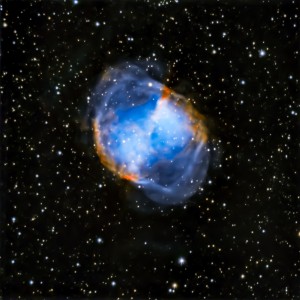
M27: the hourglass shape is visible, with two of the “corners” especially sharp.
M64, M93 : surprisingly good results. I suspect that superior transmission is at work here, but mostly, the baffling helps to keep the background sky dark. I probably should not be writing this, I don't really have a clue.
On all these deep-sky objects there is a clear improvement over my short tube 80 (it better be!) and my now-departed 80mm Vixen Fluorite. The jump from 80 to 100mm does make a clear difference between the two fluorites.
 Lunar observing:
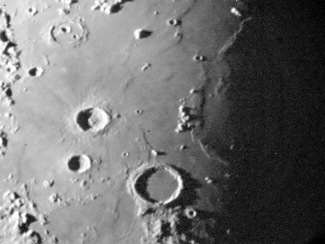
This is a beautiful scope for lunar viewing. I’m not big on lunar observing, just look at time to time. In large telescopes lunar observing is quickly hindered by less than very good seeing; turbulence makes those “heat waves” on the lunar surface which, if they don’t harm resolution, make the viewing frustrating. And the Moon is too bright for an 8”, forcing you to use lunar filters which are not that neutral – they tend to scatter light and make images less contrasty. This does not happen here. Turbulence is less of a factor; magnification can be pumped very high and detail is exquisite. Not only resolution of craters, riles or mountains, but also the shading of lunar maria. And did I mention the lack of chromatic aberration?
Conclusions:
I am not going to tell you now whether you should pluck $2,000+ on a scope like this. If you have been through this article, you know if you want one or not. My belief is that this is not a beginner's scope even for the beginner who has a budget; but any beginner who would fall for this scope would be very happy with it. Ideally it's the second or third scope of a deep-pocketed observer who already has a large aperture scope or two, and who has been through enough quirky "budget" telescopes to indulge into the perfect, zero-maintenance unit. Neither will I engage in the “aperture rules” or “refractor vs. reflector” debates. In pure performance it does not beat a large aperture scope, but the views provided are as pleasing to the eye as possible. Refractor lovers have a point here; sometimes I don’t go outside to have the best view of an object but the most pleasing one and this scope definitely provides it.
Comparisons with luxury cars are obvious. Unlike a car, though, this telescope can last a lifetime, and retains its value pretty well on the used market. They don't age fast, and they are unlikely to become obsolete.
Click here for more about the Takahashi FS-102II Fluorite Apochromat OTA Only. -Ed.
False color is non-existent; for me at least. When looking at the limb of the gibbous moon, there is the moon, which is white, and the sky, which is black. Period. Arcturus is bright orange; Vega is white-blue. On the first night, out-of-focus images of Vega showed the outer ring to be sharper and brighter inside focus than outside of focus. I made my homework and read that was a sign of under-correction. But the next time I had an opportunity to make a test I could not tell a difference between inside- and outside-focus images; so if the lens is under-corrected it is very, very slightly. As for the focused star image, it is textbook perfect, with two rings neatly surrounding a little white ball. Sometimes, if I star-hop towards a target, I will just look for 20 seconds at a dumb 4-th mag star, just to enjoy how sharp it looks.
Deep-sky objects:
M3, M5: not resolved, but the brighter stars on the "outskirts" are visible.
M13: very pretty sight; partly resolved, there are fewer stars visible than in an 8" of course, but this is partly made up by the outstanding optics. It looks like the dimmest stars still appear pinpoint-like so the outer edges of the globular are made of stars, not a smudge of unfocused stars. So it’s not as good as in the 8”, but very pleasing nonetheless. On smaller or dimmer globulars however, 4” is a little shorthanded and you are not observing the objects, you are just seeing them. The same reasoning would go for galaxies.
What is interesting to see is that among the “big” Northern Globulars, the scope gives a fine enough image to show each globular’s “personality”. I guess I could take a “blind test” and recognize M15, M13, M3 and M5 from each other.
M57: elongated doughnut-like, but that's about it.
M27: the hourglass shape is visible, with two of the “corners” especially sharp.
M64, M93 : surprisingly good results. I suspect that superior transmission is at work here, but mostly, the baffling helps to keep the background sky dark. I probably should not be writing this, I don't really have a clue.
On all these deep-sky objects there is a clear improvement over my short tube 80 (it better be!) and my now-departed 80mm Vixen Fluorite. The jump from 80 to 100mm does make a clear difference between the two fluorites.
Lunar observing:This is a beautiful scope for lunar viewing. I’m not big on lunar observing, just look at time to time. In large telescopes lunar observing is quickly hindered by less than very good seeing; turbulence makes those “heat waves” on the lunar surface which, if they don’t harm resolution, make the viewing frustrating. And the Moon is too bright for an 8”, forcing you to use lunar filters which are not that neutral – they tend to scatter light and make images less contrasty. This does not happen here. Turbulence is less of a factor; magnification can be pumped very high and detail is exquisite. Not only resolution of craters, riles or mountains, but also the shading of lunar maria. And did I mention the lack of chromatic aberration?
Conclusions:
I am not going to tell you now whether you should pluck $2,000+ on a scope like this. If you have been through this article, you know if you want one or not. My belief is that this is not a beginner's scope even for the beginner who has a budget; but any beginner who would fall for this scope would be very happy with it. Ideally it's the second or third scope of a deep-pocketed observer who already has a large aperture scope or two, and who has been through enough quirky "budget" telescopes to indulge into the perfect, zero-maintenance unit. Neither will I engage in the “aperture rules” or “refractor vs. reflector” debates. In pure performance it does not beat a large aperture scope, but the views provided are as pleasing to the eye as possible. Refractor lovers have a point here; sometimes I don’t go outside to have the best view of an object but the most pleasing one and this scope definitely provides it.
Comparisons with luxury cars are obvious. Unlike a car, though, this telescope can last a lifetime, and retains its value pretty well on the used market. They don't age fast, and they are unlikely to become obsolete.
Click here for more about the Takahashi FS-102II Fluorite Apochromat OTA Only. -Ed.
Funding Member