Reviews & Articles
Image of the day

About Astromart
My Account
New to Astromart?
Register an account...Need Help?
Photon Instruments 127mm f/9 Achromat

What is the Photon Instruments 127mm f/9 achromat? Like a lot of inexpensive achromats, it is made in China, and imported by Photon Instruments of Arizona. (Some amateurs that I spoke to thought it was made in Taiwan, which is part of why I bought it instead of the Meade 5" refractor. Photon Instruments has never promoted this idea--I'm not sure where this mistake started.) I've mentioned this refractor before, in reviews of the Baader Planetarium Fringe Killer and the Aries Chromacor. These reviews discuss in considerable detail how each of these devices handles the problem of chromatic aberration, by comparison to the unimproved refractor; for the purposes of this review, let me simply summarize by saying that my particular refractor appears to have been about 1/4 to 1/3 wave undercorrected, with a level of chromatic aberration that I would expect of a 5" f/9 achromat: more than I am happy with, but if you stay below 100x, and avoid objects brighter than Jupiter, you probably won't be too disappointed.
Had I paid the full list price of $650, I think I would have been pretty disappointed, but I bought it used through astromart for $375, less than a month old. The original owner told me that it was too heavy for his mount, and he appeared to have chipped the paint in one place on the tube, so I suspect that he decided to sell it, rather than try to return a damaged OTA. Perhaps if the OTA were a bit better quality optically, he might have spent the money on a better mount!
Appearance is pretty impressive.
I would consider the optical quality tolerable, even at the full list price. It isn't a Televue or an Astro-Physics, but I could spend $375--or even $650--without feeling like I was cheating my family of anything that they needed. The equivalent Televue or Astro-Physics refractor is a whole lot more money. It was also cheap enough, I rationalized, that if something bad happened to it at a star party, I would be disappointed, but not heartbroken.
While the optics are okay, the mechanical components leave quite a bit to be desired. The 2" focuser was a bit disappointing at first; quite stiff, with plastic knobs. I spent a bit of time disassembling the focuser, and cleaning out the heavy grease with which many Chinese made telescopes are lubricated. Afterwards, the focuser was still not quite as nice as the University Optics focuser on my 8" f/7 reflector, but it wasn't bad--and when I had occasion to compare it to a Televue Genesis at a recent star party, I couldn't see that the Photon's focuser was really much more coarse on the focus.
I did find myself wondering if I might benefit from replacing it with an aftermarket focuser. Mercury Support Systems at the time was selling a fine focuser for Synta refractors--but whoever makes the Photon, it apparently isn't Synta, and there is no way to use a Synta compatible focuser on the Photon.
On the plus side, the focuser has more than 5" of travel, meaning that I can use even outrageous eyepieces like the Russell Optics 85mm Super-Plossl. The Aries Chromacor that I used now limits my inward travel for astrophotography, but that is not a limitation of the Photon Instruments refractor as delivered.
The finder mount uses a dovetail, with a single thumbscrew to hold the dovetail in place. It seems to be quite repeatable--meaning that the alignment of finder to telescope stays about right when you take it out and put it back. Unfortunately, this thumbscrew tends to work itself loose rather easily, so you have to retighten it pretty often, and there is some real risk of the whole assembly sliding out if you have the telescope pointed downward. The mount holds the finder with three screws in each ring, and works well.
The 7x50mm finder is a source of frustration. Optically it is very nice--except that the eyepiece threads into the finder to focus, and to get it to focus requires you to unscrew the eyepiece to a point where it feels like it is in danger of falling out. I have decided to live with a slightly blurry image, rather than risk losing the eyepiece in a thud and groan maneuver. The eyepiece has a good crosshair, but not illuminated.
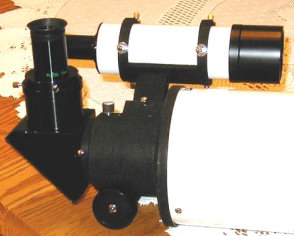 The tube seems to be aluminum, with a white paint coat on a blue base coat. The original owner had managed to put one significant ding in the paint near where the focuser meets the tube--perhaps the result of trying to replace the focuser. I have since managed to add a couple of more dings to the paint, not quite as large--and without any collisions or drops. I think the paint is not very durable.
The mirror diagonal that came with it is optically unobjectionable--but had no threads on the barrel that goes into the telescope. Perhaps you should not expect that on a telescope in this price range. It was a source of frustration to me because I needed a threaded diagonal for the Aries Chromacor. Still, if you need a spare 2" diagonal, I have a spare!
The diagonal is held in the focuser tube by a single screw, which tends to work itself loose. Because I have added an Aries Chromacor to an aftermarket diagonal, the extra weight is certainly stressing this design. I suspect that it would work fine without the extra weight. Still, it is not a bad idea to tie a lanyard from the diagonal to the focuser, just to make sure it doesn't get away from you.
The objective cell is not adjustable for collimation. Again, this is not too surprising on a scope of this price. While I did have to make some adjustments to the objective, it was not because of tilt problems, but because the objective cell was holding the two element objective a little too tightly. Loosening the cell substantially improved the undercorrection problem--from really, really bad to 1/3 to 1/4 undercorrected.
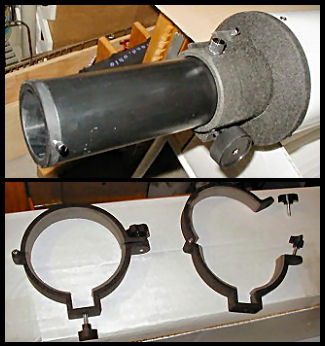
My biggest mechanical frustration has been the rings that came with it. They are some sort of crinkle coat black aluminum, and they attached easily with the included thumbscrews to a Losmandy dovetail.
For the first few months, they worked just fine. I had a few occasions to unscrew the ring screws and lift out the tube--but not more than a couple dozen times. Then, one of the screws stripped out the threads. This may have been because I had to tighten down the screws pretty hard to get the rings to reliably hold the tube. Now, even with a lock washer and a nut on the far side, I can't get these rings to hold the tube in place if I am pointing much above a 45 degree angle. I had enough of a disappointment at a star party last night with this that I am now actively looking at replacing them.
There is a dew shield (really necessary at some seasons in Idaho), and while it isn't exactly a tight fit onto the end of the tube, it doesn't fall off, either, even at pretty severe downward angles.
 Included with the telescope was a 1.25" adapter for the 2" diagonal (or directly into the focuser), which seems to be well-made, and a 25mm Plossl eyepiece. I haven't used the 25mm Plossl much, since I have a very nice 25mm University Optics orthoscopic, but the 25mm Plossl seems to be both a bit brighter and wider field than the orthoscopic.
Overall, this refractor is a lot like most goods that comes from China these days: it has acceptable optics for the price, but no one is going to mistake its mechanical parts for something manufactured in Japan, the United States, or Taiwan.
Had I paid the full list price of $650, I think I would have been pretty disappointed, but I bought it used through astromart for $375, less than a month old. The original owner told me that it was too heavy for his mount, and he appeared to have chipped the paint in one place on the tube, so I suspect that he decided to sell it, rather than try to return a damaged OTA. Perhaps if the OTA were a bit better quality optically, he might have spent the money on a better mount!
Appearance is pretty impressive.
I would consider the optical quality tolerable, even at the full list price. It isn't a Televue or an Astro-Physics, but I could spend $375--or even $650--without feeling like I was cheating my family of anything that they needed. The equivalent Televue or Astro-Physics refractor is a whole lot more money. It was also cheap enough, I rationalized, that if something bad happened to it at a star party, I would be disappointed, but not heartbroken.
While the optics are okay, the mechanical components leave quite a bit to be desired. The 2" focuser was a bit disappointing at first; quite stiff, with plastic knobs. I spent a bit of time disassembling the focuser, and cleaning out the heavy grease with which many Chinese made telescopes are lubricated. Afterwards, the focuser was still not quite as nice as the University Optics focuser on my 8" f/7 reflector, but it wasn't bad--and when I had occasion to compare it to a Televue Genesis at a recent star party, I couldn't see that the Photon's focuser was really much more coarse on the focus.
I did find myself wondering if I might benefit from replacing it with an aftermarket focuser. Mercury Support Systems at the time was selling a fine focuser for Synta refractors--but whoever makes the Photon, it apparently isn't Synta, and there is no way to use a Synta compatible focuser on the Photon.
On the plus side, the focuser has more than 5" of travel, meaning that I can use even outrageous eyepieces like the Russell Optics 85mm Super-Plossl. The Aries Chromacor that I used now limits my inward travel for astrophotography, but that is not a limitation of the Photon Instruments refractor as delivered.
The finder mount uses a dovetail, with a single thumbscrew to hold the dovetail in place. It seems to be quite repeatable--meaning that the alignment of finder to telescope stays about right when you take it out and put it back. Unfortunately, this thumbscrew tends to work itself loose rather easily, so you have to retighten it pretty often, and there is some real risk of the whole assembly sliding out if you have the telescope pointed downward. The mount holds the finder with three screws in each ring, and works well.
The 7x50mm finder is a source of frustration. Optically it is very nice--except that the eyepiece threads into the finder to focus, and to get it to focus requires you to unscrew the eyepiece to a point where it feels like it is in danger of falling out. I have decided to live with a slightly blurry image, rather than risk losing the eyepiece in a thud and groan maneuver. The eyepiece has a good crosshair, but not illuminated.
The tube seems to be aluminum, with a white paint coat on a blue base coat. The original owner had managed to put one significant ding in the paint near where the focuser meets the tube--perhaps the result of trying to replace the focuser. I have since managed to add a couple of more dings to the paint, not quite as large--and without any collisions or drops. I think the paint is not very durable.The mirror diagonal that came with it is optically unobjectionable--but had no threads on the barrel that goes into the telescope. Perhaps you should not expect that on a telescope in this price range. It was a source of frustration to me because I needed a threaded diagonal for the Aries Chromacor. Still, if you need a spare 2" diagonal, I have a spare!
The diagonal is held in the focuser tube by a single screw, which tends to work itself loose. Because I have added an Aries Chromacor to an aftermarket diagonal, the extra weight is certainly stressing this design. I suspect that it would work fine without the extra weight. Still, it is not a bad idea to tie a lanyard from the diagonal to the focuser, just to make sure it doesn't get away from you.
The objective cell is not adjustable for collimation. Again, this is not too surprising on a scope of this price. While I did have to make some adjustments to the objective, it was not because of tilt problems, but because the objective cell was holding the two element objective a little too tightly. Loosening the cell substantially improved the undercorrection problem--from really, really bad to 1/3 to 1/4 undercorrected.
My biggest mechanical frustration has been the rings that came with it. They are some sort of crinkle coat black aluminum, and they attached easily with the included thumbscrews to a Losmandy dovetail.
For the first few months, they worked just fine. I had a few occasions to unscrew the ring screws and lift out the tube--but not more than a couple dozen times. Then, one of the screws stripped out the threads. This may have been because I had to tighten down the screws pretty hard to get the rings to reliably hold the tube. Now, even with a lock washer and a nut on the far side, I can't get these rings to hold the tube in place if I am pointing much above a 45 degree angle. I had enough of a disappointment at a star party last night with this that I am now actively looking at replacing them.
There is a dew shield (really necessary at some seasons in Idaho), and while it isn't exactly a tight fit onto the end of the tube, it doesn't fall off, either, even at pretty severe downward angles.
Included with the telescope was a 1.25" adapter for the 2" diagonal (or directly into the focuser), which seems to be well-made, and a 25mm Plossl eyepiece. I haven't used the 25mm Plossl much, since I have a very nice 25mm University Optics orthoscopic, but the 25mm Plossl seems to be both a bit brighter and wider field than the orthoscopic.Overall, this refractor is a lot like most goods that comes from China these days: it has acceptable optics for the price, but no one is going to mistake its mechanical parts for something manufactured in Japan, the United States, or Taiwan.
Funding Member