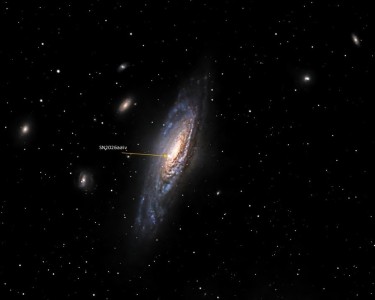
Mysterious Space Blob Discovered 12.9 Billion Light Years Away

Using information from a suite of telescopes, astronomers have discovered a mysterious, giant object that existed at a time 800 million years after the Big Bang. Even with superb data from the world’s best telescopes, they are not sure what it is. Because it is one of the most distant objects ever found, its faintness does not allow the researchers to understand its physical origins.
Comments:
Perhaps someone here can help me understand this. I just read the latest article about the mysterious blob that is 12.9 billion light years from us and is the vision of this object as it would have appeared 800 million years after the big bang.<br>This is where I get lost: Are we to assume that the universe is expanding at almost the speed of light? Otherwise I don’t see how light that is 800million years old has taken 12.9 billion years to reach us. I suppose that if this object was ejected from the big bang in the opposite direction from us, that our combined speed could approach the speed of light without violating any rules. However, I was also taught that the speed of light is constant and not effected by the speed of the observer. It is just hard for me to wrap my brain around how we could see that far into the past, unless the expansion is at least close to the speed of light. Am I looking at this correctly or have I swallowed too much of the kool-aid?<br>Thanks in advance for your hopefully kind and enlightening words.<br><br><br>
You are correct. The universe IS expanding, perhaps even faster than light! Though it is said that nothing can travel faster than light, the fact is expansion of the universe itself can be faster. This is why, at the present rate of expansion, we can not see (nor will we ever see) objects that are heading away in the opposite direction. The light will NEVER reach us b/c the fabric of space is actually expanding faster than the light can travel. BTW, because of this expansion, it is believed that the observable universe is about 50 billion light years while the universe's actual (?) age is only 13.7 billion years old.
It is confusing. In fact, everything was a lot closer together than that when photons were first able to berak loose from atoms, but some of that light may still not have crossed than gap. Remember, the nature of the expanding Universe is that space itself is expanding, rather than objects (e.g. galaxies) moving away from each other through space. So the light took so long to reach us because it is running up a down escalator, if you will. The maximum speed of anything moving through space is the speed of light, but there is no such "speed limit" on the speed of the expansion of space (that we know of). Space could expand faster than the speed of light. In fact, Inflation Theory says that it just might well have done that for a brief time quite early on. That would mean that the Universe is much, much bigger than we thought (that is why it appears to be "flat", like the Earth appears to be "flat" to a casual observer: because it is BIG), and much of the Universe might never be visible to us (bummer). You are basically correct that the speed of light appears constant to both the observer and the source; that is, it is not affected by the motion of either the source or the observer. As a consequence, the frequency of the light (the distance between the waves) gets stretched or compressed by the relative motions of the source and observer (e.g. red shift). Hope that helps some.