Is It Time to Discard the Whole Dark Matter Contrivance?

10/14/2016 04:12PM

Is It Time to Discard the Whole Dark Matter Contrivance?
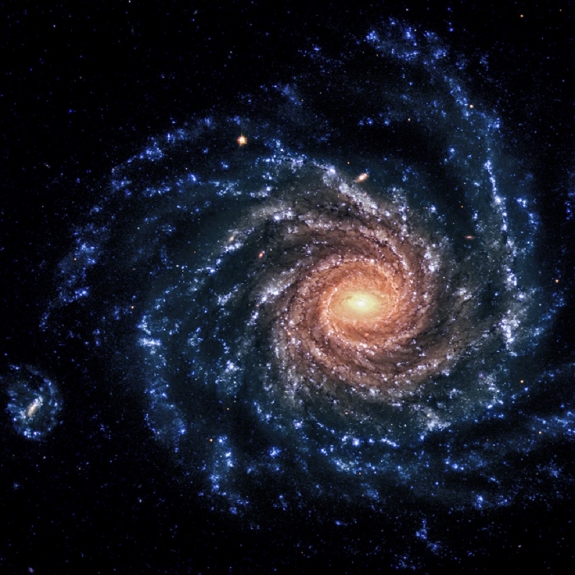
In the late 1970s, astronomers Vera Rubin and Albert Bosma independently found that spiral galaxies rotate at a nearly constant speed. The velocity of the stars and gas inside a galaxy does not decrease with the radius, as one would expect from Newton's laws and the distribution of visible matter. Rather, it remains approximately constant. For lack of a better explanation, such "flat rotation curves" have generally been attributed to a mysterious, invisible, and still undetected dark matter surrounding these galaxies, which provides the additional gravitational attraction required to balance everything out. Now a team led by Case Western Reserve University researchers has found a significant new relationship in spiral and irregular galaxies -- The acceleration observed in rotation curves tightly correlates with the gravitational acceleration expected from the visible mass only. This new work challenges the current understanding (and possibly even the existence) of dark matter.


Comments:

Many thanks for the article. VERY interesting.<br><br>The key sentence seems to be this one:<br><br>>>Lelli compared the relation to a long used natural law. "It's like Kepler's third law for the solar system. If you measure the distance of each planet from the sun, you get the orbital period, or vice versa" he said. "Here we have something similar for galaxies, with about 3,000 data points."<<<br><br>So, if I understand this correctly, the orbit of a star around the center of the galaxy correlates to its distance from the core? Is that correct?<br><br>
<br>Joseph:<br><br>Yes -- That just about sums it up.<br><br>One may ask "So, why was this distance to orbital period relationship not detected before?"<br><br>The key is that the near-infrared light emitted by stars is far more reliable than optical light for converting light measurements to mass. And the near-infrared images collected by NASA's Spitzer Space Telescope, which have only been available in the last five years, is what has allowed the researchers to establish the distance to orbital period relationship more accurately.<br><br>Apparently, better data leads to more accurate results.<br><br>It will be interesting to see how this all plays out.<br><br>Thanks,<br><br>Guy<br><br><br><br><blockquote class="blockquote"><div class="italic"><i>Joseph Babendreier said:</i><br><br>Many thanks for the article. VERY interesting.<br><br>The key sentence seems to be this one:<br><br>>>Lelli compared the relation to a long used natural law. "It's like Kepler's third law for the solar system. If you measure the distance of each planet from the sun, you get the orbital period, or vice versa" he said. "Here we have something similar for galaxies, with about 3,000 data points."<<<br><br>So, if I understand this correctly, the orbit of a star around the center of the galaxy correlates to its distance from the core? Is that correct?<br><br></div></blockquote>

In case anyone is still interested, there is this "refutation":<br><br>http://backreaction.blogspot.co.ke/2016/10/the-concordance-model-strikes-back.html<br><br>It seems that the authors of the study are basically saying that the rotation curve is not flat but it is almost flat. Which is ultimately not really big news since that was already known.


  • piscaer [Benne Piscaer]
  • 10/17/2016 06:17PM
I never could get away with my thought that the "dark matter" story sounded like the flogiston tehory in the 19th century. An attempt to explain the ununderstanded.
<br>Benne:<br><br>Yes, history provides us with many examples where scientists have simply invented ideas out of thin air to help explain away things that are just, as you say, "un-understood."<br><br>With regards to Dark Matter, we'll need more extensive data and analysis before we can do away with it once and for all. But if that indeed happens, I don't think it will be long before scientists begin to tackle the whole Dark Energy contrivance as well, but that's another story altogether.<br><br>When I think of these new Dark Matter findings, what comes to mind is the Michelson–Morley experiment of 1887. Back then, everybody just "knew" that space was filled with an "aether wind." The problem was that no one had ever seen it nor measured it. <br><br>Albert Michelson and Edward Morley set out to prove the existence of aether wind once and for all. Their experiment failed spectacularly in its attemt to detect any aether wind, but in the process they showed that the whole concept of aether wind, which most scientists at the time simply accepted as fact, was flawed -- There was no such thing. <br><br>Albert Michelson eventually won the Nobel Prize in Physics in 1907 for this work. He became the first American to do so.<br><br>An interesting coincidence - Albert Michelson and Edward Morley's work was done at what is now Case Western Reserve University in Cleveland, Ohio -- The same university where this new work on Dark Matter is being done. <br><br>Wouldn't it be something special if this work on Dark Matter ends up being the "Michelson–Morley experiment of the 21st century?"<br><br>Guy<br><br><br><br><blockquote class="blockquote"><div class="italic"><i>Benne Piscaer said:</i><br><br>I never could get away with my thought that the "dark matter" story sounded like the flogiston tehory in the 19th century. An attempt to explain the ununderstanded.</div></blockquote>

  • tbennett [Thomas Bennett]
  • 10/18/2016 06:10PM
If I'm understanding this correctly, this article indicates a correlation between the distribution of visible matter (based on near-infrared observations) and radial velocity in spiral and irregular galaxies. <br><br>It does not explain the issue of there being inadequate visible matter observed to hold the galaxies and galactic clusters together based on Newtonian gravity. If the Dark Matter contrivance is discarded, then some other contrivance would still be necessary to explain this phenomenon.


physicists should stop trying to take shortcuts before proposing new matter. If GR is wrong thats a different story, no one should use Newtonian approximation for any of this.

  • brokenarrow [Robert Sheldon Padawer]
  • 11/05/2016 10:03PM
Excuse me, but I am still confused about the mass contained in a cone 5 millimeters in diameter (my eye) at one end and 500,000 kilometers in diameter at the other - 10 billion light years away? We have a volume of space represented here. Now all we have to do is figure out how much mass has covered this particular distance over time. <br><br>Do particles and / or waves possess any properties that may be represented relative to their source? How about to "tugs" exerted upon it as it light speeds through space to every 5 mm diameter patch on a 20 billion light year diameter sphere?<br><br>For me it is simply inconceivable that that what is "observable" could be much more than 16% of all that exists. I believe the terms "dark energy" and "dark matter" take serious exception to the terms "energy" and "matter". The debate leaves me perilously discontent about any "breakthrough" with regard to what and how much the universe is made of.
