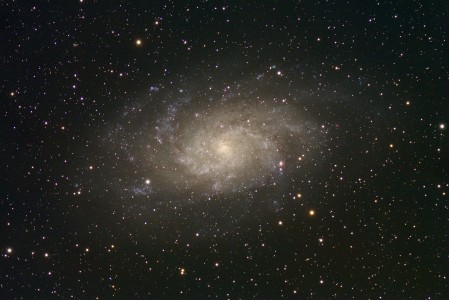
Good Bye Dark Matter and Dark Energy… Say Hello to Co-varying Coupled Constants and “Tired Light”

Throughout history, we have seen many examples where scientists have simply invented ideas out of thin air to help explain away things that are just not understood at the time. Such may be the case with today’s infatuation with Dark Matter and Dark Energy. A new University of Ottawa study challenges the current model of the Universe by showing that it has no room for Dark Matter or Dark Energy. The model combines two ideas — about how the forces of nature decrease over cosmic time and about light losing energy when it travels a long distance (Tired Light). In some ways, the concepts of Dark Matter and Dark Energy bring to mind another imaginary concept -- the so called "Aether Wind" of the 1800s. Back then, everybody just "knew" that space was filled with an "Aether Wind." The problem was that no one had ever seen it or measured it… And in 1887, when Albert Michelson and Edward Morley set out to prove the existence of Aether Wind once and for all, their experiment failed spectacularly -- There was no such thing. Michelson eventually won the Nobel Prize in Physics in 1907 for this work and became the first American to do so. These ideas may or may not pan out, but at least researchers are seriously considering other alternatives.
Comments:
Funding Member

Hmm, from somewhere, decades ago, oh yeah, college astronomy, I seem to recall redshifts aren't really accurate measurements. Checking the internet today and that still seems to be the case: "It is not an accurate measurement. Only an approximation."
Any yet, the "redshifts" appear to be the measuring stick that underpins the competing theories in the article. So, in my mind, you start off with a flawed concept, apply it even though it's an "inaccurate approximation" and then make the determination that everything, as per the article, "been shown to match up with several observations, such as about how galaxies are spread out and how light from the early universe has evolved."
Er, ah, excuse me for being skeptical; I guess I'm just missing something...
- "The 10 most overhyped physics and astronomy claims from 2023,"
found at https://bigthink.com/starts-with-a-bang/10-biggest-physics-astronomy-lies-2023/ , and
- "Ask Ethan: Has a new study disproven dark matter and dark energy?"
found at https://bigthink.com/starts-with-a-bang/new-study-disprove-dark-matter-dark-energy/ , and
- "Is the Universe 13.8 or 26.7 billion years old,"
found at https://bigthink.com/starts-with-a-bang/universe-13-8-or-26-7-billion-years/
Thank you, Guy, for all your time and effort and interest in continually reporting on what is going on in this strange, but interesting universe of ours!
Richard Johnson