Does Dark Matter Really Exist? Or is It a Figment of Our Imagination?

05/15/2015 01:03AM

Does Dark Matter Really Exist? Or is It a Figment of Our Imagination?
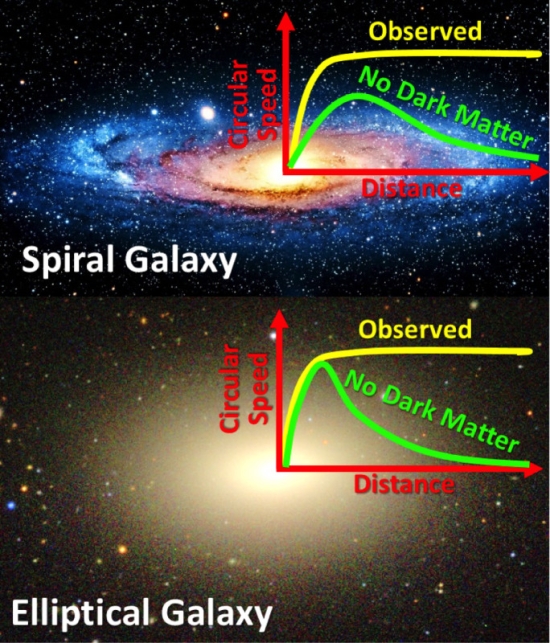
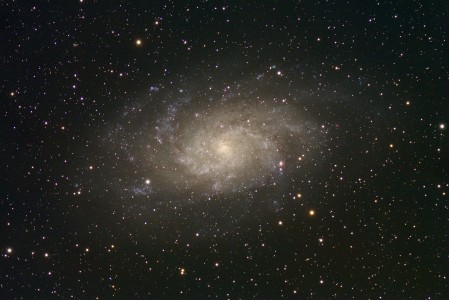
One of the most important scientific discoveries of the 20th century was that the spectacular spiral galaxies, such as our own Milky Way, rotate much faster than expected, powered by an extra invisible gravitational force. For lack of a better term (coupled with a lack of better understanding), this mysterious force was dubbed "Dark Matter." However, dark matter models do not come out naturally and require some disturbing fine-tuning to explain the observations. For this reason, some scientists suggest that rather than being due to dark matter, the faster than expected rotation of galaxies may be due to Newton's law of gravity becoming progressively less accurate at large distances. Remarkably, decades after this alternative theory (a universe without dark matter) was proposed, it still cannot be conclusively ruled out.


Comments:

  • 2dogs7 [Tim Libert]
  • 05/15/2015 04:19PM
Very nicely researched and expressed. I brought up this topic in a forum post more than 10 years ago before the newer scientific data and was ridiculed by other members here. All I pointed out was that we were talking about theory and had no proof of the actual existence of dark matter and could not prove it's existence or non existence. At that point everyone was excepting it as fact. I am very glad to see continued science discovery along with unbiased/open minded scientific minds at work. Now it they could only open up on the Quantum Mechanics theory.
Those who depart from the herd and ask questions are often ridiculed in the "unbiased" realms of scietific academia. That's where it started with Galileo for example - not in the Roman church - though we don't usually hear that part of the story. Don't let it stop you.

I "see dark matter" as more of a place-holder rather than anything that has been further characterized. That is, if we ONLY say that there is an influence on the dynamics of the large scale (galaxy size on up) that exerts gravitational force (or equivalent warpage of space-time) but otherwise seems to exhibit no Other interaction (other forces of nature)...we might just as well call it "Dark Matter." i.e. It's just a name for our current ignorance and should not be taken any more literally than that. Related: The "Quantum Paradox" that somehow the wave and particle aspects of bosons are logically inconsistent = paradoxical... not really! More to the point is that we use the word "particle" for emission/absorption event(s) and the word "field" for the propagation twixt the two. So in this sense---the paradox evaporates as an unnecessary imposition of familiar structure on things that don't obey our conceit of the familiar. Tom Dey


The idea for Modified Newtonian Dynamics does not explain the behavior of the bullet cluster and and this article did not address that. <br>This does not mean the idea is wrong, but it definitely has things going against it.

  • dgruss23 [David Russell]
  • 05/17/2015 10:35AM
Anyone that is interested can read more about the dark matter fine tuning problems in my article posted in the members section - "The visible matter - dark matter coupling problem." This new result is another example of the kinds of results that provide problems for a DM interpretation of galaxy rotation.<br>
  • tbennett [Thomas Bennett]
  • 05/22/2015 05:45PM
Hi David,<br><br>Thanks for you informative article on the DM coupling problem. I was able to follow most of it but didn’t understand why the total rotational velocity (RV) is not the sum of the halo RV and the disk RV components in the decomposition curves (figures 2, 4, and 5). For example, in Figure 2 the cross-over point for halo and disk occurs at about 105 km/sec but the total appears to be about 150 km/sec and not 210 km/sec. Is there something else contributing to the total?<br><br>Also, is the DM density considered to be constant throughout the halo or does it also diminish with increasing radius like the baryonic matter?


There is already an alternate to Newton's law of Gravity. It's called General Relativity. It's been applied to galactic motion already. Remember, Gravity, just like light, travels at the speed of light, this is part of what makes such collisions of large extended objects look so strange. Taking shortcuts in Astrophysics is not a good idea.
