Crab Pulsar Sets New Record for High Energy Photons
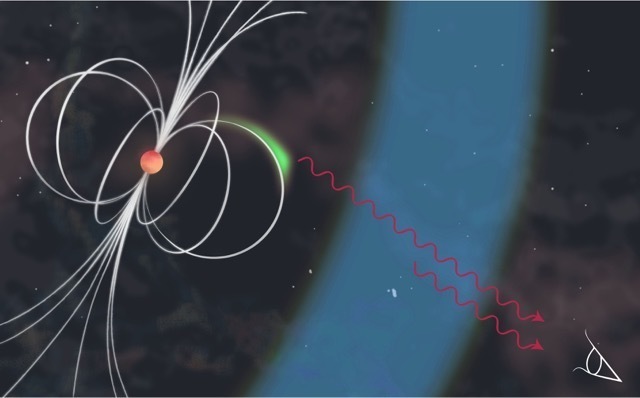
The Crab Nebula is the remnant of a supernova explosion that was observed on Earth in the year 1054. The pulsar at the center of the Crab Nebula is extremely small, with a diameter of just around ten kilometers, and rotates around its own axis at approximately 30 times per second. Thus, it emits light pulses like a lighthouse and these pulses stretch across the entire electromagnetic spectrum -- from long radio waves, to visible light, to the short waves of energetic gamma rays. Recent observations show that the Crab Pulsar has now set a new record. It is sending out the most energetic light radiation, in the form of photons, that has ever been measured from a star. This could challenge our current understanding of pulsars.