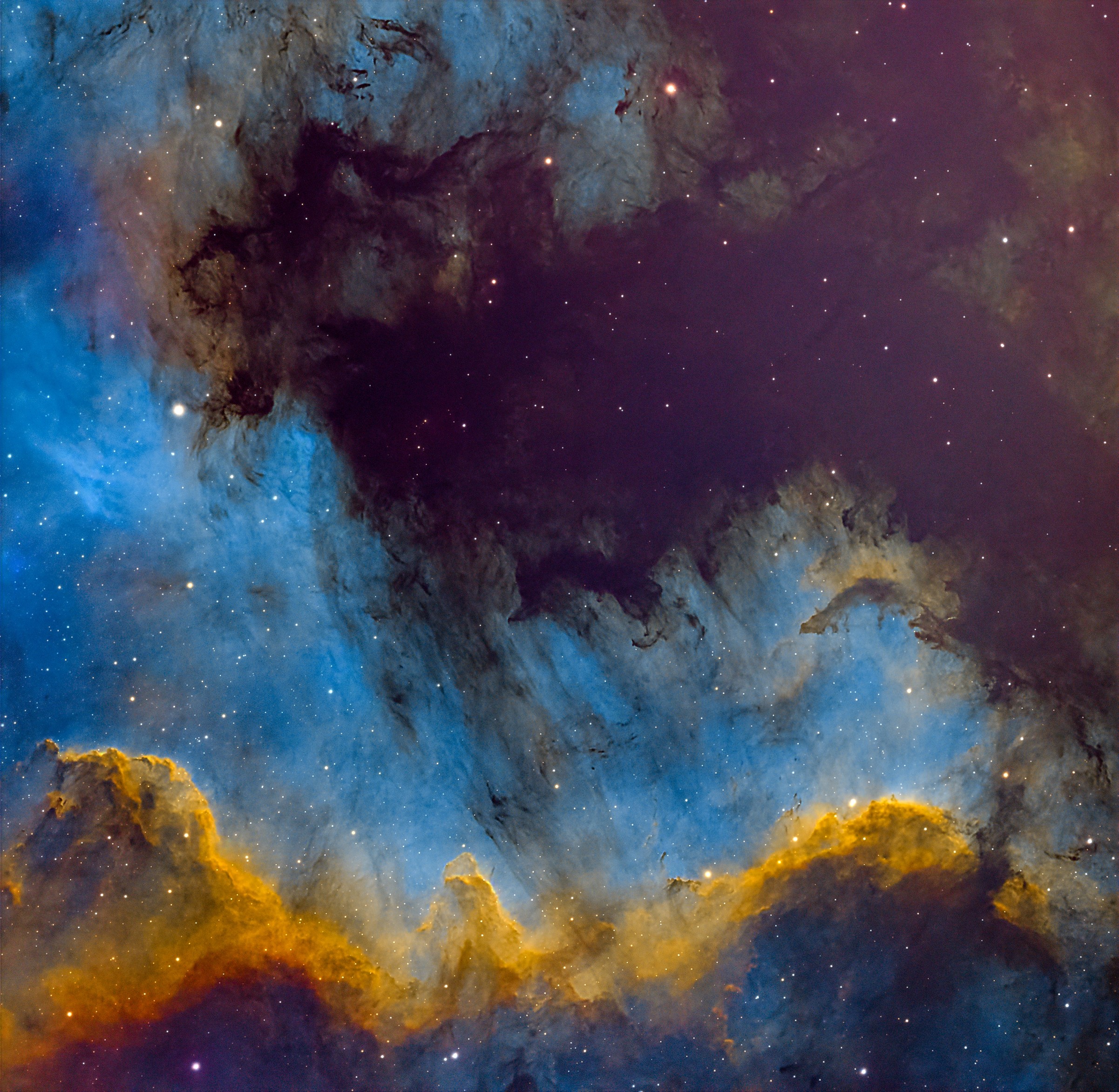
The Cygnus Wall in the North America Nebula
- Date Posted: August 7, 2024
- Resolutions: 2403x2345 , 820x800 , 307x300
- Date:
- Time:
- Number of frames:
- FPS:
- Focal length:
- CMI/CMII/CMIII:
The Cygnus Wall in the North America Nebula I'm excited to share my latest capture of the Cygnus Wall, a fascinating and dynamic region within the North America Nebula (NGC 7000). This nebula, which closely resembles the North American continent, is a stellar nursery where new stars are born amidst towering clouds of gas and dust. The North America Nebula was discovered by William Herschel on October 24, 1786. However, it wasn't until the early 20th century that the nebula's striking resemblance to the North American continent was noted, leading to its popular name. The Cygnus Wall, representing the "Mexico" and "Central America" regions of the nebula, is a prominent feature of this emission nebula. The Cygnus Wall is rich in hydrogen gas, glowing due to the ionizing radiation from nearby young, hot stars. This radiation creates the characteristic red and pink hues seen in many images of the nebula. The wall itself is a dense ridge of gas and dust, sculpted by the intense stellar winds and radiation from these young stars. It's an active star-forming region where gravity causes the gas and dust to collapse, forming protostars. Some of these newly formed stars will eventually blow away their surrounding material, contributing to the dynamic and ever-changing structure of the wall. Embedded within the Cygnus Wall are dark nebulae, regions of dust so dense that they block the light from behind them. These dark patches add contrast and depth to the nebula, making it a favorite subject for astrophotographers. The young stars within the Cygnus Wall emit copious amounts of ultraviolet radiation, which ionizes the hydrogen gas and causes it to glow. This radiation pressure also pushes the gas and dust outward, creating intricate and beautiful shapes. Observing the Cygnus Wall in infrared light reveals details hidden to the naked eye, such as newly formed stars still shrouded in their natal cocoons of dust and gas. Infrared observations help astronomers understand the early stages of star formation. One of the most intriguing aspects of the Cygnus Wall is the presence of Bok globules, small dark clouds of dense dust and gas that are potential sites for future star formation. These globules are often found in star-forming regions and are considered to be the early stages of star development. Capturing the Cygnus Wall has been a rewarding experience. The intricate details and vibrant colors highlight the complexity and beauty of our universe. This image is a testament to the wonders of astrophotography and the endless discoveries that await in the night sky. I hope you enjoy this image as much as I enjoyed capturing and processing it. Clear skies! Imaging Telescopes Or Lenses Sky-Watcher Esprit 100ED Imaging Cameras ZWO ASI2600MM Pro Mounts ZWO AM5 Filters Astrodon H-alpha 3nm 36 mm · Astrodon OIII 3nm 36 mm · Astrodon SII 3nm 36 mm Dates: July 29, 2024 Frames: Astrodon H-alpha 3nm 36 mm: 43×180″(2h 9′) Astrodon OIII 3nm 36 mm: 46×180″(2h 18′) Astrodon SII 3nm 36 mm: 46×180″(2h 18′) Integration: 6h 45′ Avg. Moon age: 23.61 days Avg. Moon phase: 34.74%
- User details
-
- Jedadiah Ashford
- January 4, 2023
- Followers 1