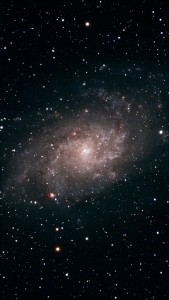

M42 - The Orion Nebula in HaRGB
- Date Posted: February 20, 2014
- Resolutions: 3099x2307 , 650x483 , 200x148
- Date:
- Time:
- Number of frames:
- FPS:
- Focal length:
- CMI/CMII/CMIII:
The Orion Nebula is a diffuse nebula located in the constellation of Orion, the hunter. This nebula is one of the brightest and is naked-eye visible in the night sky. It is seen as the middle "star" of the three in the sword of Orion, just south of Orion's belt. While the "star" appears fuzzy to even sharp-eyed observers, the nebulosity becomes obvious when viewed through binoculars or a small telescope. It lies at a distance of around 1,344 (+/-20) light years away and is the closest region of massive star formation to planet Earth. It has a mass of about 2,000 times the mass of the Sun and is estimated to be 24 light-years across. This nebula is one of the most intensely studied, most scrutinized, and most photographed objects in the night sky. Other designations: NGC 1976; The Great Orion Nebula; Messier 42 Telescope: Stellarvue SV80S Apo @ f/6 Accessories: Stellarvue SFF3 flattener; Dew control by Dew Buster; Alnitak Flat-Man Mount: Takahashi EM-200 Temma2 Camera: QSI583wsg CCD @ -20.0C Guiding: Starlight Xpress Lodestar Filters: Astrodon Tru-Balance E-series Gen2 LRGB & Astrodon 5nm H-alpha Exposure: 10 x 1sec., 10 x 10sec., 10 x 60sec., 10 x 300sec., 10 x 20min. binned 1x1 in H-alpha; 10 x 5sec., 10 x 15sec., 10 x 30sec., 10 x 60sec. binned 1x1 in each R, G, & B Acquisition: The SkyX Professional Processing: PixInsight 1.8 Date(s): Dec. 24, 26, & 31, 2013 SQM reading (begin - end): N1:19.04 – 19.23; N2:19.00 – 19.11; N3:18.98 - 19.11 Temperature (begin - end): N1:24.8ºF – 22.5ºF; N2:34.0ºF – 27.3ºF; N3:32.0ºF – 28.4ºF Capture conditions: N1:transparency: Above Avg 4/5; seeing: good 4/5; N2:transparency Above Avg 4/5; seeing: good 4/5; N3: transparency: Above Avg 4/5; seeing: good 4/5 Location: Hendersonville, TN, USA
- User details
-

- Craig & Tammy Temple
- January 26, 2016