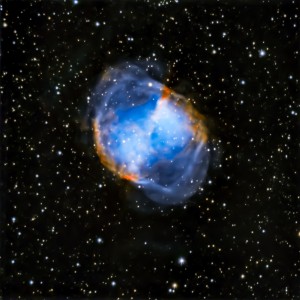

Messier 10 (NGC 6254)
- Date Posted: June 18, 2013
- Resolutions: 800x604 , 800x604 , 800x604
- Date:
- Time:
- Number of frames:
- FPS:
- Focal length:
- CMI/CMII/CMIII:
Messier 10 (NGC 6254) is one of the bright globulars populating constellation Ophiuchus. Full frame image captured 10 Jun 11 & 12, 2013 from Top of Mississippi Skies (T.O.M.S.) Observatory (lat 34.998°N, lon 88.276°W.) with a TMB-130SS Apo Refractor, CGE-Pro (Hypertuned by Deep Space Products), AutoGuiding with Lodestar via PHD, SBIG ST-8300C OSC camera, Astronomik CLS Filter, RigelSys nSTEP focusing. 10 subs @ 7 min (1hr 10min) and 20 subs at 5 min (1 hr 40min) for a total of 2hrs 50min. Acquired with ImagesPlus (IP) Camera Control v5.5; calibrated, stacked and processed with IP v5.5. Dark, Flat and DarkFlat Frames. From SEDS database: This globular cluster was discovered by Charles Messier on May 29, 1764, cataloged as No. 10 in his list, and like most globular clusters, is described as a "Nebula without stars" of round shape. William Herschel was the first to resolve it into stars. This 7th mag globular cluster appears at about 8 or 9 arc minutes diameter when observed visually in smaller instruments. Average photos show it at about 15.1 arc minutes diameter, and deep photos show it to reach out to about 20 arc minutes, or 2/3 of the diameter of the Full Moon. At its distance of 14,300 light years, this corresponds to a linear diameter of 83 light years. Its brighter core which can be seen visually is only less than half as large, about 35 light-years. It is receding from us at 69 km/sec. Its central region, according to Mallas, appears pear-shaped, with a grainy texture; the outer regions show brighter knots at medium magnification (120x).
- User details
-

- Thomas Walker
- November 27, 2015
- Followers 0
Funding Member