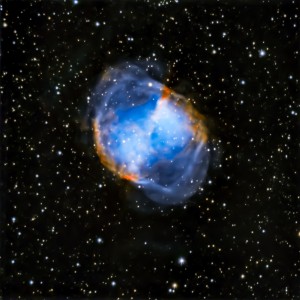

M5 from T.O.M.S. Observatory
- Date Posted: June 6, 2013
- Resolutions: 800x600 , 800x600 , 800x600
- Date:
- Time:
- Number of frames:
- FPS:
- Focal length:
- CMI/CMII/CMIII:
M5 - Top of Mississippi Skies (T.O.M.S.) Observatory (lat 34.998°N, lon 88.276°W) Jun 3, 2013. TMB-130 F/7 Refractor, CGE-Pro, AutoGuiding with Lodestar via PHD, SBIG ST-8300C, Astronomik CLS Filter, 42 subs @ 5 min (3 hrs 30 min.) Acquired with IP-CC v5.0 Calibrated, stacked and processed with Dark, Flat and Dark Flat Frames completely in IP v5.5. Messier 5 or M5 (also designated NGC 5904) is a globular cluster in the constellation Serpens. It was discovered by Gottfried Kirch in 1702. Under extremely good conditions, M5 is just visible to the naked eye as a faint "star" near the star 5 Serpentis. Binoculars or small telescopes will identify the object as non-stellar while larger telescopes will show some individual stars, of which the brightest are of apparent magnitude 12.2. M5 was discovered by the German astronomer Gottfried Kirch in 1702 when he was observing a comet. Charles Messier also noted it in 1764, but thought it a nebula without any stars associated with it. William Herschel was the first to resolve individual stars in the cluster in 1791, counting roughly 200. Spanning 165 light-years in diameter, M5 is one of the larger globular clusters known. The gravitational sphere of influence of M5, (i.e. the volume of space in which stars are gravitationally bound to it rather than being torn away by the Milky Way's gravitational pull) has a radius of some 200 light-years. At 13 billion years old, M5 is also one of the older globulars associated with the Milky Way Galaxy. Its distance is about 24,500 light-years from Earth and the cluster contains more than 100,000 stars, as many as 500,000 according to some estimates.
- User details
-

- Thomas Walker
- November 27, 2015
- Followers 0
Funding Member