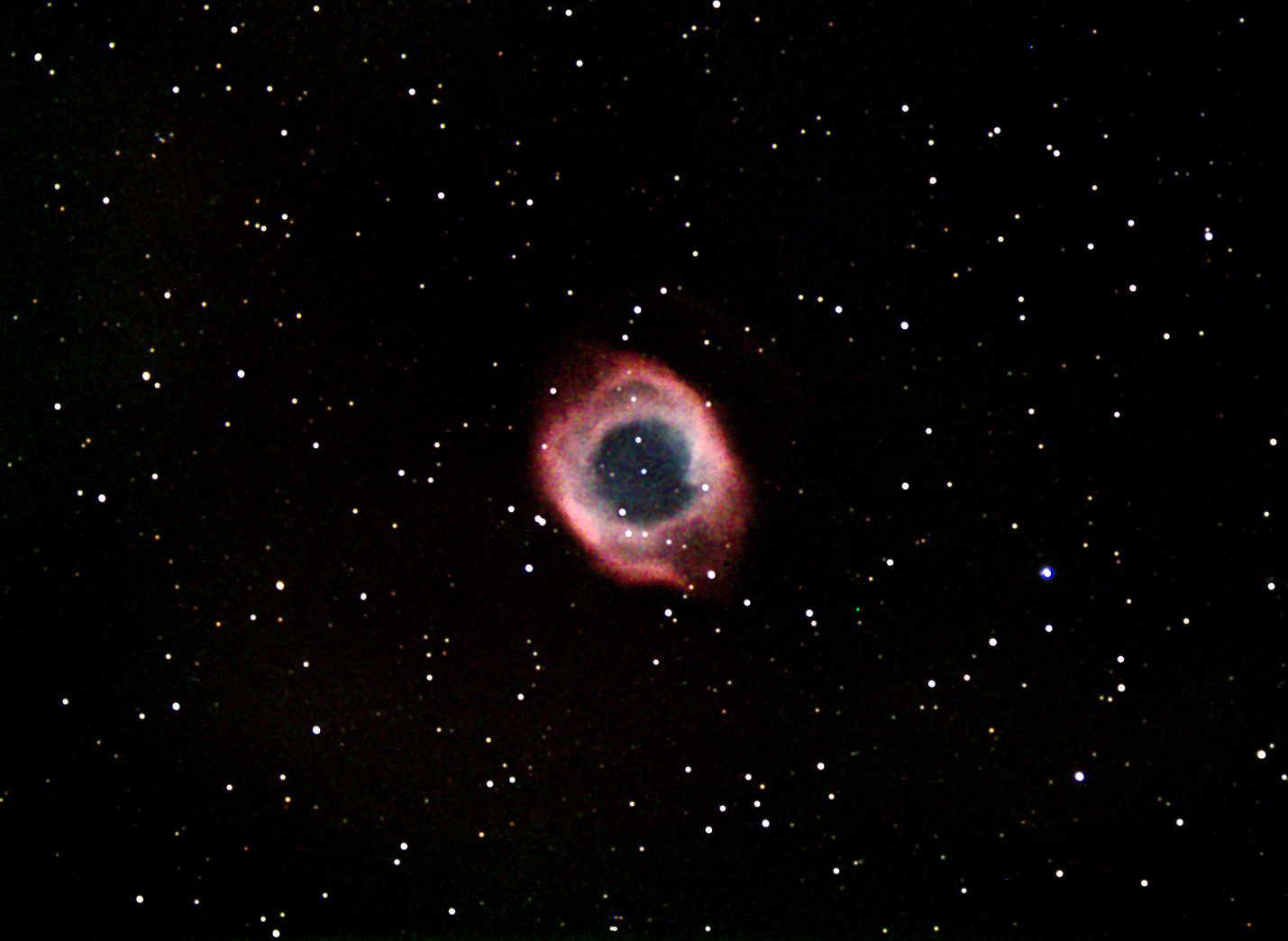
The Helix Nebula
- Date Posted: July 20, 2006
- Resolutions: 1429x1044 , 1429x1044 , 1429x1044
- Date:
- Time:
- Number of frames:
- FPS:
- Focal length:
- CMI/CMII/CMIII:
Image captured from my driveway in north Texas on 6 Jul 06. SkyWatcher Pro ED-80, EQ-6 Pro mount, SBIG ST2000XM, CFW-8, Astrodon LRGB and Ha filters. Takahashi focal reducer. Image data: f/5, total time Ha for lum 2x20min, RGB 2x8min each. Autoguided, captured aligned and combined in MaxIM DL. Final processing in Photoshop. The Helix Nebula is one of the closest of all planetary nebulae: Lying at a distance of perhaps 450 light years, it is the only planetary nebula for which a parallax could be obtained by ground-based observations. Nevertheless, its distance is quite uncertain: The first determination by A. Van Maanen yielded about 85 light-years, Becvar (1961) has 590, L. Kohoutek (1962) 280, I.S. Shlovskii (1956) and P.A. Ianna & H.A. McAlister (1974) 160, the Sky Catalogue 2000.0 gives about 300 ly, and C.R. ODell (1963) obtains 450 light-years. It is also one of the apparently largest planetaries known: Its apparent size covers an area of 16 arc minutes diameter, more than half of that of the full moon; it halo extends even further to 28 arc minutes or almost the moons apparent diameter (These dimensions were taken from Stephen J. Hynes who quotes AAT and ESO photos). Although the nebula is quite bright, its light is spread over this large area so that it is not an easy object for visual observing; the Herschels have apparently never cataloged or observed it. (http://seds.lpl.arizona.edu/messier/xtra/ngc/n7293.html)
- User details
-

- Max Corneau
- January 19, 2022
- Followers 0