Just ballparking, here, but...
First, some assumptions: good Pronto optics, good diagonal & eyepieces, and good seeing.
Moon: Luna's brightness makes pushing beyond ~100X per inch do-able, but that's pretty-much "empty" magnification (no gain in discernibility/resolution beyond lower powers; just a bigger image). I'd expect to spend most of my time in the 100-150X range. Still, "maxing out" on Luna *can* be a kick, even if one doesn't see any more detail.
Mars: Larger features (i.e. Syrtis Major, Erythraeum, Tyrrhenum, Acidalium, perhaps more), polar ice cap(s), and a gibbous phase are all do-able. Surface likely a pink-ish orange. Ice will be *white* -- you won't mistake it for clouds or dust.
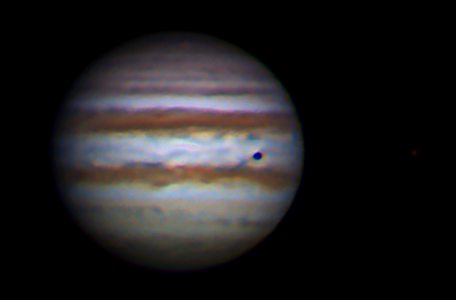
Jupiter: Expect some irregularities in widths, hues, & tones of belts &/or zones (i.e. clumps, lumps, or "this section's darker than that one," or "this belt looks browner" -- that sort'a stuff). Large ovals can be seen, given enough contrast (oval vs. background of Jupiter). Same goes for barges/disturbances. Shadows of Jovian moons should be easy & obvious. Given sufficient contrast *and* excellent seeing conditions, the moons themselves may also be seen (though not often) against the background of Jupiter. Great Red Spot and its "hollow" should also be available. Hues will include brownish, cream, grey-blue, and perhaps pinkish.
Saturn: Cassini, no problem. Encke "Minima" should also be do-able. Polar region ("olivine cap") will stand out (darker than rest of globe), as will the Equatorial Zone. Shadow of rings on globe can be seen, as can the shadow of the globe on the rings. Yellow-brown, cream, olive-brown, & white-ish blue.
Recommended "filter": a whole lot'a careful observing and a whole lot'a patience.
Best wishes.
-Dan