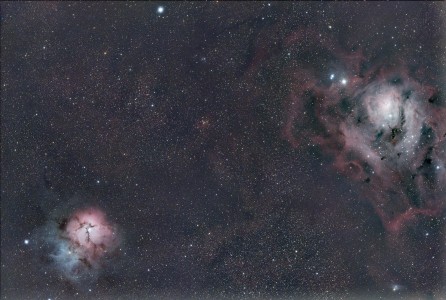
Image of the day

Captured by
Michael Scherman

Lagoon and Triffid Celestron C6 Hyperstar4

My Account

New to Astromart?

Register an account...

Need Help?

Posts Made By: Paul Bailey

July 10, 2008 08:04 PM Forum: Reflectors

Paracorr, how slow?

Posted By Paul Bailey

Anybody using a Paracorr (for visual) in a Newt slower than f/5? I've looked at the paracorr performance graph on the Televue website, and I'm thinking I could appreciate one
in my f/6 newts (I have three, 6", 8" and 10"). I also have small f/5 and an f/4 newts, and it's apparent to me f/6's have less coma, but why not go for it?


Kind of a cart before the horse deal, but I think if I already own a paracorr, I'd be more
likely to get another dob, larger than 10", and I do like standing on the ground.....

Comments?


February 11, 2009 09:18 PM Forum: Reflectors

SCT and MacNewt F.L. ???

Posted By Paul Bailey

How is the focal length, and therefore also the focal ratio, of a MAC-Newt measured? It appears to me that a SCT's focal length must start from the corrector plate, but evidently the focal length and ratio of a MacNewt are measured from the primary mirror?

November 20, 2009 03:26 AM Forum: Reflectors

Celestron-Vixen C6 primary cell removal?

Posted By Paul Bailey

Just picked up an old Celestron C6, I assume made by Vixen for Celestron, maybe 20 years old. I decided I'd learn to get along with the sled focuser for the quality of the mirror. But f5 is pretty fast to try getting along without a center spot. No sweat, I figured.

I figured wrong. Looks like the screws that attach the primary cell to the OTA are actually bolts, and there are nuts on the inside!

Anybody dealt with this situation before?

(And maybe NOW I'll learn my lesson and stop fooling around with commercial newtonians.....)

sad Paul Bailey

March 29, 2008 10:33 PM Forum: Reflectors

Vixen r130s collimation screws?

Posted By Paul Bailey

Vixen r130s - ? is that the same as the Vixen r130sf? I'm guessing it is. On my Vixen r130sf, the secondary collimation screws are allen head bolts, the same size as my Starblast's, I'm pretty sure.

I was puzzled about the primary collimation screws, to put it mildly. But I had great help from some more experienced friends.

It's a push-pull system, in that sense similar to the Orion Newts' cell. But instead of knobs, you need a phillips screwdriver and another allen wrench, not the same size as for the secondary, but a bit larger. Sorry, I don't know the exact sizes. The phillips head screws control the mirror 'pull', and the allen head bolts lock it in place, 'push'.

I'm assuming you recognized to remove the steel plate at the back, which covers the mirror and collimation screws.

My r130sf also arrived without a center spot on the primary. A friend installed one. Made a paper pattern of the mirror, folded it carefully into quarters, and cut out a small arc from the apex, unfolded, placed the paper back on the face of the mirror, and there's the center. Cut out a center spot doughnut from white vinyl tape, so it might survive an eventual mirror cleaning, and put it down in the hole in the middle of the paper pattern.

He also replaced the primary support springs, which were little rubber O rings, with thicker, 'stronger' rubber doughnuts. Now it's much easier to collimate, and stays put longer.

Hope this helps.

Paul

June 20, 2009 07:44 PM Forum: After Dark

Anybody Catch Jupiter on 6-19?

Posted By Paul Bailey

Yes, I saw that too. I was looking thru a 4.5"f8 newt when I first saw it - initially, it was like Jupiter was growing ears, made me think of the Mouseketeers. Then I looked thru an excellent 6"f6, and it was abundantly clear what was happening. The air was nice and still; the moons appeared as little disks, and the almost symmetrical spacing of two moons on each side was striking.

Also watched Venus and Mars, very close, at least within binocular fov. So low in the sky, Mars wasn't really sharp, but there was a bright polar cap, and I don't know what else might have shown up if I'd gotten anything larger on it, but I only used a small Starblast - it was only visible from a corner of the yard. And our own moon, bathed in Earthshine.

Sometimes I think I'm just an equipment junkie when I'm using 2 or 3 or 4 or even more telescopes in one viewing session; but I think I see more by comparing views, trying to see more in each scope, eeking out features in smaller apertures than before, tweaking collimation to see what's possible.

Just a few nights ago, there was a double shadow transit. I wasn't using a large/good enough scope to see the moon(s) in transit, though.

Tonight I'll be at 7400 ft. elevation, with a 10" dob; I'll have a good shot at actually observing transits of Jupiter's moons, if there are any; I'll look at the Jupiter's Moons site before I leave. There's likely to be a 20" dob too, that should reveal a lot.
