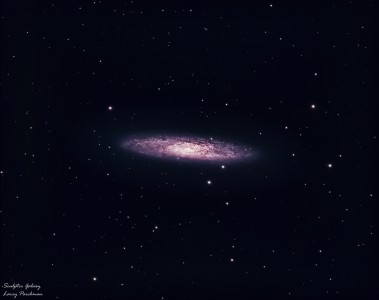
Image of the day

Captured by
Lawrence Parchman

Sculptor Galaxy (NGC 253)

My Account

New to Astromart?

Register an account...

Need Help?

Posts Made By: Alex McConahay

January 5, 2007 07:58 PM Forum: Off Topic Discussions

Proof of the non-existence of UFOs

Posted By Alex McConahay

What's the big deal about this thing in Chicago--Nobody got probed or impregnated or anything, right?

Alex

January 6, 2007 09:17 PM Forum: AstroMart FAQ

pictures in forums

Posted By Alex McConahay

A decent quality jpg at about 800 dpi on the long side is the way I like to have images posted. It is not too large, and still good enough quality. It does not overfill the page, requiring me to scroll around to see all of it, and allowing me to see the whole composition at once. If you want to show a larger resolution, higher quality, then ADD a link, but by add, I mean put the smaller jpg on the screen for me, then add a link for my option if I want to see more.

Alex

January 12, 2007 05:07 PM Forum: Digital SLR AstroPhotography

M42 from the Blue Ridge Parkway

Posted By Alex McConahay

I like this. I prefer the composition here to the one I posted.

As for the banding. When I replied to Robert about the banding, I was referring to a broad dark band that stretches the width of the image along the bottom three or four per cent of the frame. Is that what you are referring to? You seem to have that here. Look along the bottom--the nebulosity seems to cut off in a fairly straight line (albeit a wide (20-30 pixels) and fuzzy one) along the bottom of the frame.

Your explanation--monitor calibration or compression artifact--does not seem to fit that description. If it were compression or calibration, it would show across the frame and top to bottom, I should think.

One thing I did to really bring this home was to take a flat field frame, load it into Photoshop, and Image-Adjust-Threshold, and move the slider down from 128 to lower. It was immediately obvious that there was a frame-width vignetted area along the bottom of the frame. Mike Unsold, the developer of Images Plus (who was with me at the time, helping to run this little experiment) thought that it was a mirror shadow, and this would make sense to me--but why does it not show in daytime pictures--or maybe it does, but I have never noticed it!

Another explanation of this phenomenom is that there is a heat source along the bottom of the chip (or that that area loads up more as the chip is read) and when this is processed out, it appears as a dark area. (By the way--I'm just taking wild guesses.)

Now, on my monitor here I can just barely make out a much different kind of banding on your photo (and mine, also). It looks like we have the faintest of stripes running horizontally across the frame. THey are less than six or eight pixels wide, and extremely hard to see. I would agree that these might be something to do with compression.

I calibrated my monitor with the Spyder system not long ago, and I think it helped....But my monitor (a 1999 Gateway stock) just doesn't have the quality it needs to calibrate properly.

There is another kind of banding one sees in Canon 20D (and perhaps other) images. Tony Hallas calls it the "Green River." It is a wide (one tenth to one quarter of the frame) fuzzy horizontal stretch of dark greenish cast that shows on some exposures--right across the center usually, and stretching pretty much from side to side. I was with a group of thirty or forty imagers at a workshop discussing it. Many of us had seen that, but nobody had a good explanation of it. Tony did, however have a way to get rid of it that was fairly satisfactory.

At any rate--nice photo.

Alex

January 13, 2007 02:53 AM Forum: Digital SLR AstroPhotography

January 13, 2007 05:57 PM Forum: CCD Imaging and Processing/Deep Sky

Canon Question

Posted By Alex McConahay

Yes, you can get excellent pictures either with or without the IR filter.

However, if there is something that is particularly rich in IR, most of that IR will be blocked if you leave the filter on. This will not only increase exposure times, but radically change the color balance.

As you know, many objects in the heavens do not have much in the way of IR. The moon, A planet, a typical star, and a distant galaxy are all pretty much full spectrum, white light, essentially. So, they won't change very much whether you have a filter or not. However, the dep sky things most people like to take pictures of, especially the bright nebulae of various sorts, tend to be rivh in IR. And you would miss much of this. In short--The results would really benefit from removing the IR filter.

If your favorite astrophotos are of things that have a lot of red or pink, then you would want to remove the filter because this is the infrared showing through.

Alex

January 13, 2007 06:04 PM Forum: CCD Imaging and Processing/Deep Sky

Canon Question

Posted By Alex McConahay

As for whether you use the telescope or the camera lens:

Theoretically, a telescope used with a camera is basically a very long telephoto lens on the camera. SO, no, in theory it does not matter. If you happen to have a camera lens with the same focal length and aperture as your telescope, it should be about the same. However, as I am sure you realize, very few camera lenses are as long as your typical telescope.

Practically, of course, the camera lens is generally optimized to act as a camera lens. It has an iris that will change the aperture, and is engineered (often) to be sharpest a stop or two below maximum aperture. It has a wider, flatter field than the typical telescope. And the image circle is made to cover the chip. It also has focusing mechanisms. Telescopes are not so engineered.

A shorter form of the answer--Your camera lens will probably have a much wider field and less magnification than the typical telescope.

Alex

Alex


January 13, 2007 06:38 PM Forum: Beginning Astronomy?

Oh, how did this happen?

Posted By Alex McConahay

Yeah, It has a name: Aperture Fever.

As for binoculars. No, they are not a necessity. I spend a lot of time without them. The binocular experience is fundamentally different from the telescope experience. Yes, they both show off some things in the sky. But , walking is not running. And riding a bike is not driving a car. They all do the same thing--get you from point a to point b, but the experience is essentially different.

If you have a few dollars for binoculars, get them. They may help you find more guide stars when star hopping, and are particularly good at larger objects like big open star clusters. But do not expect them to do what a telescope does.

Alex

January 18, 2007 05:01 AM Forum: Sports

Marty watch

Posted By Alex McConahay

"14-2 coach" ?

Nope, Marty was 0-1 in the second season.

Alex

January 22, 2007 02:45 PM Forum: Eyepieces

Whats the lowest magnification I should buy?

Posted By Alex McConahay

Casey,

It depends on what kind of scope you are using and your entrance pupil.

If you have a scope with an obstructed view (like an SCT or Newt) you can have a hole in the middle of the field of view (shadow of the secondary) if you have too much of an exit pupil. This does not happen with a refractor.

Also, if you are young, and still can get your pupil open to 7 mm, then you can tolerate an exit pupil of 7 mm. If not, you are "wasting light" using a five mm eyeball on a 7 mm exit pupil.

Alex

January 22, 2007 06:10 PM Forum: Equipment Talk

Astrophotography Equipment List and Prices

Posted By Alex McConahay

It depends on what you want, and how high end you want to go. I am offering two levels of suggestion.

Beginner--Enough quality equipment to eliminate most of the frustrations to take wide field deep sky astrophotos for somebody just starting out.

Advanced amateur--better equipment, and allowing more of the smaller objects.

1: Scope

B--I'd start out with a short, wide field refractor like an 80 mm apo. Used price $500-800. This allows not only great astrophotos, but is fairly forgiving, and less complicated.

A--Move to a quality SCT or Newt, which could be had for anywhere from $600-1200 for the tube.

2: Mount

B--The minimum would be a good Super Polaris or equivalent, driven in both axis and particularly if it has an autoguider port. Available for about $500.

A--A G-8 or G11 German Equatorial mount. Available for about $1400-2400. Nice if it had goto, (but costs $1200 or so more).

3: Camera
B--A DSLR, $600-1200, modified if in budget range ($900-2000) or webcam or equivalent (LPI, DSI, etc.) (anywhere from $90 to $400)

A--Still a DSLR or move to a dedicated astro camera (won't hazard a guess on price)

4: Guidescope
B--A cheapo 60-80 mm achro salvaged from the junk pile. But make sure it has a strong focuser. ($40 to $100)

A--Actually, if you got a good example of the cheapo achro--use it. Or use your 80 mm refractor with a Barlow.

5: accessories (focusers, adapters, flip mirror, guide camera etc.)

B--Any good, solid focuser on your scope.

A--an electric focuser that can be moved in steps, preferably small steps. Rigel makes an entry level model--($240 I think, or was it $170?). JMI and lots of others makes them also ($450.)

An autoguider, either an old SBIG, or more often nowadays, a webcam.

As for other products--there are many that can aid one's efforts. I'll just leave it as it is here.

6: anything I should add (keep it short and don’t expound)

Ireland's book on Processing IMages. $40
Images Plus Software. $175 I think
Photoshop. $600, but I'm not sure on current price.

Alex