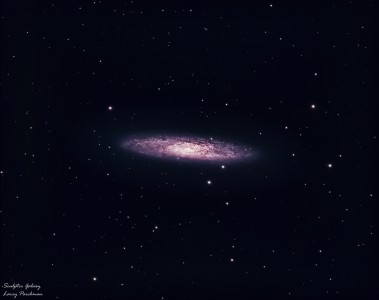
Image of the day

Captured by
Lawrence Parchman

Sculptor Galaxy (NGC 253)

My Account

New to Astromart?

Register an account...

Need Help?

Posts Made By: Alex McConahay

December 25, 2006 01:58 PM Forum: CCD Imaging and Processing/Solar System

The Lord of the Ring

Posted By Alex McConahay

>>Between the Turkey and al the Christmas stuff

You know, that would make it time for Saturnalia among the ancient Romans.

Alex


PS. Nice Picture, and quite a nice concept.

December 28, 2006 11:57 PM Forum: Deep Sky Observing

Object database preferences

Posted By Alex McConahay

My vote would be for an Excel Spreadsheet, with a link in the "picture" column. As a spreadsheet, I could re-sort and filter as I needed. I could sort things by size or by RA, or whatever.

Alex

December 29, 2006 05:00 AM Forum: Reflectors

Why Dawn?

Posted By Alex McConahay

>>>>What does dawn have that other liquid dishwashing detergents don't?

Nothing. And that is why one uses it. Others commonly have scents, dyes, hand softeners, lotions, and other things you do not want. And some versions of Dawn have some of these things. Some forms of Ivory, and even other dishwahing liquids are just as pure as Dawn, and have been recommended. The key is to avoid additives.

Photoflo is probably good too--but may be expensive.

Alex

December 30, 2006 02:28 AM Forum: Beginning Astronomy?

how to post pictures

Posted By Alex McConahay

Complete the first page of the ad information.

Hit the Continue button at the bottom.

Browse to the picture file you want (It should be on your own computer, not in a website or someplace else). Click on it. And then click on the button that says "Upload." Continue as needed to post your ad.

The picture should be 800 x 640 or so. JPG is best usually.

Alex

January 1, 2007 09:46 PM Forum: Beginning Astronomy?

Computers versus star charts

Posted By Alex McConahay

I find the laptop useful for setting up astro images, since I can compare the FOV, and for when I want to see a large swath of sky....

But, as I said, for the average star hop, the atlas is a lot more convenient.

I don't want anybody to think that I won't use a laptop, or that the star charts meet all my needs. But, this is a beginner's forum, and I think it important to say that the tried and true bright star atlas meets most of one's in -the-fields-needs.

Alex

January 1, 2007 09:52 PM Forum: Off Topic Discussions

Sky & Telescope Feb. 2007?

Posted By Alex McConahay

I believe it is part of their attempt to synchronize their publication date with their delivery date. I mean, if we get the February issue in December, but they mark it November, then it is not quite so far ahead of its time.

Alex

January 2, 2007 03:22 AM Forum: Equipment Talk

Collimation

Posted By Alex McConahay

Regarding the small specs: They do not hurt much. You can use a small blower (a bulb blower would probably work well) if the stuff is just on the mirror, and not attached to it. But you don't have to worry about them. They will not affect the view at all.

As for why the scope looks out of focus--got me there. I assume you go through the whole collimation process. Getting the laser collimator to hit the center of the primary is only part of the job. You also have to line up the primary so that the lazer beam goes back to its origin.

And if your scope is seriously out of collimtion when you start, a laser collimator is not sufficient. You can get a reading that looks right for a laser collimator and still have a scope that is out of adjustment.

Alex

January 2, 2007 03:33 PM Forum: Equipment Talk

Overkill

Posted By Alex McConahay

I've used my G-11 (on a pier) with a TV 85.

It was pretty stable.

Alex

January 5, 2007 07:32 PM Forum: Beginning Astronomy?

Super-beginner questions

Posted By Alex McConahay

Kay, you already have gotten good advice.....

You asked something to the effect of "which eyepiece do I use for what object."

There is no answer to this, since it depends a lot on what you want to see of an object. For some people a big open cluster looks good up close, and for others, they want to see such a cluster with a dark background and other stars in the picture. Some people want the detail in a galaxy, others want to see it floating in space!

One good method is to start looking for an object with a properly lined up Telrad (or equivalent) if you have it, then shift to a well-aligned finder scope. At this point the object of your search may be very small. THen Center the object and move to your widest field eyepiece. If you have all the same construction of your eyepieces, they are probably all plossls. And this means your widest has the highest number (32 mm is wider than 10). Find and center the object, then try your next smallest, and your next. When you get to the shortest eyepiece (a 10 probably) You are at your highest magnification. Whichever eyepiece gave you the most pleasing image is the one you should be using.

Other thoughts:
As you go down in eyepiece length, the object will get brighter, but the field of view narrower--so you may lose the field (background). Some things are not as pretty without that background.
As you go down in eyepiece length, you start magnifying movement, air disturbance (bad seeing), and other imperfections. So, you may wish to stop before you get to the highest magnification.
You can use a Barlow to improve magnification. Try it with all your eyepieces.
With more magnification, you will notice the skies getting darker. The object also gets darker, but not as quickly (apparently) as the background. As a result, you will get more contrast with shorter eyepieces.

Generally--You are looking for resolution, not size. A smaller, but more detailed view of Saturn or any other object, will be more rewarding.

In other words--try them all!!!

Alex

January 5, 2007 07:55 PM Forum: Digital SLR AstroPhotography

Taking the plunge - what accessories?

Posted By Alex McConahay

Step 1. Connect the camera to the telescope--All you need is a T-ring and camera adapter that allows you to attach to your focuser. (This is the same thing you used to use with any old film SLR used in astrophotography.) (Of course, for really wide-field photography you need just a piggy-back adapter and your camera lens)

Step 2. Take pictures--You can take pictures without any other accessories. Use your mirror lockup and self-timer to minimize vibration, and simply push the camera button. Save the exposures to the compact flash. This is fine for anything up to 30 seconds (moon, solar (with appropriate filter), planets, and brightest of deepspace) using only your camera and the Compact flash card that comes with it. However, you will find focusing and other tasks difficult.

Step 3.--Attaching to Laptop--Since you already use CCD, you most probably have a laptop. Now the world of DSLR photography opens up. YOu will want to get one of the programs that allow you to download a picture from the camera to your computer. The Canon-(supplied with camera) software allows this, but is not optimized for astrophotography. Most peole use a program like DSLR Focus or Images Plus, or others. These allow you to set the camera parameters from the computer, click a picture, view it on the screen, adjust focus, click again, adjust again, and so forth to achieve focus. Then they allow a script to automate the exposures. They download the images and then store them in your computer. However, you are still limited to 30 second exposures.

Step 4--Longer than thirty second exposures--At this point you have two choices:
If you are not using a laptop, you can buy a cable release. You can buy (or even make) a dumb one that simply triggers the shutter, or buy a programmable one that allows you to collect a series of exposures.

or

If you are using a laptop, you can buy or make a cable that connects your computer to your remote-cable connector on your camera. This allows unlimited exposures.

THere are, of course, plenty of other devices you may wish to consider:
Many people focus through a Stiletto focuser. THese are good, but not necessary if you have a laptop.
Flip mirrors, Parfocal eyepieces, motorized focuers, knife-edge focusers, autoguiders, all those things useful in other types of astrophotography are also sold for DSLR's. A good small dob is nice for having something to look at the stars with while the automated exposure sequence is running by itself.

Ask more specific questions, I'll tell you what I know.

Alex