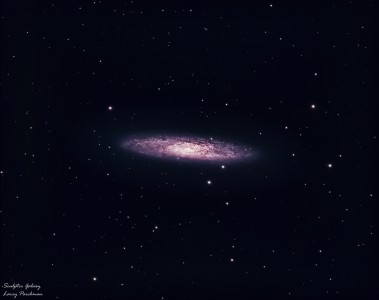
Image of the day

Captured by
Lawrence Parchman

Sculptor Galaxy (NGC 253)

My Account

New to Astromart?

Register an account...

Need Help?

Posts Made By: Ron Bee

May 16, 2003 05:11 AM Forum: Solar System Observing

TV-102 cupped the Moon

Posted By Ron Bee

With the foul weather lifted this morning, my lucky 4" TV-102 Light Cup cupped the Moon ;-) and let me peaked at the total lunar eclipse (first time through the telescope for me) tonight starting at 8:05pm PDT (03:05UT). The eclipse was already well underway in the west coast :-(.

With naked eye and a 30mm Celestron Ultima (30x), I noticed it was almost completely covered showing a small crescent. The view has a very low contrast. The "shadow" part was unlike the terminator, gradually decreasing in brightness which covered about 60-70% of the Moon with the dimmest part of the rim not seen. Mare Crisium was easily identified. The color of the "shadow" part via naked eye
and telescope was yellowish orange. At 8:27pm, I could make out Plato, though with some effort due to extreme low contrast which needed the 12mm Radian (73x). At 8:43pm, I realized Moon has a 3-D look, a sight unseen during any full moon that I've viewed. I digressed briefly to the globular NGC 5897 with great difficulty as the sky wasn't very dark.

Not wanting to bore the reader, we skip directly to most exciting part of the evening. At 9:05pm, my Light Cup showed me a sight so unexpected. The Moon's northern rim started to brighten most considerably (72x). It was like dawn was fast approaching on the Moon. No words, sketches, and I bet any CCD image could accurately describe the beauty! At 9:11pm, I dropped down my 40mm Pentax XL
(22x yielding a whopping 3d FOV). The rim is now very bright yellow contrasting with the shadow. At the opposite rim, it was pale orange. The whole image can only be described as someone putting the bright rim in the solar oven while the opposite end was an orange heat glow! The 40mm Pentax gave a stunning 3-D, colorful view as never seen
before on the Moon! At 9:25pm (22x), the Moon suddenly appeared hollow and translucent like a ball lamp with a soft-glow orange bulb within. The effect last only a couple of minutes and eroded away as the crescent is now too bright. Spectacular was an understatement! I noticed the Moon never take on gibbous shape, always crescent,
though fatter and fatter even after 10pm ;-).

I was sorely disappointed that I never saw the Moon completely dark and thought I was robbed of the **Total** Lunar Eclipse :-( before I lived too far west. Only before I wrote this report, I searched the web for some past total eclipse pictures. Say, what do you know; the Light Cup showed me the correct "total" view ;-).

Here's the nagging question: why wasn't the Moon completely dark, sort of like the Sun during a total solar eclipse?

Thanks,
Ron B[ee]

May 16, 2003 02:15 PM Forum: Solar System Observing

TV-102 gazed at Mars

Posted By Ron Bee

Awaken by worries over problems at work :-( at 4:30am PDT, I saw that the sky looked clear. Quick out went the 4" TV-102 Light Cup to cool off. Tonight the seeing was around III (often) and I was able to use mostly 220x (4mm Radian) and at times 176x (5mm Radian). Mars was gazed without filter, #21 (orange) and #80A (blue) filters.

CM: 36d - 43d
Magnitude: -0.3
Size: 10.8"
Altitude: nice 35d above horizon

The albedo looked like Margaritifer Sinus and Mare Erythraeum. No prize on the "Life-Saver Effect" :-(. See sketch.
http://members.cox.net/ronby/Planet-Sketches/Mars-051603.jpg

At 5:35am (12:35UT), I noticed uneven intensity near the western rim (still at 220x) - see sketch. So I put on the #80A filter and viola, the "brightening" looked grayish white, but not white or as bright as the polar cap. This is the first time I've seen this phenomenon on Mars with my 4-incher! Without sketching, I could have easily passed
this by! I did some research and reading into this ...

Anxious question: could this be the so called "limb
"brightening", "morning cloud", "haze", or what is it? If
not, what should I look for?

Much thanks in advance,
Ron B[ee]

May 18, 2003 02:41 PM Forum: Solar System Observing

Jupiter & Saturn phases?

Posted By Ron Bee

I've observed Mars (gibbous), Venus and Mercury (crescent & gibbous) gone through phases.

However, it just occurred to me I've never seen Jupiter and/or Saturn going through phases. At first I thought oh because they are outer planets, but wait Mars is beyond Earth as well! So can you guys assist me by bringing the phase to full in helping me understand why the gas giants don't have phases? Or perhaps I've never looked early enough (I admit I've never pushed my weary bones out of bed in the early morning hours for the gas giants as I've done on the Red Planet ;-). But wait, I've never see photos of the gas giants with phase either (except one photo of Saturn from space probe which showed very nice gibbous phase).

Thanks in advance.
Ron B[ee]

May 19, 2003 03:21 AM Forum: Solar System Observing

Planets - more spicy before spacecraft?

Posted By Ron Bee

I've recently read a post by someone stating that planetary
observation used to be much more exciting before spacecraft. (This was in the context of Mars observation.) It would place the time period to rough anytime prior to 1965 I believe.

While as a planetary newbie/tyro, I'm currently having a tremendously good times with the planets this year. I've been thinking about this more and more. Indeed, we know there's no canals on Mars, know much more about the GRS, knows about the many, many rings (not just 3) around Saturn. Today, we see incredible photos from landers and fly-bys, from the Hubble and from amateur groundbased CCDs! Thus, it seems to me there aren't much left for the amateurs to ponder about, not even much left to the imagination (such as Martians ;-).

If I may then be so bold as to ask the "seasoned" observers who are fortunate enough to have done lots of planetary observations prior to the space age, ...

A) How did it feel back then compared to today? Much more exciting in the yester-years? Much more anticipation at the eyepiece?

B) Much more exercise in imagination and speculation than today?

C) Much more contribution to the scientific communities than today?
Or perhaps Nasa doesn't afford much "crums" left for the amateur today?

D) Have you been forced to change your observation technique/approach to planetary scrutiny due to the past 35 years of advances?

E) Last but not least, after all these years, oppositions after oppositions with tons of knowledge and photos available year after year, do you still find the same ethusiasm today as it was then, or perhaps even much more today?

This is a scrutinizing serious question and I'd be much grateful if you guys to share your experience with me.

Thanks in advance,
Ron B[ee]

May 19, 2003 06:59 AM Forum: Deep Sky Observing

TV-102 first DSO sketch: M51

Posted By Ron Bee

Wow, this is much tougher than planetary sketching :-(! I had a really hard time trying to make it looked as close as through the eyepiece as possible by playing with the Adobe Photoshop and still can't get it quite the way I saw it from my backyard. The most difficult was trying to represent a range of brightness iand the gradual dimming away from the core in the sketch and then try to fine-tuned it with software :-(
http://members.cox.net/ronby/DSO-Sketches/M51-051803.jpg

The 12mm Radian (73x) was a start of a good view but I prefer the 8mm Radian (110x) much better (though slightly dimmer) as it gave a nice balance between magnification, brightness and contrast. The star in M51 was made visible with direct vision by using the 5mm (176x) and 4mm (220x) Radian. At 176x, the core of NGC 5195 seems brighter than M51. I've definitely had a better view of this pair from my backyard last year.

Telescope: 4" TV-102 Light Cup
Naked-Eye Limiting Magnitude: 5.6 near M51 (hazy sky in the day)
Sketch Time: 05/18/03 3:30UT - 4:30UT
Software Time: !@#$%^& over an hour :-(.

Interestingly, this is the first time I use my motor drive on DSOs. Now I know I like the slow motion knob a heck of a lot better, especially when changing eyepiece as I need to slew to the star SAO 44642 which I used for precise focusing. Too slow with the control :-(. The Radian's eye relief was a god-send as I spent an hour sketching!

Checking with O'Meara's sketch, nope - mine ain't anywhere close to as nice. But interestingly, looking at John Mallas' sketch with his 4" Unitron refractor, mine is a lot closer ;-). This is a "throwing in the towel" treadingly too tough :-(!

Ron B[ee]

May 23, 2003 07:04 PM Forum: Solar System Observing

TV-102 detected Jupiter phase - fact or fiction?

Posted By Ron Bee

My 4" TV-102 Light Cup seems to be in need of assistance yet again ;-). After seeing Mars' phase, I prosed a question about Jupiter and Saturn's phase. Indeed, the data shows that it would be extremely small. A couple of highly experienced observers gave me a tip to look for the difference in the brightness of the rim of the planet's
disc.

Last night, I observed Jupiter tonight with my 4" TV-102 APO and sketched it from 3:50-4:10 UT. The CM (System I?) was 147d. The seeing was betweenn II and III I believe. I could see that indeed the following rim of Jupiter is dimmer than the preceding rim, but nothing that could be all a phase. I would described it as dimmer whitish yellow than the planet's whitish yellow color. Checking with
my TheSky software, Jupiter has about 99% phase :-(. Here's my sketch.
http://members.cox.net/ronby/Planet-Sketches/Jupiter-052203.jpg

I used 220x (which the seeing could not support on the features) but it helped me with the "phase". Then, down to 176x for the rest of the sketch. The #12 filter seems to bring out the contrast and a strong impression of the difference between the brightness in the proceding rim vs the following rim.

It was quite difficult to convey the view with the sketch, adding to it my inexperienced sketching skill :-( Notice the very tiny gray "crescent" in the sketch at the following rim. The boundary in my sketch is actually imaginary and it was more gradual than the sketch could convey.

What do you think? Did the Light Cup show me phase detection fact or was the view imaginary fiction? Has anyone seen the difference in the brightness between both rims?

Very much obliged to any help I can get.

Ron B[ee]


May 27, 2003 02:19 PM Forum: Solar System Observing

TV-102 Light Cup first Mars color sketch

Posted By Ron Bee

http://members.cox.net/ronby/Solar-System/Mars-052703.htm

Enjoy,
Ron B[ee]

May 29, 2003 04:14 PM Forum: Deep Sky Observing

Light Cup First Pilgrimage

Posted By Ron Bee

http://members.cox.net/ronby/Observations/052803-Pilgrim.htm

Enjoy,
Ron B[ee]

June 1, 2003 07:16 AM Forum: Equipment Talk

The Faithful Star Party (Part 1)

Posted By Ron Bee

If you recall, I reported on the Fateful Star Party a few months ago. Well, tonight, I took Peter's invitation to go to SDAA club's dark sky location at Tierra Del Sol. My family and I spent time from 8pm to 10pm. Well, this star party seems a lot more *Faithful* to those I read about.

Indeed there were quite a few more scopes this time. Seems like the 10" SCT was very popular (quite a few including Peter's). I saw a Takahashi APO and thought it was a 5" when the owner told me it was the 4" FS102. Sure looked a lot bigger than my TV-102 on the Tak EM (whatever mount). Also present were a good looking Orion Vixen 4" f/6.5 102ED refractor, 7" Meade MCT, 8" XT8, 10" SCT, 11" C11, 13"
Dobs, 16" Dobs and 20" Dobs. There were others but I wasn't interested in them (the 8" SCT was pointed at double stars :-().

Jupiter in the Vixen looked very nice but has some purple halo around it. It was much less than my old 4" C102-HD acrhomat and not at all objectionable and gave a pleasing view of the gas giant. But I can see that my TV-102 showed no chromatic aberrations. The view of Jupiter through the 7" MCT and 8" Dobs was a wee bit brighter and very noticably brighter in the 10", and blindingly bright in the 13" and 20" Dobs. I find the view through these large Dobs distasteful! Because Jupiter was shimmering, the 4", 7", 8" and 10" seemed to all show the same amount of detail. Interestingly enough, I clearly saw the spider spikes in the 8" XT8 which didn't look objectable to me like I thought it would, but I could not see it in the 13" nor the
20" Dobs! I wonder why?

===> Part 2

June 1, 2003 07:19 AM Forum: Equipment Talk

The Faithful Star Party (Part 2)

Posted By Ron Bee

After the sky got darker, most of the scopes were pointed at the DSOs. M13 throught the 10" was not completely resolved. Though a nice view indeed, it looked brighter but not profoundedly different than I've seen through my 4" TV-102. I asked Peter for a look at M51 through his 10" SCT. Wow, spiral arms were quite easy with direct vision (but better with averted vision) as with the 13.5 mag star embedded inside it. The bridge could be seen with averted vision. (Just a reminder, I've caught glimpse of the spiral arms and detect the bridge with my 4" TV-102 before though with great difficulty and only with averted vision.) I quickly rushed over to the 16" Dobs and
asked the owner to point it at M51. Yes, it's noticably brighter, the spiral arms easier with direct vision and the bridge easier with more stars embedded in M51. BTW, I brought a chart of Bootes with me with stars down to mag 7.2. Well, the naked eye magnitude between 9:30-10pm was 6.0. BTW, guess what, most people were using either
Naglers or Panoptics ;-), no Radian :-(! I went back to Peter's 10" for a treat of M82. Wow, mottling was easy (I don't recall ever seeing this through my 4" from my backyard)! M81 was nice too.

But you know what, the 16" gathers 2.5 times more light than the 10". I'll say this much: the math looks good, but at the eyepiece this ain't so, not 2.5 times as bright to me! Similarly, the 10" gathers 6.5 times more light than my 4". But you know what, M51 through the 10" doesn't seem to look "blow-off" brighter than my 4"! But the 10" sure did show more detail, and made it much **easier** to see!
Aperture wins - no doubt about it! But I won't let the simple math that everyone likes to quote fools me from now on! Ok, I admit a side-by-side would be better. I think those who have been trying to tell me that the 10" is a sweet spot for DSOs maybe trying to tell me somethign ;-).

====> Part 3