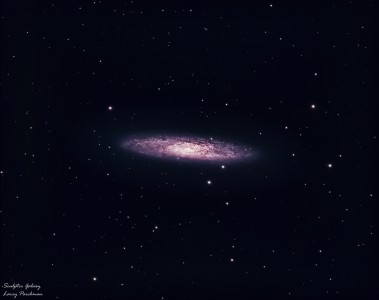
Image of the day

Captured by
Lawrence Parchman

Sculptor Galaxy (NGC 253)

My Account

New to Astromart?

Register an account...

Need Help?

Posts Made By: Alex McConahay

September 15, 2006 12:23 AM Forum: Off Topic Discussions

Xena is no more!

Posted By Alex McConahay

Yeah, now we have discord and lawlessness!!!

Alex

September 15, 2006 02:57 PM Forum: Eyepieces

parracor below focuser?

Posted By Alex McConahay

The distance from the top of the Paracorr to the focal plane is on the order of two inches, if I recall correctly. I don't think you could find a focuser that has a low enough profile that would allow you to sandwich it between the paracorr and the field stop.

I also do not know whether the paracorr has to be moved to a specific point in the light path for it to work properly (Does the field lens of the Para-Corr have to be at the focal plane, for instance?) If it does, then you would need another focuser at that point.

Alex

September 18, 2006 07:39 PM Forum: Digital SLR AstroPhotography

Mount suggestions for DSLR & lens only

Posted By Alex McConahay

At 200 you may get by with a Super Polaris. It depends a lot on which motort system you have driving it. 400 mm would be more demanding, but the Super Polaris might do the job.

Of course, if you plan to go further later, you should skip to the more advanced mounts.

Alex

September 19, 2006 02:12 AM Forum: Beginning Astronomy?

Barlowed magnification and 150mm reflectors

Posted By Alex McConahay

You are already running at about 225 power. If you cannot make out the bands of Jupiter, it is not because of lack of power. It is because of lack of resolution.

This lack of resolution could be related to seeing, collimation, or quality of the optics.

Moving to more magnification will not get you the bands.

Alex

September 19, 2006 09:36 PM Forum: Digital SLR AstroPhotography

New camera

Posted By Alex McConahay

I would suggest you look into a DSLR, like the Canon Digital Rebel. Get a standard one, or one modified for astrophotography.

I emphasize that you go to the DSLR because if you just get a "point and shoot" you will be limited in the long run.

By the way, Emanuel, you will notice the further you go in astrophotography, that the mount is at least as important as the scope. Your CG-5 is a good start, but will probably need upgrading in the long run. It is not unusual to spend twice as much for the mount as for the camera in astrophotography.

Alex

September 20, 2006 02:07 PM Forum: CCD Imaging and Processing/Deep Sky

Newbie Question-Focusing

Posted By Alex McConahay

I use DSLR Focus mostly.

On my newt 10" F4.5 newt, I have a homemade parfocal adapter. I glued a surplus 2" to 1.25" adapter to an appropriate rear lens cap (that had a hole cut in the middle. I use this adapter to locate the object and do the intitial focus. I can then remove it from the t-mount and place the camera on the t-mount already mostly focused.

I then use DSLR Focus. There are other programs that do the same job though. The only two I have is DSLR Focus and Images Plus, and, despite the improvements in IP 2.8, I still like the process better in DSLR Focus.

I also use an electric focuser with a step controller. ON the SCT, I have a stepper motor, and can go back and forth exactly. On the newt, I have a DC focuser, and the steps are not quite repeatable. But at any rate, I would suggest you use an electric focuser so that you can avoid touching the scope while focusing. I also recommend a motor controller with a step in it (sends out a pulse instead of continuing power) so you can control just how much the focuser moves each time you hit the button.

Remember, the depth of focus is less than part of a millimeter--easily enough that just touching the focusing knob can send the focuser right through the critical area and out the other side. So, relying on your hands becomes difficult.

I also have a Stiletto CVF (or whatever it is called). I think it would do a good job, but I have not used it too much at night. (I bought it for eclipse photography.)

I do use a flip mirror on my guiding port--but I would not rely at all on the flip mirror for focusing the main camera body. There is no guarantee that the eyepiece on the flip mirror is in exactly the same place as the camera body. It is sufficient for the ST-4, but not for critical image focusing.

Alex


September 20, 2006 02:17 PM Forum: Sports

What a finish!

Posted By Alex McConahay

Did you notice that a couple of the ninth inning homers (and back-to-back) were on first-pitches?

Alex

September 20, 2006 08:08 PM Forum: Equipment Talk

How Big Should the Secondary Be?

Posted By Alex McConahay

There is no one answer to this. Just gfo down to the ATM area and ask down there. You will get lots of opinion. It depends on how much of the field of view you want fully illuminated, which is a matter of taste, of vision, of type of eyepieces. Everything is a compromise, and you just have to make some choices.

Alex

September 21, 2006 05:08 PM Forum: Film Astrophotography - Imaging and Processing

WHY FILM?

Posted By Alex McConahay

Interesting discussion all the way through.

However, when you go to see what people are producing nowadays, I think you will see that astrophotography is better today than it was ten years ago. The pictures we see on our screens, and the pictures we see on paper at exhibitions are better than they were a while ago. Why?

I think part of it has to do with the ST-4 and later autoguiders. In the olden days, when one had to guide by eyeball and hand, people gave up on astrophotography before they got really good at it. Now, they can keep at it because the at-the-telescope drudgery is no longer a problem. So, while somebody may have been an astrophotographer for four or five years a long time ago before giving it up, people today stay at it for a lot longer, and develop better techniques.

A second observation. Any photographer will tell you that how you are viewing the photograph has a lot to do with your imaging medium. And nowadays, we are viewing most of our images over a computer screen that is approximately 1280 pixels wide. SO, how many megapixels does that take? The argument that a 35 mm film image has Billions of pixels is largely immaterial if we are viewing over a screen that is only using a Megapixel and a half. (And counting grain and other film gremlins, just how many pixels does a 35mm piece of film have?) Furthermore, how many of us really understand how to print a color film photograph? Fact is that nearly all photographs today are processed in a computer, printed on a digital printer, and/or viewed on a digital screen--so the argument that film is inherently superior to digital just does not apply.

As to the argument that the cameras are changing so much that the digital medium is not "stable..." well.... How many of us are still riding horses just because the automakers have not yet decided between conventional internal combustion, diesel, hybrid, and hydrogen?

Fact is--images are better today than they were ten years ago. And more people are doing them in a hobby (astronomy in general) that has remained at best static in overall numbers. And I think the reason is largely because digital images are better and easier to do than are film images.

Alex
