Well, you gotta watch out here. In the first place, there are diferent uses of the terms "magnitudes."
When we talk of magnitude of the star, we are talking about the total amount of light coming from a point source. That is, all the light is coming from a single point. This is pretty easy to compare.
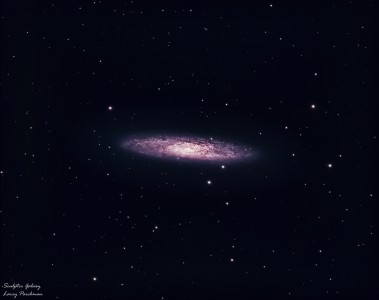
However, when talking about deep space objects, we are talking about the total amount of light coming from an area. To compare these magnitudes, one must take into account the size of the area. And this is much more difficult.
Another similar concept is "surface brightness." Surface brightness is, well, the brightness (or amount of light) coming from a given area. When you add up all the surface brightnesses, you get a "magnitude" for an deep space object. When you are talking about "point sources" such as stars, there is only one area to add up--the point of the star--but you still get a magnitude.
At any rate, compare a tungsten filament to a flourescent bulb. The tungsten filament is much brighter--puts out more photons (has a higher surface brightness--more light per unit of area) than any one small part of the flourescent tube. However, the Flourescent Tube is much, much larger. As a result, the the Flourescent bulb can put out as much overall brightness as a tungsten filament, even though the tungsten filament has a much brighter surface area.
OK, back to the stars. M42 may have more total light output than a sixth magnitude star-- But it is spread out over a larger distance. Therefore, no one part of it shows through.
M33, for instance, has a pretty bright overall magnitude, but it is so large, that it appears rather dim (has a low surface brightness).
In addition to this little explanation, remember that various measures of magnitude depend on visual, photographic, wavelength of light, and so forth. The eye is more sensitive to some colors, etc. So, there is no one "magnitude" for a celestial object.
Alex