Image of the day

Captured by
Michael Scherman

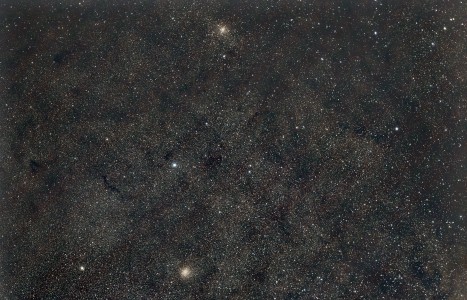
Dual Clusters near Antares

My Account

New to Astromart?

Register an account...

Need Help?

Posts Made By: Jason Higley

December 4, 2008 07:21 AM Forum: CCD Imaging and Processing/Deep Sky

Tasco 60mm on M31, M32, M110 - P&S Camera

Posted By Jason Higley

Hello, I just bought a 60mm Tasco 9vr on craigslist for $50.

Here are M31, M32 and M110 via the Tasco and a point-n-shoot camera

http://setisociety.org/m31-Tasco60mm9vr-roxi.jpg

I know this image has many bad attributes, but please consider the stats:

Shot tonight in my light-polluted driveway while the Moon was up!

Afocal, eighteen x 15 sec subs using a Canon Powershot A590 point-n-shoot camera held by an Orion SteadyPix to a 20mm EP.

Telescope was a 1983 Tasco 9vr (which is F/5! without the EP) which shows significant issues with the bad star shapes.

Mounted on a 1978 Criterion RV-6 mount (it looks so funny mounted on that thing!)

I know it's not the good stuff, but I bet you haven't seen an image of M31/M32/M110 from a 60mm Tasco and a point-n-shoot family camera on a Criterion mount? :^)

Regards, Jason H.


December 6, 2008 05:34 AM Forum: CCD Imaging and Processing/Solar System

A recent Titan flyby (that I've processed using my

Posted By Jason Higley

Tonight I downloaded 3 frames (taken at slightly different distances) from the NASA/Cassini website of a recent flyby of Saturn's moon Titan, then I processed them using similar techniques that I use for planet images, and here is the result:

http://setisociety.org/TITANDEC508CLOSER.jpg

Here is one frame from the original shots

http://setisociety.org/N00124646.jpg

Although I'm certain that I've also enhanced image defects, I believe that I'm seeing more real details than are apparent in the originals.

Regards, Jason H.

December 13, 2008 05:03 AM Forum: CCD Imaging and Processing/Solar System

Diminutive IR Venus

Posted By Jason Higley

Tonight's experiment, a diminutive shot of Venus using a Hoya R72 infra-red pass filter

http://setisociety.org/VENUS-MVI_1248regoneroxnoresz.jpg

The filter doesn't pass any light that is less than 720nm. As you probably have surmised, the reddish color is not natural but caused by the filter.

As some of you already know, although digital consumer cameras (like the Canon A590 that I used for this shot) have IR cut filters, they sometimes still pass a significant amount of near IR and IR. If you take a remote control from your TV, DVD etc. and point it at your digital camera, you can see the normally invisible flashes through your camera LCD screen.

I suspect that any details that appear in this particular image in the clouds are likely processing remnants from Registax trying to figure out what to do with such a dim and poor AVI as the one I used (I wasn't near thermal equilibrium and Venus was getting low; I should really try this during the daytime when Venus is near the meridian!) but Registax seems to have figured out the shape O.K. as Venus was supposed to be at around 65% illumination when the shot was taken afocally via the Criterion and a 10mm EP.

The IR-pass filter is a 58mm one usually used for photography, I just hooked the edge of it over the end between the extended point-n-shoot lens and the telescope eyepiece and crossed my fingers.

Regards, Jason H.

December 17, 2008 05:09 AM Forum: CCD Imaging and Processing/Deep Sky

M1 expanding over decades animation (real images)

Posted By Jason Higley

Hi, I've just put together an animation of M1 The Crab Nebula from a few images taken by Palomar over ~30-50 year span (see the rapidly moving star too!)

http://setisociety.org/m1-30-50-ds12rb.GIF

As many of you know, M1 was a supernova witnessed by Chinese and Arab astronomers in 1054. What we see today has expanded since then to 11 light years wide and is expanding at a rate of 1500 kilometers per second (or roughly 1/200th the speed of light) which evidently is fast enough to show significant change over a 30-50 year period.

I made the image by first stacking a red and blue image from the first Palomar Sky Survey taken between 1945-1955 in Registax 4, then I stacked a red and blue image from the second Sky Survey taken between 1984-1999, then I cleaned both stacks up in Adobe PhotoDeluxe and then animated them with GIF Construction Set Professional.

Best regards, Jason H.

December 19, 2008 04:58 AM Forum: CCD Imaging and Processing/Solar System

Venus at 63% illumination (18 Dec, '08)

Posted By Jason Higley

Venus from tonight (Dec. 18, 08)

http://setisociety.org/venusMVI_1307reg2.jpg

13% neutral density Moon filter, Celestron #96 filter, and a Light Blue filter. Afocal via Canon A590 in video mode, stacked ~960 frames, Criterion RV-6 scope, 10mm EP, 2x barlow and used the 4x camera optical, but I decided during post-processing to reduce the shot to 75% of original.

This shot was taken late in a lenthy session; I actually started in the daytime when Venus was at Zenith, and tried multiple experiments and tried to use the IR-pass filter, but I couldn't recover Venus at a higher magnification, so when Venus started slipping away near the end of the session, I decided to try to at least get tonight's phase.

Regards, Jason H.

December 20, 2008 06:34 PM Forum: CCD Imaging and Processing/Deep Sky

Christmas Tree Cluster

Posted By Jason Higley

Just a Christmas card from space wishing you all a happy holiday

The Christmas Tree Cluster

http://setisociety.org/Christmas-Tree-Cluster-1fr.jpg

Although this is a very rich nebula region, this single 15 sec. image from my P&S camera can only show the stars of the cluster; enough I guess for the holidays :^)

Merry Christmas, Yule, Saturnalia and Winter solstice (the longest night of the year! The Amateur Astronomer's night! :^), Jason H.

December 20, 2008 06:41 PM Forum: CCD Imaging and Processing/Solar System

OT - Christmas Tree Cluster

Posted By Jason Higley

Off topic - Just a Christmas card from space wishing you all a happy holiday

The Christmas Tree Cluster

http://setisociety.org/Christmas-Tree-Cluster-1fr.jpg

Although this is a very rich nebula region, this single 15 sec. image from my afocal P&S camera can only show the stars of the cluster; enough I guess for the holidays :^)

Merry Christmas, Yule, Saturnalia and Winter solstice (the longest night of the year! The Amateur Astronomer's night! :^), Jason H.

January 9, 2009 05:22 AM Forum: CCD Imaging and Processing/Deep Sky

Processed SOHO Sun/Milky Way movie

Posted By Jason Higley

I've scrunched ~110 SOHO satellite frames into a 3 frame movie from recently taken images (Dec. 21-23 '08) around our Sun (the black occluded thing in the center) entering the galactic equator of the Milky Way (relative to Earth.) Make sure to expand to full size.

http://setisociety.org/sohoxmas75pt.gif

The elongated smudge to the right of the Sun in each frame is Mars movement over roughly 24 hour period, and a bunch of Messier objects are within this field of view.

Stacked in Registax 4, post-processed in Roxio PhotoSuite 5.

Regards, Jason H.

January 9, 2009 06:06 AM Forum: CCD Imaging and Processing/Solar System

Processed SOHO Sun/Milky Way movie

Posted By Jason Higley

Here's the recent apparition of our Sun (the black occluded thing in the center) entering the galactic equator of the Milky Way (relative to Earth). I've scrunched ~110 SOHO satellite frames into a 3 frame movie from recently taken images (Dec. 21-23 '08.) Make sure to expand to full size.

http://setisociety.org/sohoxmas75pt.gif

The elongated smudge to the right of the Sun in each frame is Mars movement over a 24 hour period, and a bunch of Messier objects are within this field of view.

Stacked in Registax 4, post-processed in Roxio PhotoSuite 5.

Regards, Jason H.

January 18, 2009 03:23 AM Forum: CCD Imaging and Processing/Deep Sky

Deep Space Images Using NASA's STEREO

Posted By Jason Higley

I was able to create the following deep space images using the Solar Terrestrial Relations Observatory (STEREO)

Gas and dust
http://setisociety.org/stereoclouds.jpg

A star cluster
http://setisociety.org/stereostarcluster.jpg

Clouds and stars
http://setisociety.org/stereoclouds3.jpg

Zooming in on the above clouds
http://setisociety.org/stereoclouds2.jpg

NASA's STEREO is really 2 satellites, one orbiting a considerable distance ahead of the Earth, one behind a similar distance. I created these images by going through their archive of their solar heliograph instrument images on their website, from October and November 2008.

Regards, Jason H.