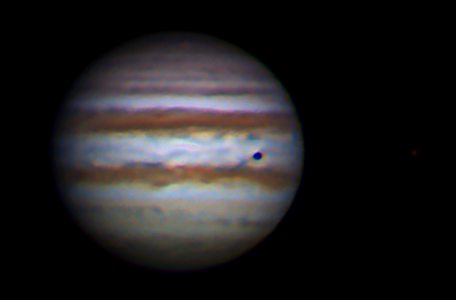
Image of the day

Captured by
John Roach

Jupiter IO Transit 12-10-26

My Account

New to Astromart?

Register an account...

Need Help?

Posts Made By: Curt Renz

June 4, 2005 12:06 AM Forum: Solar System Observing

Preview of Late June Trio of Planets

Posted By Curt Renz

In late June we will be treated to a trio of planets (Mercury, Venus & Saturn) close together in the the early evening western sky.

Here are the data for the closest approaches of each pairing as viewed from the center of the Earth:

-------Date------UT---Sep-----Pair
2005 JUN 26 02:34 1.3° Venus-Saturn
2005 JUN 26 12:33 1.4° Mercury-Saturn
2005 JUN 27 16:00 3.9' Mercury-Venus

The trio will appear about 23° east of the Sun. Notice that the minimum separation between Mercury and Venus will merely be 3.9 arcminutes. The two bright stars in Gemini (Castor and Pollux) will be pointing toward the planets.

I created a preview graphic of the trio in the western sky on the 25th 30 minutes after sunset as viewed from Chicago's Adler Planetarium, although it should well serve most North American observers. To see the graphic, click:

http://www.curtrenz.com/astronomical.html

The graphic may be removed soon after June 27. wink

June 10, 2005 07:04 PM Forum: Solar System Observing

Fat Crescent Moon Rides Above Regulus

Posted By Curt Renz

On Sunday evening, 2005 JUN 12, at 22:05 CDT as viewed from Chicago the center of the 6-day-old Moon will pass 2.8° north of Regulus, the first magnitude star in Leo. Each month the pair will appear closer together until a series of occultations commences on 2007 JAN 07 and concludes on 2008 MAY 12. The following Regulus series won't begin until 2016 DEC 18.

I've created a graphic previewing this month's Moon/Regulus conjunction for my website: http://www.curtrenz.com/astronomical.html . wink

June 25, 2005 05:44 AM Forum: Solar System Observing

Planetary Trivia Quiz

Posted By Curt Renz

Here is a planetary trivia quiz. It's open-book - research is allowed. Don’t be afraid to guess - bonus points will be given for bravery. The first one to answer all five questions correctly earns the right to pose the next question or pass that right to someone else. Good Luck. wink


1) How many years are there between inferior conjunctions of Venus?
--A. 0.6
--B. 1.6
--C. 3.6
--D. 8.6
--E. 121.6

2) When is the earliest year in which Mars will approach closer to Earth than in 2003?
--A. 2005
--B. 2082
--C. 2287
--D. 7233
--E. 62101

3) Which of these is a triple conjunction?
--A. 3 planets sharing the same right ascension
--B. 3 planets sharing the same ecliptical longitude
--C. 2 planets and a fixed star sharing the same right ascension
--D. 2 planets and the Sun sharing the same ecliptical longitude
--E. 2 planets sharing the same ecliptical longitude thrice in less than a year

4) How many times during 1900-1999 did Mercury transit the Sun?
--A. 0
--B. 2
--C. 5
--D. 14
--E. 46

5) When is the last time that there was a transit or occultation between two planets?
--A. 1818
--B. 1940
--C. 1959
--D. 1984
--E. 2003

June 28, 2005 06:40 PM Forum: Solar System Observing

July Astronomical Calendar - Computer Wallpaper

Posted By Curt Renz

I've created a July astronomical calendar that can be downloaded as your computer's desktop background wallpaper or printed to paper. The Moon is the main feature. Information on planetary visibility is included.

To see it, click:
http://www.curtrenz.com/astronomical.html

For those interested in details, read on:

Most of the information on the calendar is topocentric and assumes that the observer is located at the Adler Planetarium in Chicago. Although, it should well serve those in most northern hemisphere locations.

Each daily Moon image is depicted as it would appear on the night of the two dates it straddles. That includes the orientation of the illuminated portion and its relative apparent size. Specifically, a waxing Moon is shown as it would appear midway between sunset and moonset. A waning Moon is shown as it would appear midway between moonrise and sunrise. The effects of earthshine and the oppositional flash are also demonstrated.

The phases shown at the bottom of the page are calculated for more classical and intuitive definitions, rather than the simplistic ones employed in more recent times but before the advent of computers. Dark Moon is the moment during the monthly cycle in which the apparent lunar disk is least illuminated. Full Moon is when the disk is most illuminated. Half Moon comes when the disk is 50% illuminated. The fraction illuminated is printed under each image.

Only the apogee and perigee data are geocentric: kilometers from center of Earth to center of Moon. Otherwise, this information might seem somewhat chaotic as the Earth's rotation causes a daily oscillation of the distance between a surface based observer and the Moon.

Here are the meanings of the planetary visibility tables: For this explanation the horizon has been divided into two halves, eastern and western. A Morning Star is a planet that at sunrise is either above the western horizon or at least 10 degrees above the eastern horizon. An Evening Star is a planet that at sunset is either above the eastern horizon or at least 10 degrees above the western horizon. A Midnight Star is a planet that is above the horizon at local midnight, the time midway between sunset and sunrise (the evening date is posted.) It is possible for a planet to be all of these during a particular night. Lost in Glare means the planet fails to meet any of the previous three criteria and is therefore too close to the Sun to be easily observed. wink

July 4, 2005 08:58 PM Forum: Solar System Observing

July New Moon Spotting Contest

Posted By Curt Renz

Who will be first to spot the New Moon by naked-eye after its conjunction with the Sun on 2005 JUL 06 at 12:02 UT? After sunset on the 7th the Moon will be seen surrounded by Mercury, Venus and Saturn along with the bright stars Pollux and Castor. That may provide clues for locating the thin young Moon.

This slender young crescent Moon, a day or two old, was traditionally referred to as the New Moon. On the day of conjunction our ancestors called it the Dark Moon. However, most modern calendar makers insist on labeling the conjunction day as that of the New Moon.

Since I began this series in 2004 March within several astronomical message boards, the overall champion is Navneeth (SN1987A) in Madras, India with a 2005 January sighting 24:51 hours after conjunction.

Please report your July observation within this thread, including location and time with zone. Even negative results would be interesting. Photos would be especially nice. No prizes, just bragging rights.

I've created a graphic previewing the western sky 30 minutes after sunset on July 7 as seen from Chicago's Adler Planetarium. Nevertheless, the diagram should be useful for most North American observers. To see it, click:

http://www.curtrenz.com/astronomical.html

Then click the small blue button for the "July New Moon Spotting Contest".

The graphic may be removed soon after July 7. wink

July 8, 2005 03:45 PM Forum: Solar System Observing

Diana's Bow Meets Mercury & Venus

Posted By Curt Renz

This evening the nearly 3-day-old Moon (Diana's Bow) will appear in a grouping with Mercury and Venus. It should be a nice photo op. If you take any pictures, you may want to add them to this thread. I've created a graphic previewing the event. To see it, click:

http://www.curtrenz.com/astronomical.html

The graphic may be removed soon after tonight. wink

July 9, 2005 10:56 PM Forum: Solar System Observing

Venus as Evening Star - 2005-06

Posted By Curt Renz

Marvelous Venus appears far brighter to us than any celestial objects other than the Sun and the Moon. It will be gracing our western skies as the brilliant Evening Star from now until January. It was on the other side of the Sun for its Superior Conjunction on 2005 MAR 31 (all dates here are UT and the observer is assumed to be at a mid-northern latitude.) Around mid-May Venus started to become visible in the western sky after sunset. It is currently in its gibbous phase about 89% illuminated at Mag -3.5.

Venus will continue to gain in brightness as it approaches its Greatest Eastern Elongation from the Sun at 47°06’ on 2005 NOV 03 when it will appear about half illuminated. It will remain nearly its brightest for about another six weeks as it approaches closer to us but as an ever thinner crescent. The greatest brilliance will actually come on 2005 DEC 04 at Mag -4.7. All the while Venus will appear to be drawing back toward the Sun until the planet passes it again on the near side for Inferior Conjunction on 2006 JAN 13.

Many of us recall the winter and spring of 2004 as Venus rose quite high in the sky after sunset before proceeding to the much anticipated transit. This apparition the situation is quite different. From now until the Autumn Equinox the ecliptic (path of the Sun and approximately so for the planets) will continue to make a sharper angle with the horizon after each sunset. So even though Venus now appears to be constantly spreading farther from the Sun, the celestial geometry will keep it for several months at a fairly steady 10° above the horizon for those observing at a half hour after each sunset. However, each week Venus’ azimuth will have noticeably decreased as it shifts toward the south.

I’ve created charts for Venus watchers. They demonstrate the western sky 30 minutes after sunset as viewed from Chicago’s Adler Planetarium. The first chart covers the period from June 18 (Venus on the right, north) through October 10 (Venus on the left, south). All the while Venus will remain about 10° above the horizon at that same time after each sunset.

The second chart picks up with October 10 (Venus near the center) and concludes with January 11 (Venus in the lower right). You’ll notice that it crawls upward during November reaching a peak altitude of 18.5° (half-hour after sunset) on December 9. This is due to Venus’ declination becoming less southerly during November. Then it will appear to dive closer toward the Sun each evening, dimming noticeably as its crescent shape narrows. After its Inferior Conjunction it will suddenly pop into view for early risers as the magnificent Morning Star. Some will think it is a UFO. :S

Venus’ regular 1.6-year synodic cycle has been a wonder to observers for many thousands of years. Enjoy the show that Mother Nature provides us. 8)

You can view the charts by clicking http://www.curtrenz.com/astronomical.html

They may be removed in a week or so.

July 16, 2005 04:38 PM Forum: Solar System Observing

Mars Emulates Zorro - 2005-06 Opposition Loop

Posted By Curt Renz

During this year's apparition, Mars may not come as close as it did in 2003, but it might make a finer showing for northern observers due its crossing our skies at a much higher altitude.

Mars is currently rising during the very late evening at Mag -0.7 with an apparent width of 10.2", but will rise earlier each night (at sunset at opposition) and appear to increase in brightness and size. It recently surpassed its quadrature (90° separation from Sun) presenting a minimized illuminated portion of its apparent disk at 84%. At opposition, Mars will appear full (100% illuminated.)

Mars opposition (180° separation from Sun) will occur on 2005 NOV 07 01:57 CST. Its closest approach to Earth will be 0.46406 astronomical units or 69.4 million kilometers on 2005 OCT 29 22:25 CDT. That will also be the date for its greatest brilliance (Mag -2.4) and widest apparent diameter (20.17") for the current apparition. Its period of retrogression will last from OCT 01 through DEC 09.

I've created a chart that demonstrates Mars' upcoming opposition loop using ecliptical coordinates. It makes clear Mars' apparent retrograde movement as the Earth passes it by. This year's "loop" will actually appear more as though Mars were tracing out a "Z" in the manner of Zorro, as its ecliptical latitude increases throughout the period. To see the chart, click:

http://www.curtrenz.com/astronomical.html

The chart will not remain available indefinitely. wink

July 19, 2005 08:32 PM Forum: Solar System Observing

Huge Full Moons - July & August

Posted By Curt Renz

Look for especially large Full Moons at extreme perigees in July and August this summer. During the period from 2005 FEB through 2006 JAN, the Moon will approach nearest to Earth on JUL 21 (357,158 km). AUG 19 (357,393 km) will be the runner-up.

On JUL 21 at 11:00 UT the Full Moon will be in opposition to the Sun only 9 hours before perigee. On AUG 19 at 17:53 UT the Full Moon will be in opposition 12 hours after perigee.

Those may be great nights for outdoor parties, but watch out for the lunatics. grin

July 23, 2005 05:53 PM Forum: Solar System Observing

Lunar Quiz #3

Posted By Curt Renz

Here’s another lunar quiz for all you great lunatics out there. The first one to answer all five questions correctly earns the right to add one more. Hopefully the baton will keep passing for quite a while. Good Luck! wink


1) The maximum phase of the next lunar eclipse on 2005 OCT 17 at 12:03 UT will be:

A) Penumbral
B) Partial 6%
C) Partial 49%
D) Partial 92%
E) Total


2) The next solar eclipse on 2005 OCT 03 will be:

A) Partial at best (Arctic region)
B) Partial at best (Antarctic region)
C) Annular
D) Total
E) Hybrid (both annular and total)


3) During the current era the mean Earth-Moon distance is increasing by what amount per century?

A) 3.8 centimeters
B) 3.8 meters
C) 380 meters
D) 38 kilometers
E) 3800 kilometers


4) Which of the following first magnitude stars is not one that the Moon occults during the period 1900-2100?

A) Aldeberan in Taurus
B) Pollux in Gemini
C) Regulus in Leo
D) Spica in Virgo
E) Antares in Scorpius


5) When during the period 1990-2020 does the Moon reach its most extreme geocentric declinations, 28°43’ North and South of the Celestial Equator?

A) 1996 AUG/SEP
B) 2001 FEB/MAR
C) 2005 JUN/JUL
D) 2006 MAR/APR
E) 2015 OCT/NOV
