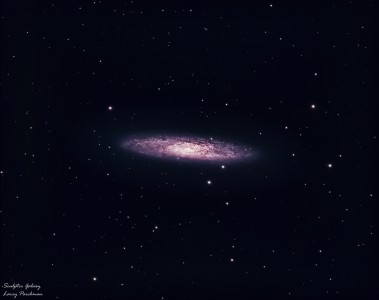
Image of the day

Captured by
Lawrence Parchman

Sculptor Galaxy (NGC 253)

My Account

New to Astromart?

Register an account...

Need Help?

Posts Made By: Michael Connelley

March 30, 2005 09:51 AM Forum: Deep Sky Observing

Spoiled

Posted By Michael Connelley

Hello:
I think that I understand what you mean. But I also think that I am much more spoiled. I also have a 12.5" scope, and really enjoy using it. But, on 2 occasions, I have been able to look through a 88" scope at anything I wanted for a few hours. I do wish that more people could see what I have seen. It's truely remarkable what the universe looks like through a really large scope. The field of view is kind of small. The main difference isn't how faint you can see, but the details and colors. Now, everything looks so small and pale. We could resolve M15 to the core, and see the colors of all of the stars. NGC 6543 (Cat's Eye nebula) looked like a brillliant green rose with a bright orange star in the center. Now and again, I thought I could see surface detail on Neptune (the seeing wasn't that good). A friend of mine, however, got to look through a 315" (8m) telescope. Now that would really be something!

Cheers
Mike Connelley
-who's also thinking about building a larger dob...

April 17, 2005 09:49 PM Forum: Telescope Making

cassegrain

Posted By Michael Connelley

Hello:
Jean Texereau's "How to Make a Telescope, second edition" has details on designing a cassegrain telescope, including the equations to get the mirror size, spacing, and conical consstants. The size of the cental hole is determined by the size of the primary mirror baffle. This, in turn, is easily determined by making a scale drawing of the light path through the telescope. As mentioned before, and in Texereau's book, you should have some experience making mirrors before taking on a cassegrain. For a cassegrain you'll need to make a fast paraboloid and a convex hyperboloid, and test both of them! Most of the telescope making parts for sale are for Newtonians, but many can be used on a cassegrain such as the tube, focuser, and spider. Cassegrains are also well suited to a truss tube design. You may need to make the secondary mirror holder yourself. For the primary mirror cell, make sure you get one that can hold the mirror in all orientations. As for the mounting, I'd recommend a good solid german mount since you'll probably be doing a lot of high magnification work.

Cheers
Mike Connelley

April 22, 2005 07:53 AM Forum: Equipment Talk

Buying New Scope

Posted By Michael Connelley

Hello:
I made a 12.5" with a mirror from Discovery, and I must say that I'm very happy with it. Being an f/6, I haven't noticed any coma even with wide field eyepieces. The planetary performance is very good as well. I've seen detail within the Great Red Spot, and have seen in the eyepiece that Ganymede is larger than Io. For a $700 mirror, this ain't bad. I can't vouch for the scope Discovery builds around the mirror; you can read Ed Ting's review for that info. So, instead of getting something like an Obsession, you could get this and still have money left over for a nice set of Naglers! That's my $0.02.

Cheers
Mike Connelley
... who used money left over from building the dob for a Nagler

April 26, 2005 06:50 AM Forum: Refractors

Sky 90 or TMB 80

Posted By Michael Connelley

Hello:
I have not used the TMB 80, but I do have a Sky90. I have not noticed any false color in focus, even on very bright stars or planets (and really, how often do we look at Vega with wide field refractors?). Out of focus there is some false color, but not in focus as far I was able to see. The wide field performance is very good. With the 31mm Nagler, it has a 5 degree field of view, so I usually don't use the finderscope. With a nebula filter, I have seen all the Veil in one shot, and both the North America and Pelican Nebula at once also. For planetary observing, it is diffraction limited, with very high contrast (judging by looking at the edge of the moon), so there's nothing more I could ask from it in this department. Looking at it objectively, nither scope is a slouch, and odds are you'll be very happy with either one. I'm happy with the Sky90, but that's just me.

Cheers
Mike Connelley

May 6, 2005 06:48 AM Forum: Beginning Astronomy?

Just a quick poll.

Posted By Michael Connelley

Hello:
My first "real" scope is a Coulter Optical Odyssey 8. I bought it in 1991 when I was 14, and i still have it, though I haven't used it in a while. I currently use a 12.5" dobsonian (home made) and a 12.5" cassegrain.

Cheers
Mike Connelley

May 11, 2005 04:15 AM Forum: CCD Imaging and Processing/Deep Sky

New plugin idea: satellite & aircraft removal?

Posted By Michael Connelley

Hello:
A friend of mines uses the clone stamp tool in Photoshop to do this sort of thing. If the satellite trail is across an empty star field, it's very hard to see that anything was done.
At some point, the photo is completely ruined by the light from the plane. I've been told that the B-52's used to fly over Palomar since it was a landmark (very high radar visibility) for approach to a nearby Air Force base. This meant that some of the long exposure Schmidt plates would be ruined when a B-52 pass through the field of view of the scope. Eventually, the Air Force was convinced to change the approach pattern for the sake of the observatory.

Cheers
Mike Connelley

May 26, 2005 06:51 AM Forum: Equipment Talk

Mass Production of High End Optics

Posted By Michael Connelley

Hello:
CNC machines are used for ion milling, which is used to touch up the figure of large optics. This uses a beam of charged particles to basically sandblast the optic on the atomic level. Only very small amounts of glass can be removed, so this is only used after traditional polishing. This is also quite expensive, and can't be used on some of the substrates not being used, such as silicon carbide. Large telescope optics (such as for Subaru and VLT) are made using computer controlled polishing machines. I suppose these can be adopted for amateur sized optics, and I wouldn't at all be surprised if folks like Meade and Celestron use such machines. With hand figured optics, there's a person who personally cares about how the optic come out, and will retest and refigure it until it's right. This is something a machine will never do.

Cheers
Mike Connelley

June 3, 2005 09:18 AM Forum: Beginning Astronomy?

Evolution of the astronomer

Posted By Michael Connelley

Hello:
Currently I only do visual observing, but I may get into planetary web cam imaging in the near future. I've only had dobs since I haven't mad much desire to do astrophotography. I like visual observing for the same reasons people like fishing: the peace and quiet, the hunt for a new faint fuzzy, and being outside with friends. I'd rather not fight with a computer when I just want to look at Jupiter. I try to keep the gadgetry from getting between me and the sky.
As I became more experienced in amateur astronomy, I may have developed a desire to get into astrophotography. But now that's my "day job" as a grad student. As much as I like professional astronomy, I don't think I'll do astrophotography on my spare time too! Plus, it's so much work! I must admit that I'm quite spoiled with these big scopes. The pointing is typically good to a few arcseconds (when your field of view is as small as 20", that's important!), focusing is a snap, the telescope operator sets up the autoguider for me, and sometimes the computer reduces the data automatically. It is truely remarkable what amateurs are doing these days, and I really enjoy looking at the pictures. I will say that as soon as amateurs can get infrared array cameras, I'll be one of the first in line.

Cheers
Mike Connelley

June 12, 2005 02:55 AM Forum: Beginning Astronomy?

Stars

Posted By Michael Connelley

Hello:
You ask a very good question: why are there so many double stars. In fact, that's the subject for my doctoral thesis! About 60% of nearby stars are binaries. Some are visual binaries, whereas others were discovered spectroscopically. This means that solitary stars, like the Sun, and somewhat unusual. But we do not know the reason why so many stars are binaries. Clearly, if we want to understand star formation, we need to understand binary star formation. Several groups (myself included) are currently pursuing the answer to this question. To do this, we make observations to measure the fraction of stars are binaries, using samples of stars of different ages. This has already been done for main sequence stars, and for T Tauri stars (these are stars that are just about done forming). My research is on Class I protostars. These are stars that are at the point in thier birth where they are putting on the most weight, and are thought to be around 100,000 to a million years old. Our hypothesis is that stars do not form in isolation, and that stars tend to form in binary, or higher order multiple groups. These multiple groups (tripples, quadruples, etc) are initially gravitationally unstable, and in a short period of time the lower mass star(s) will tend to get gravitationally ejected, leaveing the most massive pair as a tight binary. In this model, the Sun would have been the ejected star. So, by observing a sample of very young stars, we want to catch them while the binary fraction is still high. In a few months, I'll be able to announce the result of our research.
As mentioned by others, tripple and higher order systems do exist, but they tend to be hard to observe visually. All stable tripple and higher order systems must be heirarchical. This means that for a tripple star, for example, the separation of two of the stars must be much less than the separation from that pair to the third star. In this way, the third star does not gravitationally perturb the central binary (at least not that much), and the third star orbits far enough out that it feels the gravity of the two stars as if it were just one. So, it is typically the case that in a tripple or higher order system, one or more of the binaries is too close to visually resolve, and can be discovered spectroscopically. This is the case for Castor, which appears as a nice double star but actually has several more members. Epsilon Lyrae is one of the few quadruple systems that can be visually resolved.

Cheers
Mike Connelley

June 21, 2005 07:00 AM Forum: Beginning Astronomy?

Filters for double stars?

Posted By Michael Connelley

Hello:
It's not so well known that Antares is a visual binary star. It's not easy to split, since the companion is quite a bit fainter and quite close. Many people (myself included) have thought that the companion looks green. As such, I have found that splitting Antares is much easier using a nebula filter but cutting out the light from Antares much more than for its companion. This is the only case I know of where a nebula filter will help split a binary. As mentioned before, such a filter can help reduce chromatic aberration, caused by a refractor lens or by the atmosphere. If a binary is low in your sky, atmospheric dispersion can make it harder to split. If it's bright enough, a nebula filter can help to sharpen the view.

Cheers
Mike Connelley