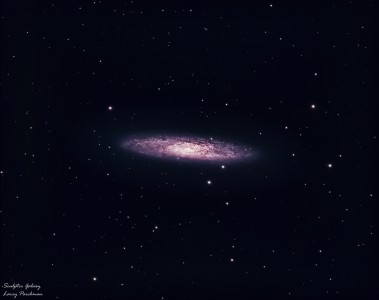
Image of the day

Captured by
Lawrence Parchman

Sculptor Galaxy (NGC 253)

My Account

New to Astromart?

Register an account...

Need Help?

Posts Made By: Alex McConahay

April 25, 2006 01:27 PM Forum: CCD Imaging and Processing/Deep Sky

Orion Rising in Palmyra

Posted By Alex McConahay

You know, I just realized that Orion was setting, not rising.......THis changes things!!!

Alex

April 25, 2006 11:22 PM Forum: CCD Imaging and Processing/Deep Sky

M81

Posted By Alex McConahay

Real prettyy, Jim

Alex

April 26, 2006 12:42 PM Forum: Beginning Astronomy?

Understanding Polar Alignment

Posted By Alex McConahay

Now, that is a very nice piece of work.

Alex

April 28, 2006 03:33 PM Forum: Equipment Talk

What accounts for poor seeing?

Posted By Alex McConahay

Astronomical "Seeing" is strictly stability of the stellar (or other) image. It is not related to clarity, brightness, contrast, or any of the other things that make stars look good. In other words, astronomical "Seeing" is only one part of "seeing" through a telescope.

Seeing is stable if the air masses in the atmosphere are stable. Different temperatures of air refract light differently. They also tend to move around as they try to equalize. As they move, the light from the distant star is bent one way and another. This causes instability in the seeing. Immediately after a storm and a cold front is moving through, for instance, the air is super clear and transparent, and the stars are very bright, but the currents and such make the stars very turbulent.

Seeing can be upper atmosphere (weather patterns causing large cells of air to move around in the upper atmosphere), local (heat generated by parking lots, cars, rooftops causing unstable air), or even in the tube (air circulating at different temperatures in the tube until it all equalizes). Wherever there is air to move around, there can be bad seeing.

It is an ongoing debate whether "seeing" is affected more in small scopes or large.

A 4 inch APO is largely immune from tube problems, and cooling/heating problems that can affect seeing.

However, it can still be afected by other kinds of bad seeing in the upper atmosphere, and by hot rooftops.

Alex

May 2, 2006 12:49 PM Forum: Beginning Astronomy?

Lunar Scope, Which Of These Is Best?

Posted By Alex McConahay

When you say disregard all that, it kinda makes the question into something like "not counting size and gas mileage, which can carry more of a load, a Honda Civic or a full size Ford F250 pickup?"

Alex

May 2, 2006 12:52 PM Forum: CCD Imaging and Processing/Deep Sky

Layer Techniques

Posted By Alex McConahay

Go here:

http://www.astropix.com/HTML/J_DIGIT/COMP2.HTM

for a good description.

Alex

May 3, 2006 06:08 PM Forum: CCD Imaging and Processing/Deep Sky

73P B Split Nucleus Movie April 23

Posted By Alex McConahay

Good Advice.

My comet movie is a lot larger, and it is composed of 60 frames of much shorter duration that yours.

(A full posting is down under Film and CCD images) To quote a part of it:
I used a Televue 85 on a G-11, guided on a star with an ST-4. Took 30 second pictures on the Canon 20D at ISO 1600. Used automatic dark frame noise reduction feature. Then I cropped to 640 x 480, and put the frames together in Windows Movie Maker. Total of 63 frames over an hour.

The movie is available at

http://users.adelphia.net/~alexmcconahay/SolarS/solarsindex.html
(it is 1.8 Meg, I believe)


Is anybody going to try to image this thing in a movie when it passes the Ring next Sunday night, I believe.....

Alex


Alex

May 3, 2006 07:19 PM Forum: CCD Imaging and Processing/Deep Sky

OT: How to save images for viewing on different mo

Posted By Alex McConahay

Exactly my problem.......I really would like to see your answers.

Alex

May 5, 2006 02:05 AM Forum: AstroMart FAQ

How do I read my Send Messages

Posted By Alex McConahay

When you are responding to an ad, there is a box to check that says "Send a copy to me" or something to that effect. If you check that, you will get a copy in our mailbox.

There may be other ways......Let's see what the others say.

Alex

May 6, 2006 04:48 PM Forum: CCD Imaging and Processing/Deep Sky

8"f/5 vs. 8" f/6

Posted By Alex McConahay

On extended objects (like nebulae) a faster focal ratio means shorter exposure times. However, on point sources, there is no difference for exposure times. (Increased aperture, however, allows better resolution and deeper (dimmer, more magnitudes) exposures.)

Alex
