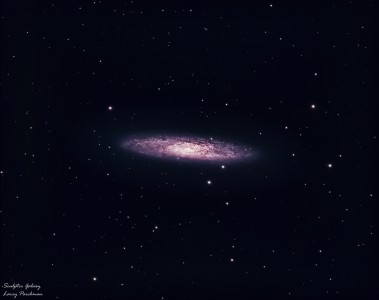
Image of the day

Captured by
Lawrence Parchman

Sculptor Galaxy (NGC 253)

My Account

New to Astromart?

Register an account...

Need Help?

Posts Made By: Alex McConahay

March 5, 2006 03:49 PM Forum: CCD Imaging and Processing/Deep Sky

Attempting longer subs.

Posted By Alex McConahay

James,

Interesting photo, and lots of potential detail. But one thing you said kinda disturbed me:

"but I spent the first couple hours just taking my darks, "

I'm not the world's best astrophotographer, but I hang around with some people who are very good. And they all take their darks later, rather than first. They have explained to me that if the getting is good, get the light exposures first. Save the dark exposures till when the clouds come, or the mount is screwing up, or when the dew is doing, or, if need be, till the refirgerator at home. The only important thing about darks is that they be at the same temperature (and ISO, time, etc.)as the light exposures.

Is there a reason you do your darks first, rather than later?

Alex

March 6, 2006 03:05 PM Forum: Beginning Astronomy?

primary and secondary scratches

Posted By Alex McConahay

The effect of light scratches is essentially non-existent.

If you see them because you are shining a flashlight on them, stop shining the flashlight on them.

Light scratches are generally caused by cleaning. That is why most people clean only rarely.

Can you have them taken out? Sure, but that will require a lot more money than they are worth. The mirror would need at least recoating, and if they are of any depth whatsoever, it will require polishing and refiguring.

Just don't worry about it.

Alex

March 6, 2006 10:55 PM Forum: Beginning Astronomy?

Replacing the secondary mirror???

Posted By Alex McConahay

It is not absolutely critical to have the exact match. As a matter of fact, there is some argument about just how big a secondary mirror needs to be, and the argument stems on decisions on what percentage you want fully illuminated.

These things come in somewhat standard sizes.

Measure how wide the mirror is at its narrowest point.

Meanwhile, one of the other members of this Forum will know (and please tell us) which of the many Forum sponsors sell secondaries.

Alex

March 7, 2006 02:04 PM Forum: After Dark

Sharing the universe with the youth.

Posted By Alex McConahay

Congratulations.

Our club (Riverside Astronomical Society), and many others, I am sure, consider such public outreaches one of the most important things we do. We do a couple a month.

Our Motto is "Bringing the joys of astronomy to the public." They think we are doing it for them, but actually it is a great kick for us!!!

Alex

March 7, 2006 02:29 PM Forum: Film Astrophotography - Imaging and Processing

The Solar Eclipse

Posted By Alex McConahay

Sure, just point and shoot. (And during totality, it is perfectly safe. More than a few seconds before or after totality, though, pointing a camera at it will put a hole in your eyeball. Also--if you are not familiar with eclipses--you must have some kind of solar filter IN FRONT OF lens when looking at the partial phases. You may not look through your viewfinder while wearing those plastic eclipse viewers and consider it safe.)

Problem is that you need a lens of something like 400+ mm to get a good image scale of the sun. And that seriously complicates focus, exposure, camera shake, etc.

For exposure information, and a good tutorial on eclipse photography, Google "Mr. Eclipse" and look to see what Fred Espenak recommends.

If you are not an experienced eclipse photographer, and therefore willing to sacrifice all for a photo, the first rule of thumb is: LOOK AT THE ECLIPSE. The best view during totality is with the naked eye, and the next best through a pair of 7 to 10 power binoculars. Camera viewfinder is nowhere close. Don't waste time with photography. (I, for instance, have a very complete exposure schedule worked out, with a two page checklist on what to do during the eclipse. It includes something like 108 exposures of the event from Bailey's beads to Bailey's Beads (about 4 minutes, 15 seconds).....and only twice in that cycle will I spend about five seconds looking through the viewfinder. All else will be simply by touch......while I am looking at the eclipse. If some dumb thing happens, I plan to still look at the eclipse and forget the camera.)

Your best bet with a standard Canon Digital Rebel, is to find a minaret if you are on land or a smokestack if you are on a cruise ship, and get a combined image of the minaret or smokestack in the foreground, eclipsed sun in background. Also, in the partial phase, get pinhole pics of eclipsed sun's image. And take pictures of the horizon, showing the sun shadow coming and going.

In short......the answer is yes. Almost any exposure, 1/1000 to 1 second (200 iso, F6.5), will get you something during totality. So click away.

But don't forget to look at the eclipse! and forget about the camera if something goes wrong with it.

One other piece of advice--take plenty of compact flash card(s) on the trip.

Alex

March 7, 2006 03:16 PM Forum: Equipment Talk

Moving device for a 12" Dob

Posted By Alex McConahay

The chipboard should easily stand the stress. The stresses are vertical, and I am assuming you are using through bolts, and not just screws.

Alex

March 7, 2006 04:07 PM Forum: Equipment Talk

Camera Lens to eyepiece connection

Posted By Alex McConahay

I've done it. They make for nice, short telescopes. THe way to do it is to get an adapter that has a bayonet mount for your camera lens on the front, and a standard 1.25 hole in the back for your eyepiece. They are available for the CCD folk who often use standard camera lenses for wide fields.

For non-demanding applications, you can also make one from the back cap of a lens (to substitute for the bayonet mount) and appropriately sized or drilled chunks of plastic, wood, or aluminum, or plumbing fixtures-----and lots of epoxy.

Alex

March 9, 2006 01:03 AM Forum: Beginning Astronomy?

Filters

Posted By Alex McConahay

Mark,

Before you go too far down the road with filters, remember that they cut down on the amount of light you will see. They work better with larger scopes. Of course, some day you will get aperture fever, and then they will come into their own. But right now, you may find them of limited usefulness. Others will, unodubtedly chime in on this. I must say this is something I have been told a few times to the point that I have never really tried an LPR in a less than 8 incher.

Alex

March 9, 2006 05:50 AM Forum: Beginning Astronomy?

"Quantum" step telescope apertures?

Posted By Alex McConahay

Stu,

While it is fun to speculate about why telescope blanks come in such a gradation, I think the idea has more to do with increments of 50 mm.

Now, how much do you need to jump in ortrder to see a difference? I don't hink that has been determined. In a camera, it was generally considered an F-Stop, which is the doubling of the amount of light hitting the film. Yet, through the years, camera have evolved settings of half and then third of an F stop.....So, I think there is no set answer. It is just a question of what you like.

I would, in general, I not upgrade from one aperture to another unless there were a difference of 1.414 from one to the other (A doubling of the light). But, that is only if aperture is the only thing I am considering. It may be the next step up is better crafted, or lighter, or something. But then I am not upgrading based on aperture anymore.

Alex


March 9, 2006 02:25 PM Forum: Digital SLR AstroPhotography

My first Astrophoto- Canon 20D

Posted By Alex McConahay

Good start to both Nathan and Steve. Keep them coming.

Alex