Image of the day

Captured by
Lawrence Parchman

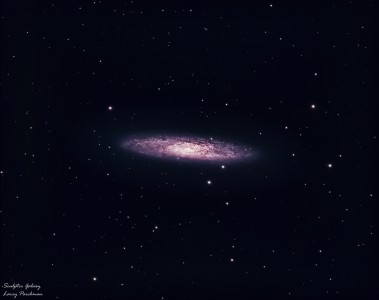
Sculptor Galaxy (NGC 253)

My Account

New to Astromart?

Register an account...

Need Help?

Posts Made By: Alex McConahay

February 5, 2006 04:46 AM Forum: Equipment Talk

Losmandy G11 cables help

Posted By Alex McConahay

Is this a regular G-11 or a Gemini.

If a regular:

As you say, RA and Dec are obvious. The other cable is the power, which goes in the proper hole on the electronics pad. It only fits in one place. Then you have the obvious hand controller, which goes in the RJ-11 jack (or RJ12???) on the electronics box.

Now, I assume the cable that you are talking about is the one that goes to the encoders. It has a plug on one end, and then splits, with two RJ11 (or 12) on the ends of the two cables. The large (I think eight conductor) end goes to the back of the computer (digital setting circles) box. Of the two split off ends, one goes to the RA, and the other the DEC controller. The longer one traditionally goes to DEC, but not necessarily. If they are the same length, just plug one end into Dec encoder. Turn on the DSC computer, pretend to align it by answering whatever questions the computer panel asks, and then set it to display position. Spin the Dec Axis on your scope. If the DEC readings on the computer change, (and you have connected to the the DEC encoder) then you have guessed correctly. If nothing spins, or the RA readings change, you have guessed wrongly. Just swap the connections and try again.

Now, if you don't have a DSC computer, or encoders--then I have no idea what the cable you are talking about is for.

Alex

February 6, 2006 04:06 PM Forum: Equipment Talk

gem question

Posted By Alex McConahay

My lxd55 counterweight bar is about fifteen inches long--and since the weight can sit at the end, it may hang a few inches past that. My G-11 is about 12 or 13 inches long. And when assembled, remember these things point to the ground, so they are less than that away from the pier. For instance, assembled, the G-11 bar itself is about 11 inches away from the pier, and with weight, the edge of a six inch weight, at the end of the bar (at 34degrees north) is about 13 or so inches away from the pier. All measurements are quick and dirty, and accurate only to an inch or two--(I mean I measured with a ruler, but I was not working real hard at it.)

But why are you are engineering something that tight?

You will need more room around the scope than just what you need for the counterweight bar.

Alex

February 9, 2006 05:25 PM Forum: CCD Imaging and Processing/Deep Sky

WhatsUp: What to know what to image tonight?

Posted By Alex McConahay

Looks nice. And easy to use.

I do the same thing using Excel and a database of objects. The database was pretty easy--just downloaded one from someplace. Then I can just filter for RA and DEC, and all the rest of the info is there.

Alex

February 12, 2006 07:51 AM Forum: Beginning Astronomy?

plan for amateur observatoire

Posted By Alex McConahay

Dominique--
Look into Sky Shed. (Google it to see what you get)
Also, try posting down in "Home observatories" Forum.

Alex

February 14, 2006 02:23 PM Forum: Solar System Observing

Red dot over the Moon

Posted By Alex McConahay

It does seem to be moving over the craters ever so slightly. However, it seems to be in the same place in relation to the frame itself. Therefore, it is probably something on the sensor of the camera itself. Probably a piece of dust or something.

Or a base for the Martians preparing to invade the earth. Although in the movies they usually stage their troops on the far side of the moon.

Alex

February 14, 2006 08:13 PM Forum: Refractors

What Makes a Doublet an APO?

Posted By Alex McConahay

There are two threads going on right now that are somewhat related. This thread, and the one about ED and Apos are confusing construction with results.

Achromatic and Apochromatic are measures of how much of a light comes to a focus at one point. With a normal lens different light comes to focus at different places. With Achromatic, two major colors focus at the same point, and with an apo, all three major colors focus together.

I have made an apochromatic telescope. Newts are generally speaking, apochromatic. They use neither ED nor Flourite, nor are doublet (meaning two lenses) or triplet (meaning three). However, by the nature of their optics, all colors come to the same point of focus--which makes them apochromatic.

To make a lens system apochromatic is more difficult. The refraction of one lens is generally corrected by the refraction of a different lens. And there is often a third lens that corrects the results of the first two. The net result is a cancellation of errors--and all three colors come to the same focus point.

The lensmaker can use shapes and materials to change refraction of the light. When the lensmaker uses glass with Flourite or other special materials, the lensmaker will emphasize that because some view that as a plus.......

In short--don't confuse the material (flourite, or Extra-low Dispersion (ED)) with the result (where the light focuses.

Alex

February 15, 2006 12:15 AM Forum: Beginning Astronomy?

Need help teaching children

Posted By Alex McConahay

Everybody needs help teaching!!!

What age--What brings them together? Are they a club, a camp, a what?

Where are you going to be doing this?

How long will you be teaching them (once a week for an hour, all summer long every evening)?

Alex

February 15, 2006 02:40 PM Forum: Off Topic Discussions

Physics question.

Posted By Alex McConahay

What the conveyor belt is doing is immaterial. What matters is the windspeed over the wings.

The "conveyor system" can move in whatever direction it wants. As long as the plane is free to roll along, and is not controlled by the conveyor, then it builds its own airspeed. This builds windspeed and allows it to take off. Until it loses contact with the conveyor system, it's wheels may be rotating a lot faster than it would without contact with the conveyor system. But, that does not control it's ability to take off.

Now, if the conveyor belt actually controlled the AIRspeed (and thus windspeed) of the plane, then things would be different.

Alex

February 15, 2006 08:53 PM Forum: Off Topic Discussions

Physics question.

Posted By Alex McConahay

Okay--Situation may be different from when the question was first posed.

You are saying that the plane cannot move forward.

We need to establish some points here or we are stuck in a question of relativity.

The plane cannot move forward relative to what?

Let's build a conveyer belt covering the whole east-west runway. Paint two big dots, a green one and a red one on the conveyer belt right in front of the control tower. Place an airplane on the green dot and a car on the red dot.

The control tower--which is not on the runway or conveyer belt-- stays put. We call that point directly in front of the control tower POINT ZERO.

Now the car and the airplane start to run. Simultaneously the airplane's engine and the cars engine start to drive the respective vehicles west at what should be 200 miles per hour (relative to POINT ZERO). The conveyer bels is dong nothing. Both vehicles move forward (west) at 200 miles per hour relative to POINT ZERO. They leave their respective dots (which are parked at ground zero because the conveyer is not running) behind at that rate.

Now, let's run it again with the conveyer belt. We start the car and the airplane off again to the west at 200 miles per hour. But the COnveyer belt starts to run east at precisely the same time at 200 miles per hour (or 200 miles per hour to the east). SO, the car engine and the airplane each speed up to 300 miles per hour worth of output west. But exactly simultaneously, the conveyer belt speeds up also to 300 miles per hour east.

Is this the situation you are describing?

In this situation, The dots on the conveyer belt are next to each other heading 300 miles per hour east in relation to POINT ZERO. The car is going three hundred miles per hour west in relation to its red dot, and zero miles per hour in relation to the control tower at POINT ZERO. The airplane is going three hundred miles per hour west in relation to the automobile and the control tower at point zero, and six hundred miles an hour west in relation to its green dot.

Now, let us posit another example--the one that you were imagining it appears: Let us say the the conveyer belt is now going to head east at exactly whatever rate the plane is travelling west. If the plane speeds up to a million miles an hour west, the conveyer belt with its little dot will be heading a million miles an hour east.

Unless the conveyer belt itself is attached to the airplane, and vice-versa, then it does not matter how fast the conveyer belt is going. Planes are not attached to conveyer belts.

It is as if you are asking the question: "If I had a perpetual motion machine, could it stay in motion forever." Well, by definition, yes. But, of course, there is no such thing as a perpetual motion machine.

(Note, all of this gedanken experiment assumes efficient wheels and engines, and that there can actually be matching accelerations, and so forth.)

Now, let us posit more than just a conveyer belt. Your conveyer "system" includes the air mass around the airplane. Now, you race the airplane west at exactly 600 miles an hour, but (relative to some imagined external reference point) it appears to be staying perfectly still because everything else out there is moving exactly east at exactly the same 600 miles per hour. That everything includes an airmass that must move east at 600 miles per hour, and if the plane is staying fixed in space, with a six hundred miles per hour headwind, it will fly. So, the plane flies.

Fact is, if the air of sufficient density is flowing with sufficient speed over properly designed wings, the airplane will lift. Whether that airflow comes from the plane moving through the air or the air moving past the wing (after for instance, being forced by a fan in a wind tunnel), the wing will lift the plane.


Alex

February 16, 2006 03:54 AM Forum: Beginning Astronomy?

Are 8" Dobs hard to track with?

Posted By Alex McConahay

I don't even think about "tracking" when using my dobs. (assuming you mean, just following an object as you are observing)

It is all very automatic with any experience. Even at high power, it is fairly easy.

Now, if you are sketching or photographing or something, it is a different story.

Alex