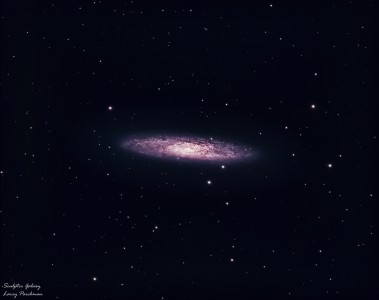
Image of the day

Captured by
Lawrence Parchman

Sculptor Galaxy (NGC 253)

My Account

New to Astromart?

Register an account...

Need Help?

Posts Made By: Alex McConahay

November 17, 2005 07:36 PM Forum: Beginning Astronomy?

Focal ratio Vs. Application

Posted By Alex McConahay

>> Also, how does f ratio effect magnification.

The focal ratio itself does not affect magnification. (That is, you cannot tell how much magnification an F 4.5, for example, will give you.) However, FR is calculated in a simple formula of:

focal length / aperture = focal ratio

And FOCAL LENGTH does affect magnification. The longer the focal length, the more magnification for a given eyepiece. Therefore, WITH A GIVEN APERTURE, making a longer focal length will give you a longer focal ratio and more magnification. This means with a given aperture, a longer focal ratio will give you more magnification.

>>It seems that "planetary" scopes have high f ratios(a TEC 8 is around f/12) while some APO refractors are running around f/5 or f/6.

The planets are fairly bright objects that need a lot of magnification. Therefore, they benefit from the longer focal length, and don't need as much aperture. Apply the formula for FR, and you can see that means a higher focal ratio is OKAY. In addition, with a longer focal ratio, it is easier to remove chromatic abberation, false color. So, a relatively inexpensive achromatic telescope can function very well as a long focal length (and long focal ratio) planetary scope. An APO, however, does not need the longer focal ratio to overcome the false color problem so you can use them at slower, wider f ratios. And, since they are often better made, you can go ahead an use a shorter eyepiece to get the magnification equivalent to a longer focal length achromat.

>>but why is a high f scope slow to collect an image on a film/ccd-i

I'm not sure what you mean by "high f scope." The F10 scope has a higher F number, but I am not sure that makes it a high F scope. Most photographers would rather use a low F ratio scope (smaller F number) if possible since it shortens the exposure time. But for planets, for example, you will get ridiculously high equivalent F ratios (take a long F ratio scope like an SCT at F10, and then put a Barlow in it, making it F20 or slower) to get the magnification. At any rate, as to why the F ratio matters to a photographer, just realize that all the light you can get to your CCD, or Film, or other sensor, comes through the front of the scope (aperture). At that point, you have X number of photons to make an impression. If you magnify that light by a factor of two you will have one fourth of that number of photons on a given area of sensor. The lower F ratios magnify the light less. (Or, for a given focal length, have much wider aperture to let in more photons..)

Alex

November 17, 2005 11:09 PM Forum: Equipment Talk

Travel scope for a trip to Africa...

Posted By Alex McConahay

Get a good tripod and a three inch APO, and just pack it well and deal with the transportation issues. They only matter a little bit, compared to the amount of time you have to use the rig. (If you were travelling, I would have a different answer--but you are planted for three months....) Also take a good pair of binos--I assume they will come in handy with animals.

Alex

November 20, 2005 07:56 PM Forum: Equipment Talk

Diffraction Limited Optics

Posted By Alex McConahay

Dave,

I agree with most of the discussion that has been going on here--But you will notice that the thread has broken into two areas. The first is your original question--What does "diffraction limited mean?"--as in "explain the concept." The second part of the thread is "What number do we assign to "diffraction limited?" As in "1/4 wave, 1/8 wave--what?"

To answer the first part of this--this is my take:

There are four things that will limit viewing:

1. Viewer Limitations: These are physical and or experience limitations of the viewer. If you have bad eyes, or not much experience, then you won't be able to see very well no matter what you use.
2. Viewing conditions: If the atmosphere is unstable, or there is a lot of light pollution, or clouds, or the mirrors/lenses are not thermally equalized, or whatever, you won't be able to see very well.
3. The quality of the instruments. And there are perhaps two parts here, a) the optics themselves, and b)how the optics are used. a) the optics themselves include the accuracy of the lens or mirror designs, the production of that lens or mirror or other optics (These are the factors that would earn the optics the designation "diffraction limited or not.). b), How the optics are used, would include the stability of the mount, collimation, cleanliness, and all that of the telescope assembly (These factors would not qualify as a good judge of "diffraction limited," because they depend on the user and the non-optical parts of the assembly, and not the optics themselves.).
4. The physics of optics. And this starts with the fact that light does not in fact travel in straight lines, but instead is "diffracted" around edges, and therefore slightly scattered.

So, with this framework in mind, "diffraction limited" means the physics of optics are in fact the limiting factor in how good the image will be. All the other errors of the optics (color abberations, different focusing points for different parts of the optics, whatever) are smaller than the errors introduced by the fact that light diffracts.

Now, notice that this definition only applies to the optics (Those parts that I listed in part 3A above.).

What is the point at which diffraction limits optics? That is the second part of the discussion in this thread.

I don't know the actual optical physics, but here is what I do know:

The Rayleigh criterion specifies that if the actual wavefront, after reflection, differs from perfection by less than ΒΌ wavelength of the color of light that the eye is most sensitive (560nm), then the image formed can appear essentially perfect. "After reflection" means the mirror surface error must be no greater than 1/8 wave. The reflection doubles the surface error. This, of course is an ideal situation, and assumes there are no other contributors to image deformation in the light path. (see Suiter, H. R., Star Testing Astronomical Telescopes for the definitive work on image aberration).

Therefore, we talk about a "1/8 wave" mirror or 1/4 wave lens as a good approximation of the Raleigh criterion.

But, of course, if you go back to my earlier exposition of the four limitations on viewing, there are the viewer limitations, the viewing conditions, and half of the instrument conditions that may affect your viewing more than the quality of the optics or diffraction. And that is the source of the controversy on the numbers.

Or at least that is what I think.

Alex

November 20, 2005 08:03 PM Forum: Digital SLR AstroPhotography

Purchasing Scope for 20d AstroPhotography

Posted By Alex McConahay

You would probably be happier with a 600 or 700 mm focal length refractor if that is the only kind of photo you wish to take. (Notice that this is a wide-field photograph.)

The more important decision with most astrophotography is actually the mount. It must be stable, smooth, and capable of being "guided" (sped up or slowed down).

Google "Astrophotography" and cruise the websites.

Alex

November 22, 2005 05:35 AM Forum: Solar System Observing

Venus (?) in the afternoon

Posted By Alex McConahay

Yeah, that sounds about right. However, I would expect it to be a bit further west than you describe. (It should be about 30 egrees--two hours--behind the sun). But all things considered, I'd say you saw Venus--

Although, Altadena is awfully close to JPL, and they do run certain experiments now and then!!

Alex

November 25, 2005 01:48 PM Forum: Beginning Astronomy?

Does Lens Cleaning Fluid Freeze?....

Posted By Alex McConahay

Doug,

What do you have on your fingers that could knock out a whole evening of viewing with just a fingerprint?

Alex

November 25, 2005 11:44 PM Forum: Solar System Observing

Solar Viewing Tips/Need to Know Stuff

Posted By Alex McConahay

The hardest part to solar viewing is finding the sun. ONe thing to remember is that you want to minimize the size of the scopes shadow on the ground. And always start with your widest field eyepiece.

Alex

November 27, 2005 05:08 AM Forum: Beginning Astronomy?

ZIPPER

Posted By Alex McConahay

Your nearest fabric store has more than you can possibly imagine.

Alex

November 30, 2005 04:43 PM Forum: Telescope Making

Mirror FL

Posted By Alex McConahay

Depends on how accurate you need it.

The saggitta measurement (drill and straightedge) is a little fickle, since it requires very accurate measurement of small distances to get an accurate focal length.

For most accurate, set up a knife edge and slit light source like a Foucault Tester.

A much easier way would be to have you and an assistant go outside on a sunny day with the mirror and a tape measure. Reflect the sun onto a wall. Move the mirror in and out until the sun is as small as it can get. Measure the distance between the mirror and the wall. That is the focal length. Note that the images will be at a slight angle, which can be minimized by catching the sun from just outside the shadow of the wall. (Be careful you don't keep the sun focused long enough to start the house on fire. Incidentally, if you have a trail of ants going up the side of the wall, and a coated mirror you can be a telescope maker and a bug exterminator at the same time!) (You can also do this with the moon, but it doesn't kill bugs very well.)

A third way involves setting a lamp next to a wall. Use the mirror to reflect the light of the bulb back against the wall. When you see the lightbulb in focus, you are at the Radius of Curvature, which is twice the focal length.

On any of these tests, if the mirror is polished, you should see something. You can wet the mirror to improve reflection. If the mirror is coated, no such thing is necessary.

Alex

November 30, 2005 04:45 PM Forum: Telescope Making

Mirror mounting

Posted By Alex McConahay

Silicon Blob is fine for relatively small mirrors.

As for thickness of spacers, I use nails. It think 16 penny, but cannot remember.

Alex