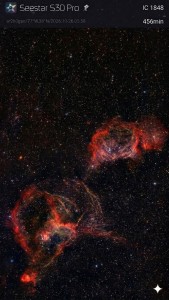
Image of the day

Captured by
Arthur Hogan

Heart and Soul Nebulas

My Account

New to Astromart?

Register an account...

Need Help?

Posts Made By: Mike Ratcliff

January 26, 2006 10:28 PM Forum: Beginning Astronomy?

10 Favorite Targets in the January Sky

Posted By Mike Ratcliff

Nice thread!

I get a kick out of the Tau Canis Major cluster, NGC 2362. It's an open cluster with a bright star in the center (Tau) with a swarm of dimmer cluster stars very close by. Must see.

I surprisingly did see "Thor's Helmet" in suburban skies with an OIII filter (and 16 inch aperature). It's an emission nebula in the upper part of Canis Major, NGC 2359. Filter is necessary where I live. Good guide stars are a bit lacking for suburban skies.

Edited to say the Tau Canis Major cluster should be reasonably easy to find for beginners after they have found M41 and M93 in the area, you would need a chart that shows Tau at least. But Thor's Helmet would be more challenging.

Mike

March 21, 2006 04:40 AM Forum: Eyepieces

9mm Nagler Type ??

Posted By Mike Ratcliff

Tom Trusock on Cloudynights.com has a good review article on the various Nagler types. The main features of the newer Type 6 Naglers are more modern glass types and coatings, lighter weight, and a uniform 12mm of eye relief. Type 6's are 13mm in focal length and smaller.

Mike R.

April 19, 2006 10:13 PM Forum: Eyepieces

So, how many have the Siebert Observatory EPs?

Posted By Mike Ratcliff

Floyd Blue said:

I am interested in your impressions for the 34-36mm Siebert Observatory EPs.

Floyd, I received a used 34mm Siebert Observatory eyepiece yesterday, purchased for $149. And strangely enough was able to use it last night. In the light polluted backyard, with the 16" f/4.9 dob. The air was cooling down fast. I have a 3" fan blowing upward into the mirror back, but there were some some thermals evident when defocusing. Seeing wasn't too bad. Saturn showed the Cassini division pretty easily at 100x-150x with other eyepieces. Collimation was checked with Tectron tools.

I don't have a 35mm Panoptic for comparison, only a 32mm Televue plossl.

First impressions: the coatings are minimal, in fact I couldn't see any of the blues, greens and purples you would normally see on Televue and other premium eyepieces. However when viewing against a 32mm Televue plossl I could not see any obvious contrast differences. But mind you it was not a dark site.

It does provide a better FOV than the plossl, but I'm suspicious of the 70 degree AFOV value, seems much smaller than the two Naglers I have now.

Sharpness: the central area is very sharp. But I was seeing astigmatism in the outer areas, but so does the plossl. I didn't see the totally sharp stars all the way across like the other poster on this thread, at least for brighter stars. I used to have a 35mm Panoptic and remember there being less astigmatism.

It is light and easy to handle, seems reasonably well made.

For now it's a keeper due to the wider FOV, especially for $149.

Mike

May 5, 2006 04:05 AM Forum: Deep Sky Observing

H-beta objects in the summer sky?

Posted By Mike Ratcliff

I've read the Cocoon Nebula in Cygnus does well with H-beta.

May 20, 2006 06:54 PM Forum: Eyepieces

Collecting eyepiece data

Posted By Mike Ratcliff

I have a personal spreadsheet, as do many others I'm sure.

Included are:

focal length (mm)
apparent field of view (deg)
eye relief (mm)
weight
barrel size (1.25" or 2")
price
type

If you know your telescope focal length and aperature, you can then calculate:

focal ratio = telescope focal length / telescope aperature

magnification = tele focal length/eyepiece focal length

true field of view = apparent field of view / magnification
(Note this equation is approximate but good enough for selecting eyepieces)

exit pupil = telescope aperature (mm) / magnification
or
exit pupil = eyepiece focal length / telescope focal ratio

Some rules of thumb:

magnification > 50x aperature in inches are difficult to achieve due to atmospheric conditions and quality of scope. This is the same condition as exit pupil less than 0.5mm.

Exit pupil > 7mm can be problematic for telescopes with central obstructions like newtonians and SCT's.


There is a large downloadable eyepiece database on the CloudyNights site.

Mike

August 3, 2006 01:34 AM Forum: Equipment Talk

Mirror Evaluation

Posted By Mike Ratcliff

Also Ed Stevens at Stevens Optical

August 7, 2006 11:13 PM Forum: Eyepieces

I stand corrected

Posted By Mike Ratcliff

Floyd, Your reviews were fair and useful to me.

I think we now know why Sky & Telescope rarely reviews eyepieces. Two years ago S&T gave a mixed review of the TMB Supermono, and, holy cow, the internet feedback was intense.

The review was subjective. So the Japanese magazine style quantitative testing (Roland) seems like a necessity for a magazine and would be great if that were done in the US too.

Mike

August 9, 2006 07:41 PM Forum: Beginning Astronomy?

ARRR....eye patches for viewing?

Posted By Mike Ratcliff

I tried an eyepatch but ran into a few unexpected snags.

I need glasses when using the Telrad (I'm nearsighted).

Turns out I couldn't wear the eyepatch and glasses at the same time, so the logistics got crazy. Would have to put on the eyepatch only after finding the object. A ski cap would also be a complication, having to take off the ski cap before putting on the eyepatch, each time I found a new object.

Another surprise was that with the eyepatch, my balance and visual acuity one-eyed was poor. A bit scary climbing a short ladder or going down the ladder to get a new eyepiece.

It would be OK once settled in for a long view.

But with those complications, I have just gone back to squinting.

Obviously, others' experiences may vary by quite a bit. With the very low cost of the eyepatches, it is worth a try. Maybe I'll give it another try.

Mike

August 11, 2006 06:09 PM Forum: Telescope Making

What size tube for a 6" mirror?

Posted By Mike Ratcliff

My older 1996 Orion DSE built by Discovery has a 7" diameter sonotube, and it has cooling problems. (The particle board cell doesn't help, that's for sure.)After installing a fan at the bottom, the narrow space between the tube and mirror was a problem. Switched to a cross-flow arrangement.

I would go with the 8".

I have seen a local 8" f/8 scope with an open cell and a wider tube, and it cools down pretty well without a fan.

September 8, 2006 08:38 PM Forum: Telescope Making

Who is this "new" commercial mirror maker?

Posted By Mike Ratcliff

Ed Stevens is relatively new and used to work for Carl Zambuto.