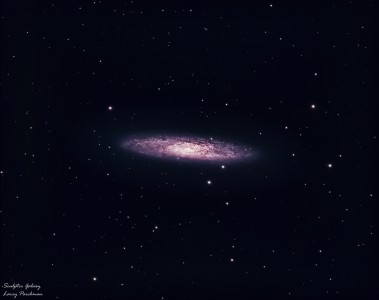
Image of the day

Captured by
Lawrence Parchman

Sculptor Galaxy (NGC 253)

My Account

New to Astromart?

Register an account...

Need Help?

Posts Made By: Alex McConahay

May 6, 2005 01:18 AM Forum: Beginning Astronomy?

Which guider?

Posted By Alex McConahay

Off Axis Guider and Flip Mirrors do two different jobs.

A Flip Mirror simply allows you to change from one imaging sensor (usually your eyepiece and eyeball) to another (the camera). You use it in one position to center the object in the eyepiece, and then flip it to the other to take the picture in the camera.

An Off axis guider, on the other hand, sticks a little prism or mirror into the light path (in a part not usually used by the cameras) and "picks off" the guide star, to send it to the reticle eyepiece (and your eyeball or autoguider). The camera can see the field of interest, and the eyeball (or autoguider) can see the guide star----at the same time.

In short, the Flip mirror is used to find and center, and then "turned off." The Off axis guider is used throughout.

As to which one to buy--I think I'll let others answer for a while first.

Alex



May 6, 2005 01:06 PM Forum: Digital SLR AstroPhotography

20D for Dummies

Posted By Alex McConahay

Mike,

If you are looking for regular daytime settings, just set it on automatic (the little green box). It will do all the thinking itself. If you are looking for astrophtography, you will be using manual, and up to 30 seconds to start for deep sky. Skip noise reduction at first. And of course, there are lots of options after that.

As for DSLR Focus. I bought it a few months back, but was not until yesterday that I first got it to work. Yesterday Chris Venter and a fellow named Craig apparently completed a revision of the software that allowed the 20D to work with an SP2 computer. Until then one had to use a difficult work-around to overcome some incompatibility of 20D and SP2. I have not tried it on a star, yet. (Nor has any other person with a 20 D and an SP2 computer.)


Alex

May 9, 2005 02:21 AM Forum: Equipment Talk

Re: GOTO System for C9.25?

Posted By Alex McConahay

What kind of mount are you using? (Sorry, I cannot tell from the description C9.25.)

A much less expensive alternative is digital setting circles, whcih can generally be had for $300-400 dollars new.

Another alternative is a used Meade LXD 55 or mount, although it would be stressed for anything as big as a C9.25.

Alex

May 13, 2005 10:48 PM Forum: Beginning Astronomy?

German equatorial mount weight capacity

Posted By Alex McConahay

The rating for a given mount does not include the counterweights. However, be aware that it includes more than the optical tube. You will also be putting finders, diagonals, and maybe a camera on it. They count as the load also. Secondly, the manufacturers get to make up their own numbers. WHat they rate the mount as may be liberal or conservative. (It will rarely be less than the mount can actually hold.) At any rate, there is no standard for what the rating is, and therefore the buyer must beware when comparing measurements from one manufacturer to another. And Finally, your demands may not be the same as their rating system. A mount that is to be used for astrophotography should have "excess capacity."

Alex

May 15, 2005 01:45 PM Forum: Equipment Talk

V-Blocks and Secondary Spots

Posted By Alex McConahay

>>If so, what is a source for v-blocks,

Go get a small piece of wood, as thick as you can find, and a saw, and cut the wood in the shape of a 90 degree V.

>>and how do you use them?

If you have a vice, stick the wood in the vice, with the open ends of the "v" pointing up. If you don't have a vice, just put the block of wood on a counter or table top (with the open end of the "v" up).

It would be nice if the laser were cylindrical the whole length, but you know it has to be round at the very bottom where it inserts into the focuser tube. Put this round part, so it nestles in the v, turn the laser on, and look at the wall a few feet (or more if possible) away.

Now rotate the collimator, and see if the spot moves. If it stays still, the collimator is collimated. If not, not.

If you need to adjust, turn the adjusting screws some, and see how it affects the beam. Adjust, and repeat until the laser point on the wall does not move as your rotate.

>>What kind of "target" do you use

The target is a blank wall. You could put a post-it note on the wall with a pencil mark to show where the laser is hitting. But it isn't necessary.

>>and how far away should it be?

I don't know that it matters much, I would try for at least three or four feet. THe further away, the more movement you get from any error (which is good), on the other hand, that movement is further away for you to see.

>>Also, is it that critical to center-spot a secondary mirror for collimation?

I would say that if you are using a laser collimator it is part of the procedure to center spot the primary, but not needed for the secondary.

Of course this assumes you have already centered the secondary under the focuser (or properly offset from the center if you really want to be right on. This can be done with a standard non-laser collimator, or a film can, or by eyeball.

>> It's easy to make a paper template and center-spot a primary, but what about for an elliptical secondary?

I've seen the secondary template it in some ATM book. (Kriege's Big Dob book if I am not mistaken). But I don't think you have to center spot the secondary.

>>And, if I you have a sonotube dob instead of an open tube, how can you even see if the laser is hitting both dots or circle on both mirrors at the same time by looking in the end of the tube?

Yes, remember that you can see the reflection of the secondary in the primary, so just look at the primary to see where the laser is hitting the secondary.

>>Do people really spot their secondary?

Yes, some people do. I don't.

By the way, lasers shine right through a spot. However, my primary usually has a donut instead of a black spot to maintain maximum reflectivity.

Alex


[/QUOTE]

May 16, 2005 12:03 AM Forum: CCD Imaging and Processing/Deep Sky

Antares widefield

Posted By Alex McConahay

Greg,

What imager did you use, what ISO if digital camera, etc.

Alex

May 16, 2005 04:41 AM Forum: Equipment Talk

Godzilla Grease

Posted By Alex McConahay

Does this "Special Need" involve an upcoming sale ad on the Astromart Classifieds?

(And no, I don't know the name of the grease.)

Alex

May 19, 2005 03:16 PM Forum: Beginning Astronomy?

Not a stupid problem

Posted By Alex McConahay

Yes, it can be removed, cleaned, and replaced. However, it is s delicate operation, and must be replaced exactly as it came off, including rotation of the corrector plate.

How can the insie of a corrector plate become "filthy?"

Alex

May 22, 2005 04:43 PM Forum: Telescope Making

Tile Tools for mirror grinding

Posted By Alex McConahay

Sometimes they do, sometimes they don't. It is not at all home depots. Just call around.

Alex

May 23, 2005 08:51 PM Forum: Beginning Astronomy?

Beginner Astrophotography Telescope

Posted By Alex McConahay

To go deep into astrophotography, you need to spend quite a bit on the mount. Sorry to say, it is probably more than you have budgeted. Actually, about twice what you have budgeted.

However, if you are not going that deeply into it, you can get by with a good mount for about the amount you have budgeted. I would suggest you look into the Great Polaris class of scopes, and try to find one used.

After that, I would suggest you go with an SCT, and the type you mentioned would be good all around starter astrophotography scopes. Some scopes might be better at some objects, but the strength of an SCT is its flexibility. It gives good images, and can handle most of what you put on the back end for imaging.

Alex