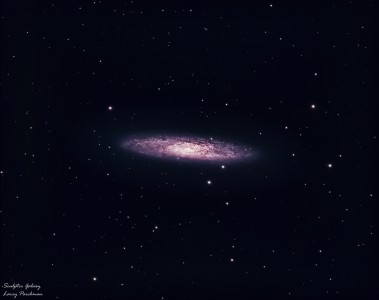
Image of the day

Captured by
Lawrence Parchman

Sculptor Galaxy (NGC 253)

My Account

New to Astromart?

Register an account...

Need Help?

Posts Made By: George Golitzin

January 21, 2006 06:27 PM Forum: Equipment Talk

Mirror Recoating

Posted By George Golitzin

Lynn--
L&L are in Mission Viejo and are generally recommended by others here, though I have no experience with them:
http://www.llopt.com/

I have found Clausing's beral coatings to be an excellent value:
http://www.clausing.com/main.html

George


January 30, 2006 06:23 AM Forum: Equipment Talk

Celestron ED80 focal length question

Posted By George Golitzin

Hi Tim--
Are you using a low profile 2/1.25 adapter on your 2" diagonal? Also, are you near-sighted at all? I ask, because on my garden variety orion 100mm f/6 (which uses the same tube, I think, as the 80ed), I can only reach focus on my 1.25 naglers if I use a low profile adapter, which I have to borrow from the focusers on my newts. Also on certain 2" eps I can only reach focus if I leave my glasses on--there isn't enough in travel to compensate for my near-sightedness. Guess I'm interested in the same question...I've seriously contemplated shortening the tube, but it's a little scary.
George

February 6, 2006 05:43 AM Forum: Telescope Making

Telescope design

Posted By George Golitzin

Hi Floyd
Funny that looks like a 14" scope I owned once. Here it is--originally it didn't have those ugly diagonal trusses, but instead 2 more aluminum rings which I removed to lower the cg. After I removed them it was way too springy--not sure if your design might wobble too. I also thought about converting it to a split-tube right at the altitude bearings but never got around to it. (the scope was so ugly after I did the mods I called it the Kluge. But it did have a nice pegasus mirror.) I don't think the slip tube thing is that important beyond helping to position the two pieces--there should be plenty of rigidity just from the mating of the rings, provided they're reasonably beefy. The problem is in the parallel tubes. Not sure your single ring in the middle of the upper cage would suffice. Parallel tubes tend not to work unless they're big, as in albert highe's scopes.
-George

February 6, 2006 06:05 AM Forum: Deep Sky Observing

Red Barber and the Virgo cluster

Posted By George Golitzin

Kim, your posts always make me drool. But then I remember a picture you or someone else posted several years back and I come to my senses! Do you have any relation to this 40" f/5 on swayze's site?
http://www.europa.com/~swayze/photo/40inchgm.jpg
george

March 3, 2006 12:26 AM Forum: Beginning Astronomy?

Re: Seeing some deltails in galaxies?

Posted By George Golitzin

Mike--

Just to echo the above replies--in what passes for a dark site (mag 6), it really does take about 12.5" to see much detail in something like m51, but at a really dark site (I mean black on the light pollution map that the sky clock links to, for example http://cleardarksky.com/lp/FcklHllObCAlp.html ), I've seen in an 8" m31's dust lanes and spiral structure in m51 and m33, and in a 4" refractor the lane in m104. It's amazing what contrast is available at a truly dark site. So to some extent, aperture is a compensator for the loss of contrast due to light pollution.

The other thing is, once you've seen the details in a large scope you learn how to see them in a smaller scope--that might be part of Floyd's experience too, regarding what he said about his 10". On the other hand, every gain in aperture yields some gain in detail.
George

March 3, 2006 08:14 AM Forum: Beginning Astronomy?

Mirror differences.

Posted By George Golitzin

OK I'll have a go at this one--we're talking about the reflective properties of conic sections. For a parabola, all incoming rays parallel to the axis are reflected to a single point, called the focus. Parallel rays at an angle to the axis are not so tightly focused, with the aberration increasing as the angle increases (coma). But with a sphere, even the rays parallel to the axis fail to focus on a single point, and the smear enlarges as the distance from the incoming ray and the axis increases (spherical aberration). (However, for a small portion of a sphere the reflected on-axis rays cluster near the point on the axis 1/2 of the distance between the center of the sphere and the sphere itself.) Thus a sphere is able to provide a decent image only if a very small portion of the sphere, relative to its radius, is used (high f/ ratio). Consequently, a 4" f/10 spherical mirror can be ok (and many inexpensive scopes are built that way), but at any shorter f/ ratio it is imperative that the mirror be parabolic.
George

p.s. For an ellipse, all rays emitted from one focus get reflected to the other focus (whispering galleries, ultrasonic kidney stone smashers). The circle is a special case of the ellipse: all rays emitted from its center get reflected to the center. For an hyperbola, all rays headed toward one focus from "outside" one branch get reflected to the other focus (the secondary of a classical cassegrain). Sorry, I'm a math teacher...

August 12, 2006 07:26 PM Forum: Telescope Making

Balancing Act

Posted By George Golitzin

Hi Jim--

I have a PhD in math and I don't bother to calculate the CG--I like Bill and Tom's approach better. With your short (f/4.3) mirror it will not be hard to get your scope balanced. As a rule of thumb, the distance from the center of your bearings to the secondary should be about 3 times the distance from the center of the bearings to the mirror--just build it and find where to hang your bearings when the whole thing is done. Also there's no law that says the center of the bearings has to be right at the top edge of the mirror box. As for the plywood thickness, my advice is to keep it light--1/2" is plenty thick; the bearings should attach with bolts, not screws anyway, and it's the gussets/corner braces (whatever you call 'em) that give the box its rigidity, not the thickness of the plywood. My $.02

Good luck!

George

August 19, 2006 11:01 PM Forum: Deep Sky Observing

8 inch SCT vs 12 inch SCT for galaxies

Posted By George Golitzin

Hi Mike--
I observed with an 8" sct for a long time, and occasionally borrowed my community college's lx200 12". There is a huge difference. You'll see the dust lanes in m31, the spiral arms of m51, with luck and persistence, the spiral arms of m81; one of the nicest views of ngc 4565 came in that 12" with a 24 panoptic: great contrast, bright, central bulge and dust lane very clearly delineated.

BUT, if visual observation of galaxies is really your thing, you should get a 15" or bigger dob, IMHO. You could pick up a discovery 17.5 truss here for about the same money, and have 3/4 the focal length with double the light of the 12" meade.

George

August 21, 2006 12:30 AM Forum: Pictures of Me and My Telescope and........

My "New" Spotting Scope

Posted By George Golitzin

Hey Lee, where were you when we had that "ugliest scope ever" thread? You've got a coupla serious contenders there!

A thing of beauty is a joy forever. grin

--George

September 22, 2006 05:17 AM Forum: Telescope Making

It...Is...ALIVE!!! First Light Report LONG

Posted By George Golitzin

Congratulations Bill!

I'd love to see a pic of the assembled scope.

I'm curious, how does the scope do vibration-wise at lower altitudes? Is there a long decay below 45 degrees, say, when you rap on the tube? I ask because I found it necessary to add braces to my alt bearings along their diameters, which like yours were simple arcs with no bracing originally. They looked cool but I finally had to admit they were acting like giant springs. Now the scope is a lot stiffer.

Anyway, best wishes and I hope you enjoy the fruit of your labor.
George
