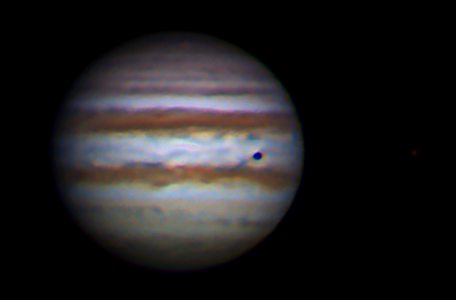
Image of the day

Captured by
John Roach

Jupiter IO Transit 12-10-26

My Account

New to Astromart?

Register an account...

Need Help?

Posts Made By: Curt Renz

January 29, 2005 03:20 AM Forum: Solar System Observing

February Astronomical Calendar - Wallpaper

Posted By Curt Renz

I've created a February astronomical calendar that can be downloaded as your computer's desktop background wallpaper or printed to paper. The Moon is the main feature. Information on planetary visibility is included.

To see it, click:
http://www.curtrenz.com/astronomical.html

For those interested in details, read on. Most of the information on the calendar is topocentric and assumes that the observer is located at the Adler Planetarium in Chicago. Although, it should well serve those in most northern hemisphere locations.

Each daily Moon image is depicted as it would appear on the night of the two dates it straddles. That includes the orientation of the illuminated portion. Specifically, a waxing Moon is shown as it would appear midway between sunset and moonset. A waning Moon is shown as it would appear midway between moonrise and sunrise. The effects of earthshine and the oppositional flash are also demonstrated.

The phases shown at the bottom of the page are calculated to conform to more intuitive definitions rather than the simplistic ones that were necessary in the age before computers. Dark Moon is the moment during the monthly cycle in which the apparent lunar disk is least illuminated. Full Moon is when the disk is most illuminated. Half Moon comes when the disk is 50% illuminated. The fraction illuminated is printed under each image.

Only the apogee and perigee data are geocentric: kilometers from center of Earth to center of Moon. Otherwise, this information might seem somewhat chaotic as the Earth's rotation causes a daily oscillation of the distance between a surface based observer and the Moon.

Here are the meanings of the planetary visibility tables. For this explanation the horizon has been divided into two halves, eastern and western. A Morning Star is a planet which at sunrise is either above the western horizon or at least 10 degrees above the eastern horizon. An Evening Star is a planet which at sunset is either above the eastern horizon or at least 10 degrees above the western horizon. A Midnight Star is a planet which is above the horizon at local midnight, the time midway between sunset and sunrise (the evening date is posted.) It is possible for a planet to be all of these during a particular night. Lost in Glare means the planet fails to meet any of the previous three criteria and is therefore too close to the Sun to be easily observed. wink

February 7, 2005 05:34 AM Forum: Solar System Observing

February New Moon Spotting Contest

Posted By Curt Renz

Who will be first to spot the New Moon by naked-eye after its conjunction with the Sun on 2005 Feb 08 @ 22:28 UT? "Sky and Telescope" magazine has a fine article describing such attempts in its February issue.

This slender young crescent Moon was traditionally referred to as the New Moon. On the day of conjunction it was called the Dark Moon. Most modern calendar makers, however, label the conjunction day as that of the New Moon.

Since I began this series in March within several astronomical message boards, the overall champion is Navneeth (SN1987A) in Madras, India with a January sighting at 24:51 after conjunction. Americans will have a much better chance this month.

Please report your February observation within this thread, including location and time with zone. Even negative results would be interesting. Photos would be especially nice. No prizes, just bragging rights.

I've created a graphic previewing the western sky 20 minutes after sunset on February 9 as seen from Chicago, although it should be useful for most North American observers. To see it, click:

http://www.curtrenz.com/astronomical.html

Then click the blue button for the February New Moon Spotting Contest.

The graphics may be removed soon after February 9. wink

February 11, 2005 09:19 PM Forum: Solar System Observing

Diana's Bow (Crescent Moon)

Posted By Curt Renz

This evening the waxing crescent Moon will have aged by three days since its conjunction with the Sun. About one-eighth of its apparent disc will be well illuminated. The rest of it should be detectable due to earthshine. Artists and philosophers have long deemed this to be the most pleasing shape of the Moon.

The three-day-old Moon has traditionally been known as Diana's Bow (as in bow & arrow.) Diana was a beautiful virgin goddess in the ancient Roman pantheon (Artemis to the Greeks.) She was believed to rule both hunting and the Moon. Hence, her using a crescent Moon as a bow for her arrow combines aspects of her two domains. In Disney's 1940 classic animated feature, Fantasia, she is depicted in just that pose.

February 19, 2005 05:11 AM Forum: Solar System Observing

Antares (Alpha Scorpii) Occultation Series

Posted By Curt Renz

On 2005 Jan 07 the Moon began a long series of monthly occultations (coverings) of Antares, the bright red first magnitude star in Scorpius. It's name means Rival of Mars. The series will end on 2010 Feb 07. Before this year, the Moon last occulted Antares on 1991 Apr 04. The next series will begin on 2023 Aug 25.

Of current interest to North American observers will be the event of the early morning of 2005 Mar 03. That same night many will see the occultation of third magnitude Sigma Scorpii. Such closely timed occultations of stars or planets brighter than 4.0 are unusual.

I've created graphics previewing the upcoming occultation of Antares as seen from Los Angeles (Beverly Hills) and Chicago (Adler Planetarium.) I've also depicted the emersion of Sigma Scorpii shortly after moonrise in Chicago. The star appearing in the central picture of each graphic is assumed to be seen by a fictional X-ray vision. To see the graphics, click:

http://www.curtrenz.com/astronomical.html

The graphics may be removed soon after March 3. wink

March 1, 2005 02:53 AM Forum: Solar System Observing

March Astronomical Calendar - Computer Wallpaper

Posted By Curt Renz

I've created a March astronomical calendar that can be downloaded as your computer's desktop background wallpaper or printed to paper. The Moon is the main feature. Information on planetary visibility is included.

To see it, click:
http://www.curtrenz.com/astronomical.html

For those interested in details, read on. Most of the information on the calendar is topocentric and assumes that the observer is located at the Adler Planetarium in Chicago. Although, it should well serve those in most northern hemisphere locations.

Each daily Moon image is depicted as it would appear on the night of the two dates it straddles. That includes the orientation of the illuminated portion. Specifically, a waxing Moon is shown as it would appear midway between sunset and moonset. A waning Moon is shown as it would appear midway between moonrise and sunrise. The effects of earthshine and the oppositional flash are also demonstrated.

The phases shown at the bottom of the page are calculated to conform to more intuitive definitions rather than the simplistic ones that were necessary in the age before computers. Dark Moon is the moment during the monthly cycle in which the apparent lunar disk is least illuminated. Full Moon is when the disk is most illuminated. Half Moon comes when the disk is 50% illuminated. The fraction illuminated is printed under each image.

Only the apogee and perigee data are geocentric: kilometers from center of Earth to center of Moon. Otherwise, this information might seem somewhat chaotic as the Earth's rotation causes a daily oscillation of the distance between a surface based observer and the Moon.

Here are the meanings of the planetary visibility tables. For this explanation the horizon has been divided into two halves, eastern and western. A Morning Star is a planet which at sunrise is either above the western horizon or at least 10 degrees above the eastern horizon. An Evening Star is a planet which at sunset is either above the eastern horizon or at least 10 degrees above the western horizon. A Midnight Star is a planet which is above the horizon at local midnight, the time midway between sunset and sunrise (the evening date is posted.) It is possible for a planet to be all of these during a particular night. Lost in Glare means the planet fails to meet any of the previous three criteria and is therefore too close to the Sun to be easily observed. wink

March 4, 2005 01:17 AM Forum: Solar System Observing

March New Moon Spotting Contest

Posted By Curt Renz

Who will be first to spot the New Moon by naked-eye after its conjunction with the Sun on 2005 Mar 10 @ 09:10 UT?

This slender young crescent Moon, a day or two old, was traditionally referred to as the New Moon. On the day of conjunction our ancestors called it the Dark Moon. However, most modern calendar makers insist on labeling the conjunction day as that of the New Moon.

Since I began this series in March of 2004 within several astronomical message boards, the overall champion is Navneeth (SN1987A) in Madras, India with a January sighting at 24:51 after conjunction.

Americans will have a shot at breaking Navneeth's record by a wide margin this month. The geometry is most favorable for us northerners in the days shortly before the vernal equinox. The nearness to perigee is also a help. The timing is such that a North American could report a sighting well under 20 hours after conjunction. Good Luck!

Please report your March observation within this thread, including location and time with zone. Even negative results would be interesting. Photos would be especially nice. No prizes, just bragging rights.

I've created a graphic previewing the western sky 20 minutes after sunset on March 10 as seen from Chicago, although it should be useful for most North American observers. For those who need an extra day, I've prepared a preview of 30 minutes after sunset on March 11. That's the day that the Moon conjuncts Mercury which is near its greatest eastern elongation for the cycle. To see them, click:

http://www.curtrenz.com/astronomical.html

Then click the blue button for the March New Moon Spotting Contest or Moon Conjuncts Mercury.

The graphics may be removed soon after March 11. wink

March 4, 2005 01:32 AM Forum: Solar System Observing

Moon Conjuncts Mercury Near Greatest Elongation

Posted By Curt Renz

On 2005 Mar 11 the Moon will conjunct Mercury. The planet will be near its Greatest Eastern Elongation for the cycle. For northern hemisphere observers, the days shortly before the vernal equinox present the finest opportunity to see Mercury, if it is also at its GEE.

I've created a graphic previewing the event as seen from Chicago, although it should well serve most observers. To see it click:

http://www.curtrenz.com/astronomical.html

Then click the small blue button for Moon Conjuncts Mercury.

The graphic may be removed soon after March 11. wink

March 27, 2005 09:40 PM Forum: Solar System Observing

April Lunar/Planetary Calendar - Computer Wallpaper

Posted By Curt Renz

I've created an April astronomical calendar that can be downloaded as your computer's desktop background wallpaper or printed to paper. The Moon is the main feature. Information on planetary visibility is included.

To see it, click:
http://www.curtrenz.com/astronomical.html

For those interested in details, read on:

Most of the information on the calendar is topocentric and assumes that the observer is located at the Adler Planetarium in Chicago. Although, it should well serve those in most northern hemisphere locations.

Each daily Moon image is depicted as it would appear on the night of the two dates it straddles. That includes the orientation of the illuminated portion and its relative apparent size. Specifically, a waxing Moon is shown as it would appear midway between sunset and moonset. A waning Moon is shown as it would appear midway between moonrise and sunrise. The effects of earthshine and the oppositional flash are also demonstrated.

The phases shown at the bottom of the page are calculated for more classical and intuitive definitions, rather than the simplistic ones employed in more recent times but before the advent of computers. Dark Moon is the moment during the monthly cycle in which the apparent lunar disk is least illuminated. Full Moon is when the disk is most illuminated. Half Moon comes when the disk is 50% illuminated. The fraction illuminated is printed under each image.

Only the apogee and perigee data are geocentric: kilometers from center of Earth to center of Moon. Otherwise, this information might seem somewhat chaotic as the Earth's rotation causes a daily oscillation of the distance between a surface based observer and the Moon.

Here are the meanings of the planetary visibility tables: For this explanation the horizon has been divided into two halves, eastern and western. A Morning Star is a planet that at sunrise is either above the western horizon or at least 10 degrees above the eastern horizon. An Evening Star is a planet that at sunset is either above the eastern horizon or at least 10 degrees above the western horizon. A Midnight Star is a planet that is above the horizon at local midnight, the time midway between sunset and sunrise (the evening date is posted.) It is possible for a planet to be all of these during a particular night. Lost in Glare means the planet fails to meet any of the previous three criteria and is therefore too close to the Sun to be easily observed. wink

April 2, 2005 08:39 PM Forum: Solar System Observing

April New Moon Spotting Contest

Posted By Curt Renz

Who will be first to spot the New Moon by naked-eye after its conjunction with the Sun on 2005 APR 08 at 20:32 UT?

This slender young crescent Moon, a day or two old, was traditionally referred to as the New Moon. On the day of conjunction our ancestors called it the Dark Moon. However, most modern calendar makers insist on labeling the conjunction day as that of the New Moon.

Since I began this series in 2004 March within several astronomical message boards, the overall champion is Navneeth (SN1987A) in Madras, India with a 2005 January sighting at 24:51 after conjunction.

North Americans will have a good chance to spot a Moon aged less than 30 hours on Saturday after sunset. The geometry of the heavens is especially favorable for Northern Hemisphere observers during the weeks near the Vernal Equinox.

Please report your April observation within this thread, including location and time with zone. Even negative results would be interesting. Photos would be especially nice. No prizes, just bragging rights.

I've created a graphic previewing the western sky 25 minutes after sunset on April 9 as seen from Chicago's Adler Planetarium. Nevertheless, the diagram should be useful for most North American observers. To see it, click:

http://www.curtrenz.com/astronomical.html

Then click the small blue button for the "April New Moon Spotting Contest".

The graphic may be removed soon after April 9. wink

April 5, 2005 02:43 PM Forum: Beginning Astronomy?

Don't Buy a Star Name for Mother's Day

Posted By Curt Renz

The International Astronomical Union is the only organization recognized by astronomers as the official registry for the names of celestial objects. They charge no fees. The many who do are charlatans. They simply enter suggested names for invisible stars in a book which they publish and copyright. Copyrighting does not authenticate the contents of the book; it merely serves as a warning to those who attempt to copy the book. One firm has scammed over a million people at about $50 a pop; usually more than double that with extras. Don't be conned by sincere sounding radio ads.

If your really want to name a star after someone, then pick a fairly bright one and print a pretty certificate. Meanwhile, warn your friends and avoid the embarrassment of having such foolishness presented to you. wink

For more info, click the links below:

http://www.space.com/spacewatch/mystery_monday_030915.html

http://www.ras.ucalgary.ca/~gibson/starnames/isr_news.html

http://www.wired.com/news/business/0,1367,49345,00.html

http://www.iau.org/IAU/FAQ/starnames.html

http://home.carolina.rr.com/nirgal/buyastar.html

http://www.nmm.ac.uk/server/show/conWebDoc.309