Image of the day

Captured by
Gary Taylor

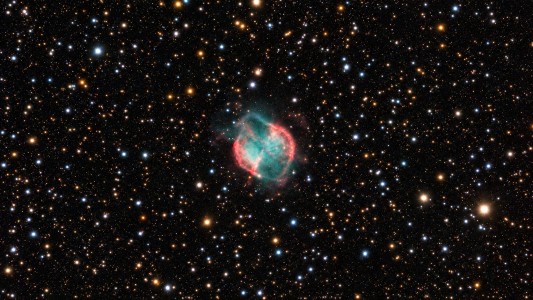
M27 - Dumbell Nebula

My Account

New to Astromart?

Register an account...

Need Help?

Posts Made By: Darren Crooks

September 3, 2003 09:50 PM Forum: Solar System Observing

[Lack of] atmospheric seeing and Mars

Posted By Darren Crooks

Hey Doug,

I have experienced the phenomenon you describe. But during most of my Mars observations, I have found that a really miserable night is often follwed by an exceptionally clear one. In one of my more recent posts (might be from Aug. 22, I don't remember offhand) I described a miserable and futile attempt to get any detail at all on Mars, while only 24 hours later, I was treated to spectacular views. All in all, I'd say it's about 50-50. I've had as many good nights as lousy ones.

Clear nights ... dark sites,
Darren

September 5, 2003 01:50 PM Forum: Deep Sky Observing

Did we inherit good galactic genes?

Posted By Darren Crooks

How about being in the middle of a cluster of galaxies, like the Virgo cluster? I've seen about fifty Messiers with my little 4.5" Newt, but only five galaxies.
Just my $.02.

Clear nights ... dark sights,
Darren

September 5, 2003 03:13 PM Forum: Deep Sky Observing

The Last ErieView StarParty?

Posted By Darren Crooks

I then decided to swing over to Andromeda, to see what M31 would look like from a really dark site.

WOW.

Not only the central core was visible, but a dim narrow oval swath that ran the length of the field of view, even using my buddy's 32mm EP. M32 was quite visible, looking like a fuzzy star, but for the first time, so was M110, a dim patch of light north of M31. I could just get all three galaxies in the FOV using the 32mm, and it was a dizzying sight.

From there, I turned eastward towards Triangulum. My target was M33. I found it after about two minutes of hunting. I must admit, I was a little disappointed, as it showed me little more than a central smudge - no detail at all. I'll have to try again, maybe when it's higher up.

M45 was a pleasant sight in the 32mm. (I really have to get one of those). I tried to look for nebulosity around some of the brighter stars, but didn't notice anything. In any event, it may not be visible in a 4.5". Shortly thereafter (about 0630 UT), the clouds moved in for good, so we packed it in.

Unfortunately, this may be the end of ErieView -- the farm will be sold shortly. Scott's wife Donna and her two brothers own the farm jointly, and Donna's brothers want to sell.

I will remember this place fondly. I got my first stunning view of some faint DSO's from this location, objects that would be no more than fuzzy blobs from my back yard. The limiting magnitude must be around 7.0. I have seen M8, M20, M13, the Double Cluster, and a stunning array of stars with my naked eye. Being able to see not only the Milky way, but to be able to see it whole, from the central core in Sagittarius to the tip of the spiral arm in Cassiopeia, and make out its classic spiral shape, complete with dust lanes, is a rare treat that cannot be described to someone who's never been out of the city. This place taught me that the single most important factor in how much one may observe is how dark the site gets.

The site also boasts one other advantage: the hospitality of Donna and Scott. I've been there three times, and all three times I was overwhelmed by the welcome I received. So to them a hearty thank-you.

Now, back to my back yard. Oh well. Mars is looking good, and Saturn will be up soon.

Clear nights ... dark sites,
Darren

October 8, 2003 06:51 PM Forum: Solar System Observing

Saturn 10.08.03

Posted By Darren Crooks

What a spectacular drawing, Sol. You've got a lot of painstaking detail in there. Good work.

Clear nights ... dark sites,
Darren

October 17, 2003 05:05 PM Forum: Solar System Observing

Mars pix , seeing

Posted By Darren Crooks

I can't help you any on the imaging stuff, as I don't do any myself ... but I can give you some information on magnitudes. First of all, the greater the magnitude, the fainter the object. -2 is actually very bright, brighter than the brightest star. The Sun's magnitude is -27, the moon's is -13. Venus varies from about -4 to -2, Jupiter from about -3 to -1.8. Mars at this latest opposition was around -3 or -2.8. Saturn ranges from around 0 to +1.

Sirius, the brightest star, is -1.4 or thereabouts. Arcturus and Vega are both very near 0 magnitude, whereas Aldebaran, Pollux, and Antares are examples of stars near magnitude +1. The stars in the Big Dipper are pretty much all between 2.0 and 3.0 (give or take). On good clear nights, from a very dark site, the faintest stars will be around +6.5 or so. This number will vary, depending on your vision. Hope this helps.

Clear nights ... dark sites,
Darren

October 20, 2003 03:21 PM Forum: Solar System Observing

10.20.03 Saturn Sketch through 244mm Dob

Posted By Darren Crooks

Great drawing, Sol - lot's of intricate detail. I see a band on the planet's surface just north of the equator ... contiguous to the B ring. Is this in fact a surface feature, the shadow of the B ring, or the faint C ring being illuminated by the planet's surface? I saw this feature myself through my 4.5" f/8 Newtonian about a week ago when I was viewing the planet.

Clear nights ... dark sites,
Darren

November 5, 2003 09:46 PM Forum: CCD Imaging and Processing/Solar System

A few pics from PSSG - 2 - North American

Posted By Darren Crooks

That has to be one of the best images of the North America nebual I've ever seen. Keep 'em coming!

Clear nights ... dark sites,
Darren

January 14, 2004 10:33 PM Forum: Pictures of Me and My Telescope and........

Me and Heep

Posted By Darren Crooks

Thanks James, but this is not my first scope - I owned an even humbler scope than this twenty-five years ago. It was a 60mm Tasco refractor. That scope was my introduction to astronomy, and my first views of Saturn, Jupiter, and some of the brighter DSO's were through it.

However, you're close. This is my first scope in 25 years. Needless to say, it is a marked improvement over the Tasco.

I think I see a nice 8" dob in my future, though ...

February 12, 2004 10:17 PM Forum: Deep Sky Observing

A change in observing habit

Posted By Darren Crooks

Interesting question, Ivan.

I get a kick out of seeing some of the beautiful images posted by astro-imagers. Some of them take your breath away. I have been itching to try my hand at astrophotography myself, but I can't afford the outlay for a good imaging setup. It appears to me that producing a quality image would be extremely difficult and painstaking work, than one who was successful at it would be justly proud of his accomplishments. I'm sure that would be part of the attraction for me.

But no image, not even one I created, no matter how spectacular, could possibly compare to seeing M42 for the very first time in a quality telescope under excellent seeing conditions. It's a completely different experience. I love to see great photos of DSO's, but I want to see them with my own eyes.

Aside from that, an image never changes. Visually, images can change significantly (such as the position of Jupiter's moon's, or features on the surface, or using different EP's on the same object) and sweeping through the night sky produces vastly different results. I'll take an hour or two sweeping through Sag, or Scutum, or Cygnus on a summer night from a really dark site over two hours of imaging any day. Just my $.02.

Clear nights ... dark sites,
Darren

February 23, 2004 10:17 PM Forum: CCD Imaging and Processing/Solar System

Sunday Morning Jupiter from Edmonton.

Posted By Darren Crooks

Nice image. Seeing seems to have taken a turn for the better here in the Great White North. Last Sunday night here in Ontario I got the best view I've ever had of Jupiter, showing distinctly the split in the SEB that is so well resolved in your image. Great work!

Clear nights ... dark sites,
Darren