Image of the day

Captured by
Lawrence Parchman

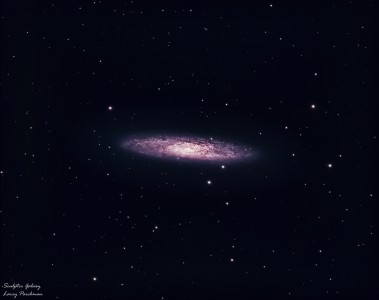
Sculptor Galaxy (NGC 253)

My Account

New to Astromart?

Register an account...

Need Help?

Posts Made By: Alex McConahay

March 10, 2005 03:26 AM Forum: Digital SLR AstroPhotography

adapter question

Posted By Alex McConahay

Bill,

There are so many adapters, I hesitate to give you directions, but, I believe the Variable adapter is designed to have an eyepiece in it. You slip the eyepiece into the big tube, hold it with a setscrew. Put one end of the adapter in the focuser tube and the other end holds the t-ring and camera.

This will give you a whole lot of magnification. Such a setup is used mainly for planets.

If you instead skip the eyepiece, and just stick one end in the focuser tube, and attach the camera at the other, you are just adding length to your tube.

I believe that same adapter can be used in a third way-- Unscrew the part that fits into the focuser tube from the larger adapter tube. You will notice that the back end of this little piece is just a set of t-threads. Screw your Eos T-ring onto it. Then mount your camera. Now you are using Prime Focus. In effect, your telescope is a long telephoto lens. NOw, it may be possible that you can't reach focus in this situation. You may need to add some tube length through another adapter, or more likely just try to insert your diagonal into the focuser, and the camera and adapter into the diagonal.

And of course, any of these methods can be used by adding a barlow--but you would be overmagnifying in many cases.

Good luck

Alex

March 10, 2005 04:22 PM Forum: Beginning Astronomy?

photo vs. visual question

Posted By Alex McConahay

What the other guys said are good answers. Another that fits right in with theirs is that the eye has two types of sensors--Rods and Cones.

One of them (and I can never remember which--rods or cones) is good with low light, but only sees in black and white and grays. The other sees in colors, but needs more light to get functioning.

When looking at astronomical objects, there is generally not enough light to get the color sensors going. That is why things come out colorless.

Alex

March 14, 2005 12:51 AM Forum: Solar System Observing

Annular Eclipse of October 2005

Posted By Alex McConahay

Robert,

If you have never seen an eclipse, the most important rule about photographing it is to not worry about photographing it.

An annular is not as exciting as a total--but it still will be spectacular. And you do not want your photography to get in the way of your enjoyment.

So----start right now taking pictures of the sun with all your imaging arsenal, and start looking at all the other eclipse images you can find. You will be surprised in your own efforts with the scale of what you get in the finder.

One of the problems with total eclipses is that you have to do much of it with filtered sunlight, and then unfilter it, and then refilter it. You have to know what you are doing there--because everything happnes quickly. Similar problem with annular---depending on how close they are to total.

And then you have the travel problem......Just what equipment do you want to take. The imaging tube is probably the easy choice. It is a lot harder to carry mounts than tubes to the far corners of the world.

Alex

March 14, 2005 04:07 PM Forum: Equipment Talk

regreasing EQ5

Posted By Alex McConahay

Search for AstronomyBoy.Com for the main articles on regreasing.

As for what kind of grease, I'll leave to others. I don't have a lot of experience in the cold.

Alex

March 15, 2005 01:07 AM Forum: Deep Sky Observing

Conditions to a Beginner

Posted By Alex McConahay

Simply put, if the skies are not too dark, you will not see much structure in anything except perhaps solar system objects, some star clusters, and doubles.

The problem is that you simply do not get much contrast in light polluted skies. All the sky is aglow, and so no matter how bright the bright parts are, the black parts are gray. And thus there is not too much contrast. You are dealing with shades of gray instead of blacks and whites.

Now, there could be lots of other problems--collimation, focuser travel, and a bunch of other dumb things. But most of these could be fixed and you would still not have great views of those objects....

However, you still have lots of things to do until you can get to a dark sky, so enjoy that scope.

Alex

March 15, 2005 10:24 PM Forum: Equipment Talk

CG5 mount questions

Posted By Alex McConahay

Because we are all fussy and it has been cloudy.

If you are happy with the movement, just put a scope on it and have fun.

Alex

March 25, 2005 02:45 PM Forum: Equipment Talk

Forum Missing?

Posted By Alex McConahay

Go to the Chinese Optics forums. There is a message (and discussion) that the name of the Burgess forum was changed.

Alex

March 25, 2005 02:50 PM Forum: Equipment Talk

Adapter for Nikon Digital 5400

Posted By Alex McConahay

Mike,

You are right, that should work. However, the way the snout of the 5400 is designed, you will need to attach that adapter to the camera itself and not the lens. Which means it needs to be recessed just like the Scopetronix adapter is.....in short, I think if you wind up getting the scopetronix type piece anyway.

I have lots of adapters, and a 5400. I'll go see if I can get anything to work.

Alex

March 26, 2005 03:33 AM Forum: Equipment Talk

Adapter for Nikon Digital 5400

Posted By Alex McConahay

Mike,

Well, I went experimenting. And I think it isn't going to work.......

The problem is that as soon as you turn the 5400 on, the nose (the lens) has to pop out. So, whatever you attach up there has to be bigger than the lens. So, whatever you buy is going to be something like the Scopetronix affair.....and probably cost as much.

Second problem, I think any existing projection photo adapter will not work because you could not get the lens of the camera close enough to the eyepiece you are using for projection. This is the great strength of the Scopetronix system......you are right there on the eyepeice. If you don't do this, you are going to get severe vignetting.

And besides, nobody else has volunteered an answer. So, I don't think such an adapter exists......Of course, Scopetronix would know if anybody.

Alex

March 27, 2005 02:32 PM Forum: Beginning Astronomy?

Moving to a 10" meade from a 10" dob

Posted By Alex McConahay

Andy,

Your friend might have been using the term "seeing" in its strictest sense....which doesn't mean the same thing to an astronomer as it does to a real person!

To an astronomer, "seeing" is the stability of the star, or lack of twinkling of a star. To a regular person, "seeing" seems to mean how good something looks. The Astronomer divides that regular definition into "Seeing" (or stability), "transparency" (how clear the air is), "limiting magnitude" (how dark the sky is), and probably a few other factors.

Astronomical "seeing" is dependent on many factors, including weather patterns, movement of cold fronts and warm fronts, winds coming over the mountains, etc. The stability of the air is dependent on how uniform the air is between the telescope and the star. "Cells" of air are different temperatures, and are moving. So, your "seeing" is dependent on how large the cells are, how diferent their temperature from other cells, and how they move, etc.). I am told (and I don't know how much I believe it) that this first factor, how large the cell, means that seeing is also dependent on the scope aperture. The theory goes if your aperture is smaller than the cell, it will not be affected as much by unstable air. So, your friend following this theory says--ten inches is ten inches. SO your "seeing" will be the same.

Enough about all that.

Alex