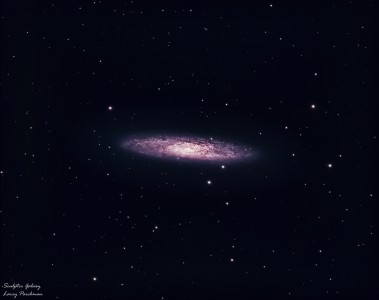
Image of the day

Captured by
Lawrence Parchman

Sculptor Galaxy (NGC 253)

My Account

New to Astromart?

Register an account...

Need Help?

Posts Made By: Alex McConahay

May 11, 2004 02:18 AM Forum: CCD Imaging and Processing/Solar System

Meade LPI imager

Posted By Alex McConahay

Freddy,
I haven't found any good sources yet, so I'm the blind giving out free advice to the willing.

I've had one session with mine. WHat I have learned to date:

Start with the moon, just because it is easier to follow it, and get it on the chip.

Use a barlow to get some image scale--although with a 14 inch SCT you do have lots of focal length. You can use more than that for planets. But you have to make sure you can get the thing on the chip, first.

just use the auto exposure function. (where it tries a variety of exposures to see which is best, and then selects the best contrast.)

If you have a secondary focuser, use it. Focusing is the hardest part of planetary photography.

Don't worry about gain and offset sliders. THey may have a use later, but I do not see much of an effect so far.

Then just click "start." Let it stack maybe 50 images, then click stop.

The defaults in the program are pretty good for first tries. Don't set the "quality" percentage too high. It just slows down the learning for now.

I did not like it's sharpening--way overprocessed.

Please keep me posted on what you have learned. I have lots to learn myself.

Alex

May 12, 2004 02:52 PM Forum: Equipment Talk

Meade Electronic Eyepiece

Posted By Alex McConahay

There is no single answer to that. If you ask how "magnified" the view is, you have to ask, complared to what. One obvious answer is: compared to the object. Well, with that, you are always stuck with the next question--from where? (All astronomical objects seen in a telescope look much smaller than they really are. However, they all look much bigger than they would have looked from earth had we not been using a telescope. Just what magnification are they really at?)

OK--enough word quibbling.

Why not take a few of your favorite eyepieces and see what you see with the telescope, and then stick in the electronic eyepiece and compare.

I think 4 mm is an apt guess. So, divide that (or whatever focal length eyepiece best compares with your television picture) into your focal length and get the traditional "power" rating.

Curiously, you cannot factor in the television's factors. If you do, you have to filter in where your eyeball is when viewing the telescope. (An eye is right at the eyepiece, separate by less than a quarter inch. However, it is several feet away from a television monitor, which shrinks the magnification.) The more distant viewing essentially cancels out the more magnified picture. Therefore, the television calculations don't matter.

Speaking of "don't matter" beyond an approximate "40 power" or "200 power" who is to say among the crowd at the outreach event that you are wrong, and who can really tell the difference if you can't?

I used to get a crowd pleasing image with my electronic eyepiece and television by using a 135 camera lens and an adapter.

Alex

May 19, 2004 03:35 AM Forum: Film Astrophotography - Imaging and Processing

Comet Neat Saturday evening

Posted By Alex McConahay

Here's Mine.

Om 1, 200 mm at F4.5, on a Losmandy G11 mount, unguided, E200 pushed one stop.
Alex

May 23, 2004 01:30 AM Forum: Meade

Q&A: 10" Starfinder Newt EQ

Posted By Alex McConahay

I'm a little confused.....the 10 inch Starfinder EQ Newt is a much older than three years ago design.

If it the one that Meade sold for so long, I have had lots of experience with it. I loved mine, and still use the tube regularly. The mount itself was insufficient for almost anything, including simple visual. But it did, officially, work. I sold it, and bought a Losmandy G-11, and use the tube to take astrophotos.

If you just want a good visual scope that will kinda follow the stars at public star parties, and such, this is a good idea. (Of course it is cumbersome for that purpose, and loves a dark sky--but it does impress the folk.)

Alex

May 25, 2004 10:10 PM Forum: Film Astrophotography - Imaging and Processing

Mating camera to scope question

Posted By Alex McConahay

Scott,

As I understand it, the Digital rebel is a digital version of EOS series, and so uses EOS lenses.

Your first question, regarding whether to get a t adapter or an off axis guider: You probably should be using an off axis guider with a classic Schmidt-Cass. (The newer Meades--with locking mirror--probably could go either way.) Try to get a two inch version so you get as much light and less vignetting.

Second question--assuming you are getting an off-axis guider--just tell them what you are attaching to, and they will sell you the version that attaches to it. An OAG does not normally need a separate t-ring--but it might, depending on the design.

A webcam can be used for autoguiding. I am not familiar with the software for that, but others should chime in here.

You do not definitely need a focal reducer. You will probably want one eventually, but you can work for a while without one. Your chip is smaller than a traditional 35 mm film, so vignetting will be less of a problem.

To summarize--buy a good off axis guider now and a focal reducer when you can. I don't have enough experience to say whether it should be a 6.3, or 3.3. It would depend on the size of your chip.

Alex


July 2, 2004 03:44 PM Forum: Equipment Talk

2" vs 1.25" eyepieces

Posted By Alex McConahay

"What about the 1.25/2" skirted eye pieces?"

THese are 1.25 inch eyepieces with a convenient permanently mounted 2" adapter. The manufacturer could have put them in a 1.25 barrel only and not changed anything optically.

Alex

July 7, 2004 01:14 PM Forum: Off Topic Discussions

Tidal flows

Posted By Alex McConahay

Yes, everything, including the landmasses themselves, experience tides. When the moon is overhead, the continent rises to meet it.

Alex

July 7, 2004 11:29 PM Forum: Politics

Bush & Cheney

Posted By Alex McConahay

And when I heard him say that, I thought--"Oh God, Dick Cheney as President. What a horrible thought!" There is no way on earth I would like a man like that to be president.

And as far as Edward's experience. What were George W. Bush's qualifications before being elected president?

Alex


July 10, 2004 01:28 AM Forum: Equipment Talk

Green lazer pointers

Posted By Alex McConahay

Jon,

If the only reason you want one is because you have some money burning a hole in your pocket, then make an investment. Put it into a CD or whatever. Buying does not make a person happy.

Now, specifically about laser pointers. They are very good at public teaching sessions (pointing out constellations and such). I can see no other reason for having them. We go to a lot of trouble to find dark sites to take astrophotos and do our observing. Why would we want to bring a bright light (even a well focused laser) into that environment?

They work better if there is something in the air (moisture, a little dust, whatever) to illuminate the beam.

Alex

July 14, 2004 03:37 AM Forum: Film Astrophotography - Imaging and Processing

Canon 10D - Vignetting problem

Posted By Alex McConahay

Please describe scope and /F ratio.

Did you use a focal reducer?

How did you attach camera to scope?

And yes, I agree it is vignetted.

Alex