Image of the day

Captured by
Lawrence Parchman

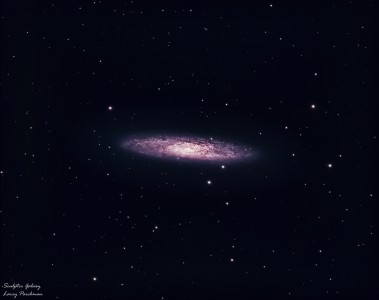
Sculptor Galaxy (NGC 253)

My Account

New to Astromart?

Register an account...

Need Help?

Posts Made By: dan kowall

October 2, 2008 05:52 PM Forum: CCD Imaging and Processing/Deep Sky

Question about today's Image Of the Day

Posted By dan kowall

The Medusa Nebula, aka Abell 21 and PK205+14.1

dan

October 6, 2008 02:48 PM Forum: CCD Imaging and Processing/Deep Sky

vdB 4 - a faint blue nebula

Posted By dan kowall

Fascinating.
Thanks for the full-sized crop, Tom. Something always gets lost in the down-sized images.

dan

October 17, 2008 03:09 PM Forum: CCD Imaging and Processing/Deep Sky

Pacman in the (near) full moon

Posted By dan kowall

Hi Greg,
Your green channel is dominating this image. I'm not sure how you assigned your channels but I would assume that the Ha is mapped to green?
With narrowband, it's good to shoot for equal S/N in each channel. Ha usually predominates, which means you need more exposure time for SII and OIII.
Here's a pleasant rendition of the PacMan:
http://www.rc-astro.com/photo/id1089.html

dan

October 19, 2008 03:36 PM Forum: Digital SLR AstroPhotography

M27 - First Prime Try

Posted By dan kowall

Hi Ed,
Your sky is indeed a bit red. The first thing that you need to do is to normalize your background.
In most cases, you want to adjust the black points of each channel so that they fall just to the left of the main peaks on the histogram. The attached image shows this adjustment.
Your 60 second subexposure will give you good star color, but longer subs are appropriate to show M27 in detail.

dan

October 21, 2008 03:08 PM Forum: CCD Imaging and Processing/Deep Sky

NGC281 in Ha

Posted By dan kowall

Jason Boyce said:
.......I stretched it pretty hard trying to show as much nebulosity as possible,hope I didn't push it too hard,let me know if I did!.....
I don't think it's pushed too hard, Jason. Although there is some faint nebulosity around the PacMan, the drop off in illumination from IC1590, the open cluster, is abrupt.
I think that you could increase the contrast in your image a bit. Other than that, it's a fine image.

dan

October 22, 2008 03:52 PM Forum: CCD Imaging and Processing/Deep Sky

advice

Posted By dan kowall

jeff OMeara said:...... I have alot of trouble trying to get colour in my stars. Any advice or suggestions would be most appreciated.
Hi Jeff,
Neal gave you good advice when he suggested longer subexposures. As a general rule, lots of white stars in an image would suggest star saturation. As you can see from what others have done:
http://www.robgendlerastropics.com/NGC7023NM.html
http://www.tvdavisastropics.com/astroimages-1_00000f.htm
there isn't a lot of color in the surrounding stars. Shortening the exposures won't gain you star color and it will only increase the 'noise' in the rest of the image.
The graininess in the outer portion of the nebula would also suggest longer exposures .
When you are faced with an area that has both colored stars and faint areas, take two sets of exposures. A short set that captures the stars without saturating, and a longer set that gets good S/N on the faint stuff. Then just layer and paste the colored stars onto the longer master.
Someone also suggested using a sigma combine (or something similar) to get rid of your outliers. That is good advice, too. CCDStack has the most sophisticated data rejection routines that I have found, but even a simple sigma will work well (assuming > 8 subs).

dan

P.S.
I almost forgot one of the most important points.
Don't touch the white point as you did. That will certainly make stars whiter. The only thing that I would do with a levels adjustment is set the black point. The midpoint slider is kind of a heavy handed adjustment. You have much better control of things by using a curves adjustment.

October 23, 2008 03:01 PM Forum: CCD Imaging and Processing/Deep Sky

ST-7 Frost problem

Posted By dan kowall

There's no need to put it back while it's still warm, Alex. It will cool to the touch rapidly. You might want to check to see if the O-ring didn't melt. It's a standard size that you can find at any hardware store should you need to replace it.
Three hours is not long enough for the dessicant to work. Wait at least 12 hours.

dan

November 26, 2008 04:29 PM Forum: CCD Imaging and Processing/Deep Sky

NGC1333/VDB17

Posted By dan kowall

It looks pretty good so far, Jason. The color is spot on.
You're correct in both of your observations. This is indeed a dim object. I put in about 14 hours on it, and that seemed just barely sufficient.
Secondly, this isn't a one trick pony. This area has Herbig-Haro objects, a reflection nebula, protostars, and lots of dust.
The Spitzer image of this area is revealing since it sees through the dust:
http://www.nasa.gov/mission_pages/spitzer/multimedia/spitzer20070829b.html
My favorite image of this area, though, is Travis Rector's:
http://www.noao.edu/image_gallery/html/im1037.html

dan

November 29, 2008 03:28 PM Forum: CCD Imaging and Processing/Deep Sky

Here Is My Latest Attempt at an Image

Posted By dan kowall

Brian Richardson said:
....Do you think the new one is better?.....
[COLOR="Navy"]No.
The second image shows effects from oversharpening: ringing, mottled areas, and hard-edged stars.
If you want to punch up the first image, I would first try some localized curves adjustments. That may be enough to get the 'look' that you want without sharpening. If not, I would just be more delicate with the sharpening.[/COLOR]

Brian Richardson said:
......please forgive the weak S/N ratio.....
[COLOR="Navy"]I know the ST-2000 is a little weak in the Ha part of the spectrum, but I would have thought 255 minutes would have given you a pretty good S/N.
The first image is pretty good as it stands.
[/COLOR]

dan

December 1, 2008 03:57 PM Forum: CCD Imaging and Processing/Deep Sky

vdB 31 and some Barnard objects

Posted By dan kowall

Most cool, as always, Tom.

dan