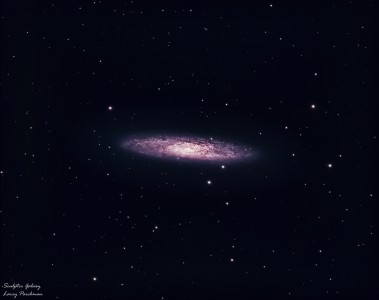
Image of the day

Captured by
Lawrence Parchman

Sculptor Galaxy (NGC 253)

My Account

New to Astromart?

Register an account...

Need Help?

Posts Made By: Alex McConahay

September 4, 2003 01:12 PM Forum: Deep Sky Observing

Did we inherit good galactic genes?

Posted By Alex McConahay

Hate to rain on your parade, but, if we had four moons, when would be the new moon night that we like to observe faint fuzzies.

I might go for the four moons if we could get rid of this atmosphere thing that we have.

An interesting sidelight: If we lived in the middle of a globular cluster we would have so many bright stars, we may never have seen past them to see other deep space objects outside our cluster.

Alex

October 3, 2003 04:19 PM Forum: Equipment Talk

Re: Newtonian Astigmatism

Posted By Alex McConahay

Before doing anything, be sure to rotate your eyepiece in the focuser--does the astigmatic pattern move? If so--the astigmatism is in the eyepiece.

I think this will be unlikely--but it is the easiest thing to check.

And--as others have said, a mirror can have astigmatism--what it does not have is chromatic abberation.

Alex

October 17, 2003 02:51 PM Forum: Equipment Talk

Orion Ultrablocks

Posted By Alex McConahay

Jim,

I can't talk about history. However, my Orion Ultrablock also says "Ultrablock Skyglow" on the side. In fact the Ultrablock and the Skyglow are two different filters. ONe is broadband, the other narrow. One is blue the other more reddish. However, the way you describe them, you do have two of the "blues."

Aalex

October 27, 2003 11:48 PM Forum: Equipment Talk

OK To Use Solar Eclipse Glasses To View Sun?

Posted By Alex McConahay

Yes, they are safe to use.

However,

Always check any solar filter for leaks before use.

And never use these glasses with any optical aid (like binoculars or telescopes). YOu may wear them "naked eye," but not hold up your binoculars in front of them. ANd do not put them over a telescope's eyepiece and look through them.

Alex


Alex

October 31, 2003 04:22 PM Forum: Film Astrophotography - Imaging and Processing

Astro Film Developing Processing

Posted By Alex McConahay

Sorry to join the thread late.......

Some helpful hints I have learned the hard way:

1. Find a professional shop. Go to your local camera shop or a few pro photographers in the yellow pages. Ask where they have their stuff sent locally for custom printing. THen go there. I use Intellicolor in Riverside, California. Teach these people what you want, and they will deliver. They are used to catering to people who know what a good image looks like. If you want, take some good photos in to show them what an astrophoto looks like.

2. Always take a few daytime scenes on the same roll as your astrophotos. Before dark, snap a few photos. THen (assuming you do not use a whole roll in one night), take a daytime photo before the next night of astrophotos.

3. Use slide film. Slides are more expensive to have printed, but you will only print one or two pictures anyway, so you don't want the whole roll printed. More importantly, you will want to have the best slides scanned so you can process them in Photoshop (or something) before printing. Then you get a print of that....

4. GO slow. Start with piggyback (wide angle then telephoto), then go to prime focus (bright objects first, then dimmer), and finally to projection. Otherwise you will really get frustrated.

5. If you don't like frustration--then find another game. When you said "Only two came out," I thought, "two came out--hey that's pretty good." I once counted seven things that could be expected to go wrong in an astrophoto (focus, tracking, alignment, exposure, vibration, composition, and I forget what else.....). SInce that time, I have found so many more things that screw up a cold night of work.

Alex

November 3, 2003 07:02 PM Forum: Equipment Talk

Guiding Scope

Posted By Alex McConahay

You would probably be better off using an off-axis guider with an LX200 or any other SCT. THe problem is the mirror shift--as you move the scope, the mirror moves ever so slightly. In the course of a long exposure, the mirror will move ever so slightly, ruining your exposure. (Not everytime, but often enough that you should avoid the separate-guidescope with an SCT.) THis problem is inherent with the most commonly used focuser system. If you have a mirror lock you can avoid this problem (newer LX200's do, I understand.)

Other than that, and decent refractor will do for a guidescope. You can pick up such just by putting a want-ad on Astromart.

Be sure to get a good set of rings that allow you to aim the guidescope somewhere wlse besides where the main scope is pointing, and then fasten down tight, so the tube cannot flex.

Alex

November 4, 2003 07:45 PM Forum: Equipment Talk

What makes a guidescope a guidescope?

Posted By Alex McConahay

A decent achromat 3 inch aperture, long focal length, refractor should do well. Be sure you have a focuser without slop and/or a lock down screw. Then get good solid rings that will allow you to move the guidescope a little (so it can aim someplace besides exactly where the main tube aims--helps to find a good guide star). Those rings should also lock the scope down so it does not move once it is set.

It should have a focal length sufficient that you can get three times the magnification at the guiding eyepiece as you get on the main imaging instrument.

Alex
Alex

November 19, 2003 08:12 PM Forum: Equipment Talk

Astronomy Class "Lab Equipment"

Posted By Alex McConahay

Rob, and others,

Thanks you for your suggestions. It was not until I started thinking in these terms till I realized how much $25,000 could buy--when you really decide on what is useful to a student in that position.

Another interesting thing I noticed--Since this was posted yesterday, we have had a lot more people respond to central obstruction v. clear aperture and Hands-on optics (and so forth) than we have had comment on this problem. What's that say? (and please don't turn the thread here--it is food for thought--I don't want a reply.)

Alex

November 25, 2003 03:43 PM Forum: Telescope Making

How Short Can the Upper Cage be?

Posted By Alex McConahay

Tom,
My 12.5 F5 has a single ring of 1/2 inch baltic birch. On one side, I have a right angle strip of aluminum from which I have attached the two inch focuser, and a smaller right angle bracket to hold the base of a Rigel Quickfinder. The other side has four right angle brackets that anchor the spider. There are also screws sticking through these brackets that allow me to anchor an extension of my shroud. That shroud extension stretches out six inches to act as a light shield.

In short--one single ring is all you really need. (I've seen it done with the rim of a bicycle wheel.) However, if you go for this design, remember that your secondary will be hanging down there unprotected, and you will need to arrange for some kind of light shield up top.

Alex

December 1, 2003 08:24 PM Forum: CCD Imaging and Processing/Solar System

CCD question

Posted By Alex McConahay

Richard has the good answer......
But you should know that many of the images you see here have been processed, and if you compared their raw shot to what you are seeing come out of your consumer digital, you would not be quite as wowed.

My friends that are into this usually take three to ten times as long to process the image as they took to get it in the first place. SOme much longer.

No question that a dedicated CCD astro camera takes better raw astro shots and better processed shots in the long run. But you probably have lots to learn from your digital camera about image processing and such that will really bring out some astounding results.

I would say if you are just getting into it, stick with the digital camera for a while until you have really run out of what it can do.

Alex