Image of the day

Captured by
John Roach

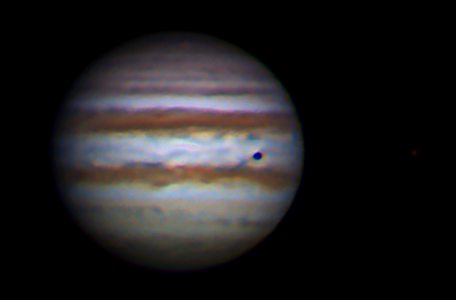
Jupiter IO Transit 12-10-26

My Account

New to Astromart?

Register an account...

Need Help?

Posts Made By: Jared Willson

July 18, 2008 10:44 PM Forum: CCD Imaging and Processing/Deep Sky

Awesome Milky Way by Dave Jurasevich

Posted By Jared Willson

Holy macaroni, Rolando! Thanks for posting those links--Dave's work really gives me something to shoot for!

August 27, 2008 03:56 AM Forum: CCD Imaging and Processing/Deep Sky

Work in Progress

Posted By Jared Willson

My goodness, look at all those 'faint fuzzies' you captured! Nice work. I particularly like the colliding galaxies.

- Jared

January 27, 2009 12:36 AM Forum: Mounts

cg-5 sirius or lxd 75

Posted By Jared Willson

I have owned the Sirius and the CG-5 so I will comment on those two only...

The Sirius is a better mount, but perhaps not by enough for your needs. The tracking is more accurate, the fit and finish are a grade above the CG-5, and the motors are much quieter when slewing. I'd say the capacity of the mount is higher as well, but the lighter weight tripod pretty much offsets that advantage.

For visual use with the 120, I'd probably save my money and take the CG-5. If you thought astrophotography was in your future, there is no question in my mind that the Sirius is the better choice.

- Jared Willson

March 19, 2009 01:55 AM Forum: Refractors

How to Read an Interferogram report?

Posted By Jared Willson

I can tell you a few pieces of it...

1) The wavelength in nanometers tells you what frequency of light was used to perform the test. In the case of a reflector, this matters only because the errors are reported as a ratio of the wavelength of light, so to determine absolute error you need the wavelength. In the case of a refractor, you usually choose the frequency of light at which the optics have been "nulled." This is usually something closer to green--in the middle of the visual portion of the spectrum. Not certain why red would be used for a refractor.

2) The Peak to Valley error tells you, as a ratio to the wavelength of light tested, what the largest error on the lens is. Generally, I do not believe this is considered a very useful number since a lens with a relatively large PTV error can still perform very well if that error covers only a very small portion of the lens.

3) RMS error is a measure of the average error (RMS = root mean square or average magnitude). This is a very good indicator of the performance of the lens, but even this number can be somewhat inaccurate since you don't know how many points were sampled, or whether those points were truly accurate representations of the overall lens.

4) Strehl ratio tells you the percentage of light that is focused inside the Airy disk when compared with a perfect optic. In some cases it is "corrected" to account for the central obstruction as well (which tends to diffract light outside the Airy disk). If you want a single, easy to read number that tells you a lot about the performance of a lens or mirror, this is probably the one. For moderate RMS errors, there is a simple formula to convert from RMS wavefront error to Strehl, so the two should be nearly interchangeable. Most people are more comfortable with Strehl simply because it is a percentage of perfection.

5) Tilt and defocus are generally removed since they are not measurements of the optic itself, but of the overall system (including how the lens was mounted in the test equipment).

6) Astigmatism, spherical error, and coma should never be "removed"--if you see that one is missing, someone may well be playing games with the report to try and show an artificially high Strehl/RMS error. In this case they are properly reported (but you'd be surprised what people will occasionally stoop to).

I don't have the knowledge to accurately tell you how to read the synthetic interferogram or the wavefront map. I can say that straighter lines in the former are good, and that a flatter surface in the latter is good, but the subtleties of how much of a wiggle and where it is located affects the performance are beyond me. Perhaps others will chime in.

PSF stands for "Point Source Function" and tries to show you how a perfect point source--such as a star--would behave at high power. The map shows a synthetic diffraction pattern at high power, and the surface shows the variation in intensity of light across the diffraction pattern.

MTF or Modulation Transfer Function describes how a lens represents contrast between line pairs that are arrayed in either a sagittal (concentric rings) or tangential (rays going outward) pattern. On the vertical axis you see, approximately, the performance as a percentage of perfect contrast. On the horizontal axis you see the line pairs getting closer and closer together as you move from left to right. I have never found MTF curves for telescopes particularly useful since they show very little deviation from perfection. They are much more useful with photographic lenses where you can see differences in performance with focal length (for zoom lenses) and often show differences in performance across the imaging plane at various standardized line spacings. In those situations you can learn where a lens's sweet spot is--best focal lengths and the resulting corner sharpness.

O.K., that pretty well exhausts my knowledge of interferogram reports. The only question in my mind on this one is why red light was used, and how that would SKU the resulting performance. I don't know the answer to either of these.

April 6, 2009 07:37 PM Forum: Refractors

Resale value of APM Refractors.

Posted By Jared Willson

Resale value on AP refractors is extremely high because the used market is the only market for people looking to purchase an AP refractor in a reasonably short period of time--there is a lengthy waiting list for new scopes. I haven't seen any evidence suggesting that APM and Tak have significantly different resale values. Some of the older Tak doublets sell for a relative song. Newer models of APM scopes seem to sell for 60% to 80% of retail. Newer models of Tak triplets seem to be in the 70% to 80% range.


- Jared Willson

April 16, 2009 04:36 PM Forum: Refractors

Less CA with quality in Achro?

Posted By Jared Willson

It's an interesting question. I hear people talking all the time about "well corrected achromats" as opposed to ordinary achromats, and it never made sense to me. I know that the designer can determine exactly which portion of the spectrum is "well corrected" (weighting it equally across the entire visual spectrum, or giving preference to red correction over violet correction, for example), but I was always under the impression that all achromats of a given aperture and focal length had essentially the same color error--assuming traditional crown and flint glass choices, of course.

That does, however, beg the question of whether poor execution of a design would result in different dispersion characteristics, or whether it would show itself just in other aberrations. My guess is that spherical correction and chromatic aberration are not linked--that the color correction would usually be unaffected by the execution of the lens. This, of course, ignores issues such as wedge error.

April 16, 2009 06:36 PM Forum: Astro-Physics

The Mach 1 a lil mount that "really can"

Posted By Jared Willson

Glad it's working out for you, Bruce. I'm about to push my Mach1 pretty hard--I purchased a new (to me) 152mm TMB here on Astromart... With the field flattener and STL series camera I suspect it will be pushing forty pounds or even a touch more--and it's a looooonnnggg tube! We'll see how the mount (and Eagle pier) handle it. I'll post a picture in a couple of weeks when I have it all running.

- Jared Willson

September 4, 2009 07:03 PM Forum: CCD Imaging and Processing/Deep Sky

NGC7331

Posted By Jared Willson

Wonderful shot, Rolando! The Deer Lick group is one of my favorites. Like Ivan, I especially like NGC 7337.

- Jared Willson

November 4, 2009 10:52 PM Forum: CCD Imaging and Processing/Deep Sky

NGC2170

Posted By Jared Willson

Lovely image--spectacular mix of colors.

I'm curious... Do you bin your 8300 when imaging with the TEC? Or is your seeing good enough to derive some real benefits from the 0.9 arc seconds/pixel?

- Jared

November 7, 2009 06:19 PM Forum: Refractors

TEC 160FL better color correction than TOA?

Posted By Jared Willson

I think the problem you will run into is finding someone (anyone) who has experience with more than one of these three fine scopes.

My expectation would be that the TEC 160FL and Tak TOE 150 would have essentially perfect color correction followed by the TEC 160ED. However, that is based purely on reputation and user reports, not based on any actual experience or having seen a side-by-side comparison.

If it were me, as an imager I would go for either the TEC 160FL or the Tak TOE 150 (or even the LZOS 152) rather than the TEC 160ED. If I were a visual observer, I would probably swap this recommendation. As it happens, I own an LZOS/TMB/APM 152 that I am extremely pleased with as an imaging scope. I chose it over the Tak and TEC options because it was available used from someone I trusted, not because I thought it was a better scope per se.

- Jared Willson