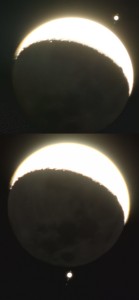
Image of the day

Captured by
John Greenlee

Before and after

My Account

New to Astromart?

Register an account...

Need Help?

Posts Made By: Darren Crooks

February 25, 2004 05:34 PM Forum: Solar System Observing

Observing Report 02.22.2004 - Part 2

Posted By Darren Crooks

Observing Report 02/22/04 (cont'd)
==================================

Jupiter was a big hit as well, and detail just jumped out everywhere. There was a thin band sliced off the edge of the SPR, and the SEB was clearly separated into two distinct bands. THe NEB was ragged and broken in spots. Jupiter for once was behaving. It was steady, unmoving, and consistent, not its usual capricious self. Again, my in-laws were able to make out all four moons plus several cloud bands.

After the party, I drove home and powered up my recently-acquired Shorty barlow with the 10mm EP, giving a magnification of 180x. Both Jupiter and Saturn held together beautifully. Jupiter was as sharp and clear as I've ever seen it.

Made a stab at NGC 2392 (I think), the Clown-Face nebula. Couldn't find it, and toes were starting to get numb, so called it a night.

But Holy Hubble Batman, I needed this night. Since Christmas it's been clear enough to observe maybe a half-dozen times, and seeing has been universally miserable. What a relief to see melting snow, warmer climes, steady air and non-frosted EP's.

Clear nights ... dark sites,
Darren

February 25, 2004 05:36 PM Forum: Solar System Observing

Observing Report 02.22.2004

Posted By Darren Crooks

Observing Report 02/22/04
Equipment: Heep ('umble 4.5" DS Newtonian on EQ mount, 900mm, f/8)
Eyepeices: 20mm, 10mm, 6.7mm Meade Plossls
Location: Aurora, Ont. (approx. 44n, 79w)
=======================================================

The occasion was a couple of in-law's birthdays: My wife's mother and her oldest brother. He lives in a semi-rural location on about a four-acre spread. The evening promised to be clear, so I brought Heep to give the assembled guests a good view of sights they would never see in the city forty or so miles south. This site suffers from very little light pollution, and skies are much darker than my suburban location fifteen miles north.

Started the evening by tuning up on Venus and an almost-new moon. The moon was unimpressive, but as the evening sky grew darker, the unlit side of the moon began to show detail as it was illuminated from earthshine. Want to see an interesting effect? At low power just after sunset when the moon is quite new, focus on the moon, then move the sunlit part right out of the eyepeice. The remainder looks like a spooky grey ghost planet.

Venus was as sharp as I've ever seen it. Generally it requires a moon filter or it's just a bright boiling flame. This evening, at 135x, it was a tiny, perfect gibbous moon, indicating that seeing would be quite good.

I went in for a while to let the scope cool and the night deepen. Returned outside to check out M42. In spite of the dark skies, it was not the best view, with little hint of the sinuous detail seen on other occasions. So I figured I'd concentrate on the planets. They're always a bigger draw anyway.

I got Saturn in the eyepeice and was rewarded with one of the best views I've ever had. At 90x, even my in-laws could easily detect the Cassini Division. I pushed it up to 135x, and noticed significant detail: At least three bands, a lightening in the centre of the SPC, making the feature resemble a doughnut, and the C ring was quite obvious, almost all the way around the planet. Also: I noticed in the big fat ring inside the Cassini (not the skinny darker one outside - not sure which is the A ring and which is the B), there was a brightening just inside the Cassini. Almost as though the edge was turned up, reflecting the sunlight directly. Gave the whole ring an eerie 3-D effect. Spooky.
(cont'd)

March 1, 2004 10:37 PM Forum: Solar System Observing

What a Week!

Posted By Darren Crooks

Observing Report 02/22/04 - 02/29/04
Equipment: Heep ('umble 4.5" DS Newtonian on EQ mount, 900mm, f/8)
Eyepeices: 20mm, 10mm, 6.7mm Meade Plossls, 2x Orion Shorty Barlow
Location: Newmarket, Ont.
=======================================================

What a week! Started at by brother-in-law's home in a semi-rural area boasting very dark skies. Observing notes posted here last week. A whole week of cloudless skies ... thought I'd died and gone to Heaven! Here are the highlights:

Every night the seeing was better than the last. Jupiter and Saturn were rock-solid at 180x. My new barlow is definitely getting a workout. Got a very good view of GRS for the first time this season. Darker than last year, but no hint of colour. The GRS was clearly defined, preceded by a white bow-wave churning up the SEB. Noticed several rounded dents taken out of the NEB towards the equator, almost like little bites taken out of a cob of corn.

Likewise, views of Saturn were the very best I've had. Surface detail was abundant, and faint colour differences on the planet's surface. The "C" ring was clearly seen at 135x and 180x. Also, for the very first time, subtle colour differences in the "B" ring itself were seen, especially on the edge bordering the Cassini Division.

Got serveral amazing views of the moon last week as well. One of the highlights was seeing a huge, long escarpment on the five-day-old moon. First time I'd really noticed it, but at 180x, it just jumped out at me. Like a long, sinuous, two hundred mile long cliff. Very interesting.

The highlight of the week was finally nailing NGC 2392, the Clown-Face nebula. I had tried to locate this several times before, but it's difficult to home in on when the brightest guide star is 4th magnitude and completely washed out by streetlights afflicting my front lawn. According to Turn Left, it's a couple of degrees from Wazat in Gemini. Sounds like an Abbot and Costello skit, doesn't it?
Lou: "That star up there, Wazat?"
Bud: "Exactly."
Lou: "That's what I'm askin' you! Wazat?"
Bud: "And I'm telling you: You're absolutely right."
And so on...

But I digress: This planetary has been called one of the brightest in the sky in TLAO, but maybe because I was viewing from my light-bathed front yard, it didn't look very bright. It certainly didn't seem to be as bright as M57. At 90x, I could detect a very bright core and a rather ragged outer shell. This is in contrast to M57, which has a dark core and a smooth outer shell. Well, maybe from a dark site it looks better.

Ended the week where I started: At my brother-in-law's place, celebrating another birthday. Showed my six year old neice Saturn and Clavius at 180x. Clavius was huge, showing crumbling, terraced walls and about a dozen craterlets. Boy, magnification does wonders on the moon. My neice was thrilled. That's one of the real rewards of this hobby, watching a child get that excited.

Clear nights ... dark sites,
Darren

March 11, 2004 04:29 PM Forum: Deep Sky Observing

Did I get M66?

Posted By Darren Crooks

Equipment: Heep ('umble 4.5" DS Newtonian on EQ mount, 900mm, f/8)
Eyepeices: 20mm, 10mm, 6.7mm Meade Plossls, 2x Orion Shorty Barlow
Location: Newmarket, Ont. (approx. 44n, 79w)
Time: 0330 - 0430 UT
=======================================================

Did I get M66?

I got something, I don't know what. I decided to move Heep from my light-bathed front yard to my slightly less light-bathed back yard last night, as the snow has recently melted. I decided to test the conditions by seeing if I could get the Leo triplets or M81/82 this night. The moon wasn't going to be up until about midnight, so I figured it might be worth a shot.

I pointed in the general area and began to slew around. I don't really know where these guys are, which is kind of a problem. I figure they're about two degrees south of Leo's back leg, assuming Denebola's the tail.

So I'm slewwing around, looking for anything that's not a tiny point of light. I figured out a new way of sweeping slowly with the scope: loosen the declination lock knob, so declination moves freely. Sweep back and forth around the declination axis once or twice, then use the RA slow motion control to move the scope slightly lower (or higher) and repeat. I was patiently scanning the target area in this manner, and just about to give up, when I spied a faint (and I mean FAINT) smudge maybe one or two arc-minutes from about an eighth-magnitude star. This was with about a 1-degree FOV using my 20mm EP, giving me 45x. It was a thin line, with a slightly thicker base an thinner top, like a lopsided isoceles triangle, that ran diagonally from northwest to southeast in the FOV, with the 8-mag star just north of it. With direct vision it was invisible, and it was quite small, smaller even than the Dumbbell Nebula (but bigger than the Ring).

After checking my trusty Peterson's, I figured it had to be one of the three, because there's really nothing else within ten degrees. But was it faint! I expected something a little brighter. After all, Turn Left at Orion indicates it can be seen in a three-inch scope. This wasn't even as bright as M32. I barely saw it.

I also hunted around for M81/82, but they would have been right at the zenith then, and there's nothing remotely bright close by to guide me to them. Also got M3, which I literally nailed within ten seconds, not even using the finder (it won't show up in my crappy plastic finder anyway). It showed a mottled graininess at 90x with averted vision. Interesting that I spent all of last spring and half the summer trying to track this puppy down. Aslo checked out Jupiter and Saturn (at least I can find these guys). I notice Saturn suffers from really bad atmospheric turbulence as it approaches the western horizon, but Jupiter at 180x was rock steady, showing lots of detail.

So guys ... can you help me out? Did I see anything, or was it my imagination?

Clear nights ... dark sites,
Darren

April 15, 2004 05:06 PM Forum: Deep Sky Observing

Heep Peers into the Past, Part 2

Posted By Darren Crooks

Observing Report 04/14/04 - Part 2
==================================

But wait, there's more! Flush from my victory in Ursa Major, I swung over to Leo, in hopes of nailing the elusive M65-66 combo. I lined up between south of the lion's back leg, between it and a fifth-magnitude star below it. Same deal. Slew around, sight down the scope again, slew around some more. What's that little smudge right beside 2 or 3 dim stars? Jiggle scope, use averted vision. Yeah, there's SOMETHING there, all right, but what? I had seen this guy before, but it's like a half-magnitude to being invisible in my scope. I could hardly believe it was M66. So: jiggle scope again. I spot another, slightly rounder smudge very close, perhaps 20 minutes, from the first smudge. Also, very faint, even fainter than the first one, and no stars nearby to enable me to pick it out. Check my scope by sighting down tube. Yes, these are M65 and M66. The crowd goes wild.

Some might say it wasn't worth the effort to try to see near-invisible smudges from my back yard. But I found four objects that eluded me for months, doubled my count of Messier galaxies, and peered back forty million years into the past. Not bad for one night's work.

Clear nights ... dark sites,
Darren

April 15, 2004 05:09 PM Forum: Deep Sky Observing

Heep Peers into Distant Past

Posted By Darren Crooks

Observing Report 04/14/04
Equipment: Heep ('umble 4.5" DS Newtonian on EQ mount, 900mm, f/8)
Eyepieces: 20mm, 10mm, 6.7mm Meade Plossls, Orion 2x barlow
Location: Newmarket, Ont. 44 degrees N, 79 degrees W
============================================================
Wow, what a night. Watched the Leafs get creamed by Ottawa last night. During second intermission, I set up Heep in the back yard whilst I grabbed some groceries. Return from shopping at 9:00 EST (01:00 UT) and point scope at Venus for kicks. Never seen it less than half full, kind of a neat sight. Back inside to put daughter to bed, have beer and watch a bit of Colorado-Dallas overtime (who won, BTW?). Return outside at 03:00 UT.

Spring having arrived and snow melted, I am now able to move Heep from my light-bathed front yard to my back yard, which is significantly better, as there are no street lights and few outside patio lights. I train on Saturn, but it's kind of low in the northwest by now, and seeing wasn't that good. Made a half-hearted attempt at NGC2392 (the Clown-Face Nebula) but couldn't locate it. Perhaps Gemini was too low. I have only seen this planetary once before, and didn't find it easily.

As the skies were fairly dark, I figured I'd try for M81 and M82, just for the hell of it. I had tried to find these two before, but with no luck, especially since they're near the zenith right now, and lining up the scope is a real pain. You've pretty much got to get down on all fours and really crane your neck up to ensure you're in the right neck of the woods. So: Line up scope, slew around for a while, scratch head, re-line up scope, slew around some more. Third pass... wait: there it is. Small but fairly bright oval smudge a wee bit south of an 8th magnitude star. Bright round core, faint glow around it. Well, if that's M81, then ... move scope up (south) just a hare ... yes! long, slim, hotdog-shaped glowing patch - M82. Both fairly bright, as galaxies go, not hard at all. Beautiful sight. No details visible in either 20mm or 10mm EP, but neat to see both objects in the same FOV, framed nicely by a scattering of stars.

(cont'd)

May 5, 2004 04:06 PM Forum: Deep Sky Observing

Is No One at the Eyepeice?

Posted By Darren Crooks

Okay, I've been busy, haven't checked in here as often as I ought to ... but after a two week hiatus, I check out the forum, and see that there has been exactly one post in the last two weeks!

What's going on? Everyone too busy watching the playoffs? No one's interested in faint fuzzies in Virgo?

My guess is weather conditions. In the two weeks since the new moon, we've had about two hours of good weather. I'm serious. One night about a week ago, it cleared up between 10:00 and 12:00 local (2:00 and 4:00 UT). I can only assume this is not a local phenomenon.

Let's hope we can all get back under the stars where we belong soon!

Clear nights ... dark sites,
Darren

May 19, 2004 05:07 PM Forum: Equipment Talk

Who put the EQ in the EQ mount?

Posted By Darren Crooks

Hi Guys,

This is more of a general interest question. I have a soft spot for Newtonian reflectors, they give all-around good views and are the cheapest on a per inch of aperture basis. But I digress. Sir Isaac Newton is credited with the invention of the Newtonian reflector. (I'm not sure whether he invented it or just popularised it, so I can't really say.) But who is credited for the invention of the equatorial mount? Was that Newton as well, or did the mount come later?

June 24, 2004 08:52 PM Forum: Deep Sky Observing

Heep Peers into Age of Dinosaurs

Posted By Darren Crooks

Observing Report 06/19/04
Equipment: Heep ('umble 4.5" DS Newtonian on EQ mount, 900mm, f/8)
Eyepeices: 20mm, 10mm, 6.7mm Meade Plossls, 2x Orion Shorty Barlow
Location: Camp Saulaine, Ont. (approx. 44n, 79w)
Time: 0300 - 0530 UT
=======================================================

Well, finally. A welcome break from the miserably wet, overcast conditions here in Sunny Southern Ontario. With a half-dozen exceptions, it has been clouded over every weekend. Monthly observing seesions with the club have been a complete bust since the snow melted. Friday's session promised more of the same. I made the trip up anyway, because the Clear Sky Clock promised clearing later in the evening - but it was not to be.

Saturday started out the same. But over the course of the afternoon, the clouds slowly parted, until by evening it was clear from horizon to horizon. So I packed up Heep and headed out to Camp Saulaine, our club's new dark site. As observing sites go, it's pretty good, but too many trees on the southern horizon for my liking. But it sure beats my back yard.

I had attended a family gathering that evening, so I didn't get there until 3:00 AM UT (11:00 PM local). After setting up, my first target was the Virgo cluster. I found it by aiming towards the middle of an imaginary line between Denebola and eta Virgo and then slewwing slowly up and down perpendicular to this line. By this time Leo was already inching towards the western horizon, so I knew I didn't have much time.

I found several faint fuzzies surprisingly quickly, but as they all looked pretty much the same, I really didn't know what I was looking at. I was later able to identify them, with the help of my trusty Peterson's, as M87, M84, and M86. These were the three brightest, but I was able to see at least three others just by sweeping though the area. And although they showed no detail whatsoever, I was happy to have wandered through this meadow of galaxies when I did - they don't show up at all from my back yard, and I was almost too late - in another month they would be too close to the horizon. I missed them last spring - I didn't want to wait another year!

It staggers me to realize I was looking sixty-five million years into the past. That's how long the light from M87 has been travelling. Back when the mighty Tyrannosaurs were terrifying the denizens of the forest primeval.

Staying with the deep-deep-space theme, I wandered over to Ursa Major for a good view of M81/82. M81 showed a bright core surrounded by a dimmer outer region, and M82's familiar cigar shape seemed slightly bent. M51 and its close sibling were quite easy, showing bright cores. I thought I even detected a curved arm coming off M51 and spiraling out towards its companion, but that was probably more "averted imagination" than anything else. Also bagged M101 for the first time. A large, hazy, dim (and I mean DIM) round blob. Tried to find M109 as well, but couldn't locate it.

Spent some time in Scorpius and Sag (naturally) as soon as they cleared the trees. M22 and M4 were both bright and easily resolved, but suffered somewhat from skyglow from Toronto. Got an eyeful of M23 and M25 as well. Ended the evening with a beautiful view of M11, one of my favourite open clusters.

5:30 AM UT, cold, teeth chattering and feet soaked, I pack up, stumble into car and drive home. Fall into bed completely exhausted and contented. Finally a good night under the stars. If current weather trends are any indication, it may be the last one for quite some time.

Clear nights ... dark sites,
Darren

April 3, 2003 03:10 AM Forum: Solar System Observing

Mars Observation (April 1, 2003)

Posted By Darren Crooks

Hi Carlos,

That is an excellent detailed observation and drawing. One of the reasons I bought my scope this year is the upcoming opposition of Mars, which I have heard is going to be one of the best in decades.

I notice that one of the limbs in the drawing is foreshortened, making the disk appear gibbous. As Mars is rising in the morning, it would seem that the eastern (rightmost) limb would be the one foreshortened. Am I correct in assuming, then, that your telescope inverts the image? I know this is the case with Newtonians; I wasn't sure about Mak-Cass's, though.

Clear nights ... dark sites,
Darren