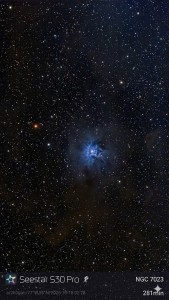
Image of the day

Captured by
Arthur Hogan

Iris Nebula

My Account

New to Astromart?

Register an account...

Need Help?

Posts Made By: Steve VanHyfte

August 14, 2004 01:49 PM Forum: Telescope Making

Flockling Problem

Posted By Steve VanHyfte

Typically the flocking will stick to almost anything, even you as you have mentioned. So the problem must be the tube. By chance did you forget to remove the wax lining in a sonotube or quick tube????

September 9, 2004 01:23 AM Forum: Telescope Making

Altitude bearing - Dob too loose

Posted By Steve VanHyfte

After building a few dobs, all with 8 inch bearings, I find it hard to believe that your telescope is balanced correctly. The 7 inch bearings should work OK for your 10 inch scope. Typically it is the eyepiece end that falls down, is this so, then you need to add some weight at the mirror end. If the eyepiece end is still falling, then you simply need to add more weight. Also moving the pads further out will help, as was previously discussed. Some have even put the soft sided velcro over one of the teflon pads on each side to add some friction.

September 20, 2004 05:21 PM Forum: Telescope Making

2" eyepieces and secondary mirror

Posted By Steve VanHyfte

In the August 2000 edition of Sky and Telescope, there was an article about diagonal size. It is a much debated issue, that has alot of variables. Sky and Telescope also has a free download computer program for helping you determine the best diagonal size for your telescope called "sec".

Running "sec" shows a 7" F7 with a 1.25" secondary with a 2" edge illumination of only about 25%. The author of the article and the program suggests an edge illumination of at least 40 to 45%, so you might have to us size the diagonal.

Most 2" eyepieces that have at least a 50 degree apparant field and have acceptable edge sharpness are in the 30mm to 50mm range. Televue has some exceptions in the 25mm to 27mm rage, but these are extremely expensive eyepieces. Your scope has about 1250mm of focal length, so the power for a 30mm to 50mm eyepiece will be only 25x to 40x. There is not enough power difference between 25x and 40x to justify more than one 2" eyepiece.

Now look at exit pupil, most eyes can only open to 5mm to 7mm. In your F/7 scope, that means only 35mm to 49mm eyepiece can be used for maximum true field while still using 100% of your mirror. So once again, only one 35mm to 49mm eyepiece will be used in the 2" format.

So being pessemistic, you will buy a 2" focuser, one 2" eyepiece, and possibly even up size your diagnoal and purchase another diagonal holder, just to get a larger true field used on one eyepiece. The larger diagonal mirror might even soften low contrast detail on planets.

Now being optimistic. You could buy and mount the 2" focuser, just incase you want to experiment with the 2" format. You could buy an inexpensive eyepiece or borrow one at the next star party to try out, and concentrating on the very far edge for brightness.

September 24, 2004 01:29 PM Forum: Telescope Making

Help with a 14

Posted By Steve VanHyfte

Thanks for all the suggestions.
1. I found out that the relay may be under the dec shaft motor cover.
2. I know how to use an DVOM, mainly for 12volt DC type work on Automotive applications, but not A/c.
3. I will make up a wiring diagram next week, and post it for further help.
Thanks again everyone.

September 29, 2004 06:16 PM Forum: Telescope Making

Help with a 14

Posted By Steve VanHyfte

Taking a 2nd look at the telescope, shows none of the wires connect to anyting, they are just spare wires in the wire harness or loom that are are not used. The large old style capacitor was for the RA motor, and was replaced along with RA motor years ago. Seems they just left the old cap under the motor cover. I was able to draw out a rough wiring diagram, but will take a few days in spare time to draw.

October 5, 2004 12:24 AM Forum: Telescope Making

large rotating rings

Posted By Steve VanHyfte

Our club used 2 focusers on their 20" F/5. Each was 180 degrees apart on the tube. The secondary mirror rotates to the needed focuser simply by rotating on the shaft that attaches to the center spider lug. The focusers are not exacly 180 degrees apart, so one focuser is well collimated and the other is slighly off. The very large 100 percent illiminated field on this scope slightly makes up for the off collimation of the 2nd focuser. The system works well and was fabricated by a guy who has made alot of telescopes. This is just another way to do it.

October 10, 2004 11:36 PM Forum: Telescope Making

Trouble lining up Primary Mirror

Posted By Steve VanHyfte

On traditional 3 point primary adjusters, to move the mirror in a specific way, you can either move one screw one way, or the other 2 screws in the oppostie direction.

November 19, 2004 10:56 PM Forum: Telescope Making

Secondary Heater help

Posted By Steve VanHyfte

Goto protostars website and use the technical help documents for the heated spider.
http://www.fpi-protostar.com/ftp/techp1.pdf

December 7, 2004 06:09 PM Forum: Telescope Making

Proto-star curved secondary holder

Posted By Steve VanHyfte

I made a curved spider for my 8" F/6. No matter how I made it, you end up bending the curve to get it collimated well. If you read the technical pdf documents on the protostar spider, at the very end of installation, they recommend the same, bending it to get it just right. Also the stability of a curved spider has the potential of not being as good as a straight vane style since the mirror holder is not under tension, so you possibly can get a springy effect when moving the tube. Concerning the diffraction, you still could see the curved vane diffraction at low power on bright objects, but at high power (where it really matters) the diffraction was invisible. So that is my experience, yours and others may vary....

January 29, 2005 11:22 PM Forum: Telescope Making

2 Questions

Posted By Steve VanHyfte

Let me try at #2. You only want focused light from the mirror to reach the eyepiece, otherwise you want it pitch black for optimum contrast. So if you look through an empty focuser on an assembled truss dob, you see the other side of the cage around the secondary, and you should see a portion of mirror box around the primary mirror. These surfaces that you see are best kept as black as possible, and the flocking from Mcmaster Carr or protostar seems to be a best-bet. The stuff is so black, if you put a piece of it next to a piece of something painted ultra flat black, the painted part will look bright, light and reflective. Concerning the off axis light, that is what the shroud and upper tube extenstions are for, and flocking those parts seem to be an smaller issue, as long as thouse parts are somehow darkened.
I have an 8" tubed dob that has the entire tube and focuser lined with black velvet from McMaster carr. The contrast improvement is so good, the view matches the image brightness of a 10" scopes. Even better, when installing the velvet, no paint mess or fumes, you either glue it in, or peel and stick.