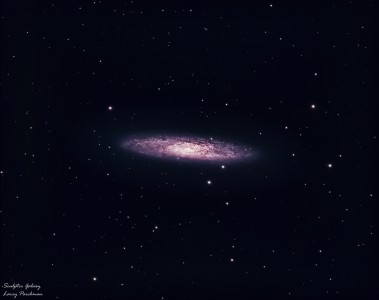
Image of the day

Captured by
Lawrence Parchman

Sculptor Galaxy (NGC 253)

My Account

New to Astromart?

Register an account...

Need Help?

Posts Made By: Alex McConahay

July 19, 2002 01:09 PM Forum: Telescope Making

Might want to build a Dob.

Posted By Alex McConahay

Matthew,

Depends on what you are building.

Aluminum for truss tubes will be $14 each times 8.
Focuser will be from $75 to $200 +.
A sheet of 1/2 inch Baltic Birch will be thirty dollars, and 3/4 inch about $50.
Fasteners will be ten to fifteen dollars.
A spider will be $30 to $50, or more with a diagonal holder.
I haven't included paint, a bit of teflon, tools, etc.

Of course you could use Sonotube, Home Depot plywood, a spider made of three dollars worth of parts.....

Alex

July 26, 2002 12:39 PM Forum: Equipment Talk

Tracking with a Dob

Posted By Alex McConahay

Bob,

A friend of mine has a DobDriver n his 18 incher. It works quite well.

Try

http://www.rivastro.org/rasddr2.htm

to see details.

Alex

July 27, 2002 01:32 PM Forum: Equipment Talk

Cut-down vibrations

Posted By Alex McConahay

Mike,

Here's a few ideas:

Get some chain or rope. Get a "pet screw." I don't know what their real name is, but you can get it at Home Depot. It is a bout a foot long, and has large threads on one end and a handle on the other. They are used to anchor the ropes that hold pets. You screw the threaded end into the ground. Tie one end of the rope or chain to it, and the other end to the spreader on the tripod, and thighten the sucker down. Vibrations will dramatically slow down.

As for making the hole in the barbell smaller--use a "bushing" they are available in brass in various sizes at your local ACE hardware.

Alex

July 31, 2002 12:40 PM Forum: Telescope Making

unknown F-ratio

Posted By Alex McConahay

Roger,

Easy to figure, depending on how exact you want it. If it has an 8.5 inch tube, it is approximately half that distance from the secondary to the side of the tube--4.25 inches. Probably another inch (maybe two, you will neeed to measure if you want it exact) from the side of the tube to where the eyepiece focuses. Add that total--5.25 inches--to the 21.5 from the secondary to the primary, and you have a total focal length of 26.75. (I am assuming you meant the 21.5 as the measure from the primary to the secondary--which is right under the focuser.) DIvide that number by the 6 inches of the primary's diameter and you get--little less than 4.5 or so.

The focal ratio (F number) is merely the total length of the light path divided by the diameter of the primary objective.

Are there any optics in the focuser? SOme scopes have a built in barlow or corrector. That could change the calculation.

Alex

August 15, 2002 01:04 PM Forum: Equipment Talk

Anyone ever consider a tilted Dob?

Posted By Alex McConahay

Inge,

What would be the difference between a "tilted" dob and a dob on an equatorial platform?

Alex

August 25, 2002 08:19 PM Forum: Equipment Talk

6 inch f/5 problems

Posted By Alex McConahay

Does this happen with every eyepiece?

RE: Colimation perfect hit in center--that does not necessarily mean you are collimated. Although if the chesire is right, and the dot is in the middle, it means things are right.

Alex

September 5, 2002 02:40 AM Forum: Deep Sky Observing

Mystery object in the west

Posted By Alex McConahay

Mark,

Assuming you are speaking of just after sunset--it is Venus.

A couple of reasons I say this:

Venus is very bright out to the west right now--the only way your mystery object could not be Venus is if you can also see a second very bright object--which would in fact be the real Venus, and then you would have a mystery. But you speak of seeing only one object--and that would have to be Venus.

Any bright light seen through the thicker atmosphere on the horizon will change colors--most of the time. The same thing that makes the stars twinkle (atmospheric refraction and "bad seeing") will make light refract on its way through the atmosphere. This shows as changing colors.

I hope this explains it.

Alex

September 6, 2002 12:41 AM Forum: Telescope Making

How much does baltic birch plywood weigh?

Posted By Alex McConahay

Grant,

On my torque calc spreadsheet for my 12.5, I got that a square inch of 1/2 inch Baltic Birch weighs 0.010982143 pounds. A 10 inch x 10 inch square would weight about a pound.

I cannot remember at this time just how I arrived at that number. Won't swear to its accuracy now--maybe I'll go find a piece and measure again. I do know that my scope came out balanced just fine.

Alex

September 12, 2002 03:02 AM Forum: Equipment Talk

Equitorial Mount opinions

Posted By Alex McConahay

Ray,

A 120 refractor would probably be a bit large for the CG-5. My 9.25 SCT was too large for it. The 120 would be even longer--so it may cause problems.

The CG-5 is a usable mount (even under my 9.25), but it is definitely the economy model. If all you are going to do is visual, and your tube weighs no more than about 20 pounds, you may be happy with it. Most people I know with CG-5's replace the legs, and have to clean and regrease the innards. But, they are a good buy.

Alex

September 13, 2002 12:26 AM Forum: Film Astrophotography - Imaging and Processing

ST4 operation.

Posted By Alex McConahay

Joe,

Hang in there. The ST-4 is a nice piece of equipment.

To start with, practice in your backyard, not at a dark sky spot.

ANd start with a fixed object--like a distant streetlamp.

Do you need a flip mirror? No, I have gone a long time without one. However, I have ordered one because I think it will be more convenient.

Now, down to suggestions:

Goto
http://www.sbig.com/sbwhtmls/app_notes.htm

and look up their manuals for the ST-4.

Start your practice just pointing a light into the ST-4 to make sure you get a reading off the chip. If you don't, you do have some kind of special problem.

Then use the shortest focal length telescope you have to get the rest of the kinks to work out.

Dinners being served--gotta go. May come back later.

Alex