Image of the day

Captured by
Douglas Rollain

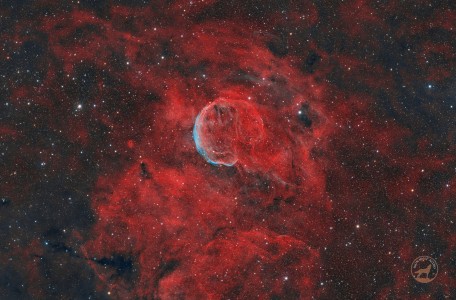
LBN 576 - The Garlic Nebula

My Account

New to Astromart?

Register an account...

Need Help?

Posts Made By: Alan French

July 24, 2005 12:26 AM Forum: Telescope Making

Thermal considerations for tube lining or flocking

Posted By Alan French

Up here in the northern U.S. where temperatures often drop at night and dewing can be a problem, a painted aluminum tube for a 6" f/8 caused problems. It radiated too well, and the secondary almost always dewed up. On some nights the primary dewed up.

A layer of cork solved the problem. A friend has had good luck with unpainted aluminum (a poor radiator) with a lining of flocking paper.

Clear skies, Alan

November 4, 2005 03:33 AM Forum: Telescope Making

off-axis refractor?

Posted By Alan French

jess tauber said:

You've all heard of off-axis Newtonians. My question is, can an off-axis refractor work? The idea I have (lacking suitable ray-tracing programs to check it) is that by suitably tilting the objectives of a refractor, one may then fold the scope at odd angles and thus reduce the number of flat reflective surfaces. Final diagonals would reparallelize the light for ep's. Kind of a refractive Schiefspiegler. This is for a large binoscope.

Would this be feasible? Or would the image generated simply be distorted out of all recognizability by the time it hit the eye? Also, assuming it would work for a simple biconvex lens, would added elements (achromats, apo, etc.) render it unworkable anyway?

Thanks.

Jess Tauber

Jess,

I have no idea why you are calling this an off-axis instrument. Folding a refractor does not result in using only an off-axis portion of the lens.

You can quite nicely fold a refractor in a variety of ways. The traditional approach is simply to use two flats and make a shorter tube, with the eyepiece at the bottom end as is traditional. Unitron sold a 3" version (I was never quite sure why anyone would bother with a 3"), and AstroPhysics brought a 6" f/12 folded this way to Astrofest one year.

You can also fold it as recommended by Henry Paul, so that it looks a bit like a Newtonian. A large flat at the bottom, up to a flat opposite the eyepiece, and then back across the light path using a small flat to the focuser.

Clear skies, Alan

November 12, 2005 08:58 PM Forum: Reflectors

off-axis mask

Posted By Alan French

Bob Buchwald said:

I enjoy reading these forums but rarely add to them unless I have a question or two.

1. What would be the benefits or drawbacks of putting an off-axis 5" diameter circular mask onto the outer edge of a reflecting telescope of 12" diameter? The mask would permit a 5" diameter column of incoming light and would be placed in such a way that it would be at the outer rim of the the 12" mirror thereby avoiding the shadow of the secondary mirror. I know that there would be loss in brightness since only a portion of the mirror is being used, but on the other hand, there would be no central obstruction since the light path is off-axis.

2. Second question, What would be the benefit of putting three of these masks next to each other onto the 12" mirror? Tbis would increase the brightness and would also have no central obstruction to deal with.

3. Would this arrangement of 3 masks create a sharper image overall as opposed to using the entire 12" mirror since there is no central obstruction?

A million thanks
Bob

Bob,

I tried a 6" mask on my wife's 14.5" f/6 Newt on several nights, viewing both Jupiter and Saturn. The views were better without the mask.

Using three holes actually produces what is essentially a 12" mirror with a very odd central obstruction. The diffraction effects of the blocking portion of your three holed mask are going to be detrimental. Of course, it is easy enough to try and see for yourself.

Clear skies, Alan

November 20, 2005 01:37 PM Forum: Equipment Talk

Age and the ability to see in the dark

Posted By Alan French

Tom Bourg said:
[SNIP]
This got me thinking about how much visual acuity I have lost in my 58 years. It has to be very significant. I wonder if anyone has estimates or can direct me to articles about the subject.

I know I have trouble splitting some double stars that were easy when I was a teenager and obviously I've lost a magnitude or so in seeing dim stars. I wonder if anyone has done research into this.

Thanks guys. I really like this sight.

Tom B.

Tom,

If you can locate a copy - I found one through inter-library loan - look at Clyde W. Oyster's "The Human Eye (Structure and Function)." It has a chapter called Time and Change that talks about the effects of aging on vision. He also provides references for further reading.

Your maximum pupil size changes with age. According to Oyster, "After an initial increase in pupil size from birth to about age 15, pupil size decreases slowly with advancing age. The mean pupil diamter decreases by about 0.4 mm/decade after age 15." He also notes that at any age the pupil diameter varies by about 4mm across the population (a number the suprised me).

The graph of visual acuity with age shows a decline starting about 50, with the rate of decline increasing with age.

Clear skies, and wishing for younger eyes, Alan


November 21, 2005 10:29 PM Forum: Equipment Talk

Age and the ability to see in the dark

Posted By Alan French

William Green said:

What do you mean by "visual acuity"?
[SNIP]
Bill

The ability to see fine detail.

To quote Oyster - "Even after refractive errors have been corrected, visual acuity begins to deline slowly in the mid-50s, then declines more rapidly with increasing age." Later he writes "Much of the decline of visual acuity with age can be attributed to transmission losses in the eye's optical media."

It is worth getting this book out of a library, if only to read the chapters on Ocular Geometry and Topography and on Time and Change.

People tend to leave the eye out of the observing equation. Even a healthy eye has considerable influence on the view with large exit pupils and large eye pupils.

Clear skies, Alan

November 22, 2005 11:15 PM Forum: Solar System Observing

Venus (?) in the afternoon

Posted By Alan French

From your description, it sounds too high in the sky to have been Venus. At 3:00 PM PST Venus would have been due south, at an altitude of just under 30 degrees. (A fist held at arms length spans 10 degrees across the knuckles.)

Clear skies, Alan

November 24, 2005 02:47 PM Forum: Telescope Making

Tube material vs. cooldown?

Posted By Alan French

Mike,

My guess is you will get diverse opinions. Personally, I think an unpainted aluminum tube with a thin insulating layer inside (flocking) is the best choice for a Newt. We have a 6" f/8 done this way and it does not have thermal issues. A friend has done much experimentation with tubes over the years, and he is sold on the same approach. For appearance, you can "jewel" the outside of the tube (overlapping swirls).

Unpainted aluminum has good thermal conductivity, but poor emissivity, so it will cool rapidly to ambient air temperature but will tend not to cool below ambient. Before we removed the paint from the 6" f/8, it had terrible problems with dewing of the optics.

Clear skies, Alan

December 18, 2005 01:19 PM Forum: Equipment Talk

Wood tripods

Posted By Alan French

You can easily make a tripod that is steadier than virtually anything you can buy, easy to set up, and quite light too. Look up "Structural Considerations for Telescope Makers" in the June, 1976, issue of Sky & Telescope (page 425). I have made three tripods based on this article, and they work very well.

If you need a bit more clearance from the legs, you can add a short, partial pier to the top.

Clear skies, Alan

December 20, 2005 01:20 AM Forum: Equipment Talk

8" vs 10"

Posted By Alan French

Bennett Burbank said:

In a Meade LX200, which will give me the better view, 8" with UHTC or 10" without it?


10" without it. Resolution is determined by aperture, so somewhat better coatings can never make up for aperture.

Clear skies, Alan

January 5, 2006 12:02 AM Forum: Equipment Talk

Temperature limits for scopes...

Posted By Alan French

Steve Stainbrook said:

I was thinking about putting my scope on a pier (covering the scope when not in use to protect from the elements of course....) but was wondering at what temperature is the scope mirror and electronics (Celestron Nexstar 8 GPS) susceptible to damage? It can get to -15 below at night but only highs in the 80's (which of course, the highs I'm not worried about).

Thanks,

Steve

Steve,

I would be a lot less worried about the highs and lows than in what happens when the temperature changes. The scope will cool at night, and as the daytime temperature rises parts on the telescope will lag behind and stay below the ambient air temperature. On some days the humidity will be high enough for moisture to condense on the cooler parts. Most covers, if they are really waterproof, tend to trap moisture, which makes things worse.

If you do want to store the scope outside, you want to think carefully about driving off moisture and keeping the scope dry.

Clear skies, Alan