Image of the day

Captured by
John Roach

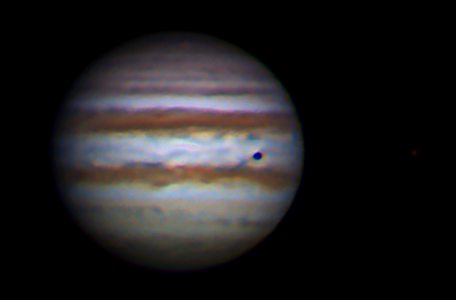
Jupiter IO Transit 12-10-26

My Account

New to Astromart?

Register an account...

Need Help?

Posts Made By: Curt Renz

August 25, 2005 03:22 AM Forum: Solar System Observing

Need info

Posted By Curt Renz

The most basic, easily observed, yet commonly misunderstood pageant in the sky is the apparent changing shape of the Moon.

Place a bright lamp at one end of a fairly dark room or hallway. It represents the Sun. Have a student stand with a ball supported by his upward facing palm at the end of his arm stretched fully in front of him. The ball is the Moon. The student is the Earth. Have him slowly rotate through a full circle. Aha! He will immediately recognize the reason that the Moon appears to change its shape.

You will be applauded for this simple demonstration. Believe me. Even by adults. wink

October 5, 2005 07:36 PM Forum: Solar System Observing

October New Moon Spotting Contest

Posted By Curt Renz

We have a winner! He is Mike Anderson (coronamike) located in southern California. He reported to me at both cloudynights.com and astronomy.com. I have received no other reports of an observation on four message boards. His location near the extreme southwest of the continental US gave him a nice advantage. Apparently the weather was also kind. His strategy of first looking through binoculars and then directly was a good one. Seeing a Moon on October 4 at 19:00 PDT aged 39:32 hours may not have been a record breaker, but it's awfully good considering his location and time of the year.

For those of us located north of the tropics, the period August through November is poor for spotting a really young Moon. The best months are February through May. It also helps to have the Moon near perigee. During the prime months it's of additional benefit to be at the right point in the 18.6-year nodal cycle. That will be the case in 2006. However, that factor currently makes New Moon spotting even more difficult at this time of year.

A truly fine opportunity will come on 2006 FEB 28. Conjunction will occur on that date at 00:31 UT. Perigee will be reached on the 27th. The Moon's nodes will be ideally placed. Those of us in the eastern half of the US will have a fine chance to spot the Moon aged less than 24 hours.

To better picture the geometry, set your planisphere to 6 PM in March. Notice how the ecliptic and zodiacal constellations stretch upward nearly vertically from the west point on the horizon. Each day the Moon will have progressed about 13° in ecliptical longitude or nearly halfway through each constellation. Now set the planisphere to 6 PM in September. Notice how the ecliptic and zodiacal constellations now slant significantly from the west point on the horizon toward the south. As the Moon moves those approximately 13° each day, it's altitude will have made only modest progress. wink

December 15, 2005 01:07 AM Forum: Off Topic Discussions

I want to believe ...

Posted By Curt Renz

People often believe what they "want" to believe. Unfortunately, that mindset has led to many of the tensions in our supposedly modern world among people adhering to opposing belief systems.

BTW, Adobe Photoshop or a similar program will clear up your picture. That's probably how someone altered it in the first place. wink

December 16, 2005 12:12 AM Forum: Solar System Observing

Virgo Occultations - Dec 23 & 25

Posted By Curt Renz

The southern graze path for the occultation of Mag 3.6 Beta Virginis during the early morning hours of 2005 DEC 23 will cross the USA from California to Florida. The northern graze path will run across arctic Canada. Those between the graze paths will witness a full occultation. Those on the graze path will be able to see the star winking on and off as lunar hills and valleys pass by. Finding an observation spot right on the graze line is always a challenge for an astronomical enthusiast.

The apparent disk of the waning Moon will be 54% illuminated. Those seeing a full occultation will watch the bright limb of the Moon cover the star; later the star will emerge from the dark limb. The star’s celestial coordinates of date will be RA 11:51.0 and Dec N 1°44’. smile

To see the map I plotted for the graze path, click: http://www.curtrenz.com/astronomical.html . The pink portion of the path indicates a daylight event. The numerals represent the Universal Time.

Below are my calculated geographic coordinates for the points on the graze path separated by five degrees of longitude. The times are UT. ZA is the Zenith Angle, which is the position of the star on the lunar limb as measured counter-clockwise from the zenith. Sea level is assumed due to the variance in altitude between plotted points. Linear interpolation would be insufficient for intermediate longitudes, but quadratic interpolation should get you close. However, please feel free to reply within this thread to learn the data that go with any specific longitudes and altitudes (above sea level) you provide.

08:11:02 UT - ZA 260.3°
W 125° – N 37.85215°
Pacific Ocean, 231 kilometers west of San Francisco, CA

08:12:13 UT - ZA 261.3°
W 120° – N 37.80308°
Stanislaus National Forest, 3 km SE of Colfax Spring, CA

08:14:06 UT - ZA 262.2°
W 115° – N 37.56101°
Nevada, 6 kilometers south of Pahroc Summit Pass

08:16:46 UT - ZA 263.2°
W 110° – N 37.10504°
Navajo Indian Reservation, 13 km SW of Mexican Hat, UT

08:20:21 UT - ZA 264.3°
W 105° – N 36.40849°
Elliot Barker State Wildlife Area, 8 km NW of Rayado, NM

08:24:58 UT - ZA 265.4°
W 100° – N 35.43664°
TX/OK state line 4 kilometers southwest of Meridian, OK

08:30:52 UT - ZA 266.4°
W 95° – N 34.14360°
7 kilometers southeast of Alikchi, OK

08:38:19 UT - ZA 267.4°
W 90° – N 32.46768°
Ross Barnett Reservoir, 26 km NE of downtown Jackson, MS

08:47:41 UT - ZA 268.1°
W 85° – N 30.32535°
4 kilometers northeast of Estiffanulga, FL

08:59:29 UT - ZA 268.2°
W 80° – N 27.60432°
Atlantic Ocean, 18 kilometers east of Route 1, Oslo, FL

December 19, 2005 08:01 PM Forum: Solar System Observing

Virgo Occultations - Dec 23 & 25

Posted By Curt Renz

The southern graze path for the occultation of Mag 1.0 Spica in Virgo during the morning of 2005 DEC 25 will cross the western USA from Alaska to Texas and into Mexico. There will be no northern graze path. For westerners the occultation will occur during nighttime. In the east the Sun will have risen, but the star should be visible in a telescope.

Those north and east of the graze path will witness a full occultation. Those on the graze path will be able to see the star winking on and off as lunar hills and valleys pass by. Finding an observation spot right on the graze line is always a challenge for an astronomical enthusiast.

The apparent disk of the waning Moon will be 33% illuminated. Those seeing a full occultation will watch the bright limb of the Moon cover the star; later the star will emerge from the dark limb. The star’s celestial coordinates of date will be RA 13:25.5 and Dec S 11°12’. smile

To see the map I plotted for the graze path, click: http://www.curtrenz.com/astronomical.html . The pink portion of the path indicates a daylight event. The numerals represent the Universal Time.

Below are my calculated geographic coordinates for the points on the graze path separated by five degrees of longitude. The times are UT. ZA is the Zenith Angle, which is the position of the star on the lunar limb as measured counter-clockwise from the zenith. Sea level is assumed due to the variance in altitude between plotted points. Linear interpolation would be insufficient for intermediate longitudes, but quadratic interpolation should get you close. However, please feel free to reply within this thread to learn the data that go with any specific longitudes and altitudes (above sea level) you provide.

13:29:57 UT - ZA 239.0°
W 125° – N 48.12053°
Pacific Ocean, 22 kilometers west of Ozette, WA

13:37:00 UT - ZA 237.7°
W 120° – N 44.71127°
4 kilometers southeast of Waldron, OR

13:46:22 UT - ZA 234.9°
W 115° – N 40.72973°
5 kilometers southeast of Clover, NV

13:58:37 UT - ZA 229.7°
W 110° – N 36.13305°
Navajo Indian Reservation, 6 km SW of Blue Gap, AZ

14:13:58 UT - ZA 220.6°
W 105° – N 30.99516°
16 kilometers west of Van Horn, TX

14:31:43 UT - ZA 206.4°
W 100° – N 25.62933°
5 kilometers north of Cadereyta Jimenez, Mexico

December 30, 2005 08:25 PM Forum: Solar System Observing

Moon Occults Pleiades - Jan 9 - North America

Posted By Curt Renz

This thread contains specific information I’ve developed for Chicagoland observers of the Pleiades occultation occurring during the evening of Monday 2006 JAN 09. Data and a map for the Pleione graze path through the area are provided, including details for those planning to observe the graze from Chicago’s Lincoln Park. wink

The apparent disk of the waxing gibbous Moon will be 82% illuminated. Therefore, occulted stars will disappear behind the Moon’s dark limb and reappear from its bright limb. Relative to the stars, the Moon will appear to be moving toward the upper left when viewed from greater Chicago. Although relative to the ground the Moon will seem to be moving toward the lower right due to the Earth’s rotation.

To see the graphics I’ve created previewing the occultation and presenting both the general North American and detailed Chicagoland graze maps, click:
http://www.curtrenz.com/astronomical.html

The 2nd, 15th, 16th and 20th brightest stars in the asterism will become fully occulted throughout the Chicago area. Pleione, the 7th brightest, will present a narrow graze path that passes through Chicagoland. Those observing from the graze path will witness Pleione blinking on and off as hills and valleys along the northern lunar limb pass by. Observers to the south of the graze path will see Pleione fully occulted; those to the north will have to be content with a near miss.


Immediately below are the data I’ve predicted for the five stars as viewed from the Adler Planetarium listed in order of the time of immersion. The apparent Right Ascensions, Declinations and Stellar Magnitudes of the stars for the date of the event (not 2000.0) are posted. The figure after the Central Standard Time is the Zenith Angle, which is the position of the star on the lunar limb as measured counter-clockwise from the zenith. The first time listed is that of immersion (disappearance). The second is that of emersion (reappearance). Please reply within this thread to request data for other locations (provide your Longitude, Latitude, Time Zone & approximate Altitude above sea level.)

Mag 6.5 - 26 Tauri (non-member foreground star)
RA 03:49:19.1 – Dec N 23°52’41”
20:14:32 – ZA 068.1° - Immersion
21:39:28 – ZA 216.1° - Emersion

Mag 6.2 - HD 23923
RA 03:50:05.7 – Dec N 23°43’58”
20:45:00 – ZA 100.1° - Immersion
21:46:42 – ZA 167.0° - Emersion

Mag 3.6 - Atlas
RA 03:49:31.9 – Dec N 24°04’28”
20:45:44 – ZA 010.1° - Immersion
21:45:30 – ZA 255.8° - Emersion (Note: Before HD 23923)

Mag 5.0 - Pleione
RA 03:49:33.4 – Dec N 24°09’28”
21:17:06 – ZA 315.7° - Immersion
21:25:06 – ZA 301.8° - Emersion

Mag 6.2 – HD 24802 (Jan 10)
RA 03:57:48.7 – Dec N 24°28’55”
01:27:32 – ZA 346.0° - Immersion
02:13:14 – ZA 254.3° - Emersion


Next are my calculated coordinates for the points on Pleione’s graze path in northeastern Illinois separated by 10 minutes of geographic longitude. The times are CST. ZA is the star’s Zenith Angle on the lunar limb. The posted longitudes are precisely defined. The corresponding sexagesimal latitudes are less precise than their decimal equivalents. The assumed altitude is 200 meters.

21:18:58 - ZA 310.9°
W 88°50’ – N 41°41’30” (41.69155)
6 kilometers southeast of Shabbona Lake

21:19:16 - ZA 310.6°
W 88°40’ – N 41°43’31” (41.72526)
6 kilometers southeast of Hinckley Airport

21:19:33 - ZA 310.3°
W 88°30’ – N 41°45’31” (41.75854)
1 kilometer southwest of Aurora Airport

21:19:51 - ZA 310.0°
W 88°20’ – N 41°47’29” (41.79139)
North Aurora, Calico Dr. & Sandy Ln.

21:20:09 - ZA 309.8°
W 88°10’ – N 41°49’26” (41.82381)
Warrenville, Winfield Rd., 700 meters south of Butterfield Rd.

21:20:26 - ZA 309.5°
W 88°00’ – N 41°51’21” (41.85581)
Lombard, south end of Rochdale Cir.

21:20:44 - ZA 309.2°
W 87°50’ – N 41°53’15” (41.88739)
Maywood Park, Des Plaines River, 30 meters south of railroad tracks

21:21:01 - ZA 308.9°
W 87°40’ – N 41°55’07” (41.91854)
Chicago, Mendell St., 50 meters north of Armitage Ave.

21:21:18 - ZA 308.7°
W 87°30’ – N 41°56’57” (41.94928)
Lake Michigan, 12 kilometers east of Lincoln Park


Additionally, I’ve determined three graze locations around Chicago’s Lincoln Park separated by 12 seconds of geographic longitude. The assumed altitude is 180 meters.

21:21:04 - ZA 308.9°
W 87°38’12” – N 41°55’27” (41.92415)
West side of Lincoln Park W, 50 meters north of Belden Ave.

21:21:04 - ZA 308.9°
W 87°38’00” – N 41°55’29” (41.92477)
West side of Cannon Dr., 100 meters south of Fullerton Pky.

21:21:05 - ZA 308.9°
W 87°37’48” – N 41°55’31” (41.92539)
Shore of Lake Michigan, 100 meters southeast of end of Fullerton Pky.


Finally, here is my graze interpolation algorithm, which is quite accurate between 87.5° and 88.8° of western longitude, when the result is rounded to five places after the decimal point. The only input value is the western longitude. All values are decimal, including the hours. Nevertheless, please feel free to reply within this thread to learn the graze output data that go with any specific Chicagoland longitudes you provide.

W = Western Longitude (input)
N = Northern Latitude (output)
H = Hours CST (output)
Z = Zenith Angle (output)

L = W – 88 (L is a negative value when W is less than 88)
N = 41.8558132 – 0.19074381 L – 0.007636581 L²
H = 21.3406141 – 0.02908514 L – 0.000411255 L²
Z = 309.480155 + 1.63937196 L + 0.009475733 L²
December 31, 2005 05:44 AM Forum: Solar System Observing

Solar System Highlights of 2006

Posted By Curt Renz

I assume you mean only events visible from southern California in 2006. If so, no solar eclipses, lunar eclipses nor occultations of planets by the Moon will be seen in your region.

As has been noted, there will be a transit of Mercury across the face of the Sun on November 8th. On August 26th Venus will appear to pass Saturn by only 4 arcminutes.

The brightest asteroid, Vesta, will be in opposition to the Sun on January 7th at magnitude 6.2. Saturn will reach opposition on January 27th. Jupiter’s opposition will come on May 5th. Venus will reach its greatest western elongation on March 25th. Mercury will present its greatest eastern elongations on February 24th, June 20th, and October 17th. Its greatest western elongations will come on April 8th, August 7th and November 25th.

Of special note regarding lunar occultations is a series involving the Pleiades cluster. The first such event in 2006 will occur on January 9th. That evening four of the Pleiades will be occulted in your area, and a fifth (actually the second brightest: Atlas) will create a graze path that passes near you. Observers on the graze path will be able to watch Atlas winking on and off as lunar hills and valleys pass by. You’ll have more opportunities to witness the Moon moving through the Pleiades on February 5th, October 9th and December 3rd. Click the following link for graphics I’ve created related to the January 9th event: http://www.curtrenz.com/astronomical.html wink

January 9, 2006 06:45 AM Forum: Solar System Observing

Goodbye/Hello Venus - Contests

Posted By Curt Renz

Pasted below is a report from a southern California participant in the message board at astronomy.com where I initiated an identical thread. wink

________________________________________________________________________


Hello Centaur,
Here is my report for Sunday Jan. 8, 2006:

2006-01-08 19:10PST
At first I went out at 4:30PST to the parking lot of my apartment complex and quickly realized that there was a strong possibility of not seeing Venus due to the buildings obscuring my horizon. The sky was very bright and hazy.

At 4:40 I kept trying but I then realized that I was also running out of time. So forsaking my telescope, I jumped into my truck with tripod and binocs and zoomed to a spot here in the city I scouted out on a previous trip.
From my perch on the top level of a large parking structure I looked but could not see the planet at first with the unaided eye.

So at 4:55PST pulling out the tripod and my binoculars, I found Venus with my 10x50s; There was no wind and calm air; A reddish-brown layer of smog and marine clouds painted the western horizon;
After spotting Venus it was easy to pick it up with my eyes. With the binocs I could easily see the very thin crescent of Venus, but with my unaided eye I could only make it out as small star-like object.

At 5:13PST, Measuring the altitude with my makeshift protractor I found the planet at approximately 5° degrees above the horizon. A large distant tree seemed to point the way.
The smog or marine layer seemed to recede just a little making it easier to pick up with the unaided eye.

At 5:18PST it seemed still to be a little easier to see. Maybe because the sky was getting darker?

At 5:24PST the cloud layer very slowly started to rise and increase. The air began to chill slightly.

At 5:32PST found that it is now getting harder to pick up with the unaided eye. Still visible in the 10x50s.
Seeing is horrible with distortion apparent even in the binoculars.

At 5:35PST Lost Venus with the unaided eye. Still visible in the 10x50s.

At 5:37PST Still is visible in the binoculars but is lost to view by unaided eye. Distortion increasing.

At 5:38PST Getting so dark I cannot write anymore and now realize I forgot my flashlight (aarrghh!).
I ended the observing session. It was great.

Clear Skies --- Silveradogold

--------------------------------------------------------------------------------
33° 48' 44"N, 117° 55' 06"W

January 26, 2006 10:14 PM Forum: Solar System Observing

Crescent Moon (January 26, 2006)

Posted By Curt Renz

Really nice drawing, Carlos. It allows me to imagine how pretty the sight must have been during a morning walk. Thanks for sharing. wink

February 5, 2006 12:27 AM Forum: Solar System Observing

Moon Occults Pleiades - Feb 5/6

Posted By Curt Renz

I've added a graphic do my website demonstrating how the event will appear from Los Angeles when the Moon is covering several stars in the Pleiades. http://www.curtrenz.com/astronomical.html wink
