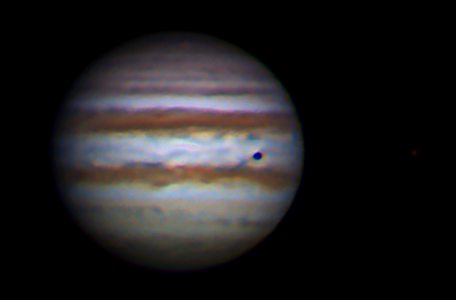
Image of the day

Captured by
John Roach

Jupiter IO Transit 12-10-26

My Account

New to Astromart?

Register an account...

Need Help?

Posts Made By: Curt Renz

June 18, 2005 12:48 AM Forum: Solar System Observing

Preview of Late June Trio of Planets

Posted By Curt Renz

In addition to the graphic for June 25th, I've now placed on my website scenes of the 26th and 27th. The combination should give you a better idea of the relative movements. wink

June 29, 2005 04:37 PM Forum: Solar System Observing

Planetary Trivia Quiz

Posted By Curt Renz

How embarrassing. Is no one here ambitious enough to attempt to provide answers? On two other astronomical message boards members actually participated until someone answered all questions correctly. Everyone had a good time. A more difficult bonus question was added, but folks applied logic and figured out the solution. I suppose that those here simply want the answers. :S

OK, here they are with commentary:


1) How many years are there between inferior conjunctions of Venus?
--B. 1.6

This is the synodic period of Venus – the time it takes to lap the Earth in its race around the Sun. Venus' last inferior conjunction was the much heralded transit of 2004 JUN 08. The next IC will be on 2006 JAN 13. In the meantime there will be a greatest eastern elongation of 47°06' on 2005 NOV 03. During 8 years, Venus orbits the Sun approximately 13 times producing about 5 synodic periods. That is the famous 8-year cycle during which the dates of conjunctions and greatest elongations nearly repeat.


2) When is the earliest year in which Mars will approach closer to Earth than in 2003?
--C. 2287

It may have been more than 60,000 years since Mars was closer than in 2003, but it will take only 284 years to get even nearer. Actually, it was only slightly further in 1924 than in 2003. As Mars’ orbital eccentricity experiences a cyclical increase, it will periodically make even closer approaches until around the year 25000.

3) Which of these is a triple conjunction?
--E. 2 planets sharing the same ecliptical longitude thrice in less than a year

Occasionally one planet will appear to pass another - turn retrograde moving by the second planet again in the reverse direction - then resume direct motion for a third passage. The probability of any of the other four choices ever occurring is zero if the conjunctions must be precise.

4) How many times during 1900-1999 did Mercury transit the Sun?
--D. 14

That’s close to the average of about 13 per century. The last one occurred on 2003 MAY 07. The next one will occur on 2006 NOV 08.

5) When is the last time that there was a transit or occultation between two planets?
--A. 1818

On 1818 JAN 03 Venus transited across Jupiter. There is no record of an observation. The only recorded event since the invention of the telescope was the occultation of Mercury by Venus on 1737 MAY 28 witnessed by a lone English amateur astronomer. The next event will be a partial transit of Venus over Jupiter on 2065 NOV 22, but it will occur only 8° from the Sun making it difficult to observe.

July 7, 2005 02:47 PM Forum: Solar System Observing

July New Moon Spotting Contest

Posted By Curt Renz

Below is a report that an observer with the nickname Silveradogold2 in north Orange County California made at astronomy.com regarding his attempt to spot the Moon on July 6. Only southern Californians had even a slim chance yesterday. wink
____________

2005-07-06 20:10 PDT Visibility of the New Moon;

20:10 PDT Started my observing session by scanning the horizon with just my eyes; Although I had my printed star charts from StarCalc, I could only see Venus, which I saw immediately; The horizon was very hazy and full of a orange mixture of something I hoped not to be breathing (smog); I am using a plastic protractor equipped with a wire pointer to get rough directions in degrees;

20:12 Started observing with my 8x50 binoculars; Picked up Mercury quickly just left and a little low of Venus; Mercury twinkled in and out the haze with the atmosphere bending those light rays;
Looking back and forth at the charts and the sky, I searched and searched for Saturn, which I had planned to use as a stepping stone to find the New Moon; Not finding Saturn is fueling my frustration;

20:15 Sky is getting a little less bright but still cannot find Saturn or the New Moon; The watchman at my workplace keeps wondering what I am doing but he is keeping his distance; I guess I am too close to his car;

20:25 Cannot find Saturn and though I have scanned and re-scanned carefully I cannot find the New Moon either; Decide to end the session as I believe from this location I probably cannot see anything below about 4° above the horizon anyway; Just too much haze and junk in the air; Thoroughly frustrated as I really hoped to at least see Saturn, which would have provided an important reference to the position of the New Moon; Did not get to see either.

July 8, 2005 02:24 AM Forum: Solar System Observing

July New Moon Spotting Contest

Posted By Curt Renz

Well I spotted her tonight quite easily at 21:02 CDT (02:02 UT) from northwest suburban Chicago. Although 38 hours isn't much to brag about. Surely somebody east of here must've seen the Moon a bit earlier.

July 9, 2005 05:00 PM Forum: Solar System Observing

July New Moon Spotting Contest

Posted By Curt Renz

Thanks to everyone for participating this month. There are no real kudos since no one reported a spotting of under 32 hours. That's been my arbitrary cutoff, since its is about twice the theoretical possibilitiy. But the pictures were greatly appreciated. That's the spirit! grin

The best timings among the four astronomical message boards on which I posted the contest both came from Chicagoans. "Tim" saw the Moon at 01:35 UT and "Chicago Astronomer Joe" Guzman spotted it "around" 01:30 UT. They were both at about the 37.5 hour mark. They reported at "The Chicago Astronomer" website, http://astronomer.proboards23.com/ , which is run by Joe. "Tommy" Jane, also near Chicago, reported a sighting at 01:43 UT on three websites.

I expected to learn of better timings from observers on the east coast or Europe, but they must have been clouded out. :S

July 14, 2005 07:21 PM Forum: Solar System Observing

Moon to pass in front of Comet Tempel 7/15?

Posted By Curt Renz

Lawrence, thanks for the heads-up. I performed some calculations with my self-written software. It appears there will indeed be an occultation of Comet Tempel 1 by the Moon on July 15. However, it seems the only nighttime opportunities will occur over the western Pacific Ocean east of the Philippines.

For Manila I predict immersion of the comet behind the dark portion of the Moon at 18:52 UT+8 with the Sun still 1° above the horizon. Emersion from the Moon's lighted portion should occur at 19:23 with the Sun 13° beneath the horizon.

Due to the dimness of the comet and lack of good viewing locations, I doubt we will be getting many reports of occultation observations. wink

July 21, 2005 09:04 PM Forum: Solar System Observing

Mars as big as full moon!

Posted By Curt Renz

The original article did not state the year, only this year. Apparently some poor innocent fool found the article a few months ago and assumed it referred to 2005, not 2003. He must've e-mailed it excitedly to his friends. The internet grapevine became quite efficient. It's amazing how many people were mesmerized by the article, yet had forgotten that the information was highly publicized two years ago. The e-mail was sent to me in April by a friend who I thought was astronomically literate. As Mitsky well states, the correct original reference to a Full Moon became corrupted by some who tried to pass along the information. There was some actual misinformation in the original article, but of minor concern when considering it was directed toward the general public. The big mistake was not mentioning the year within the article.

The point to be learned from this episode is to verify any information you have received by e-mail before passing it along to others. It's especially easy to quickly hit the forward button when an article describes something you'd like to believe is true. You may only look foolish if you act hastily.

This Martian matter is of no great importance. It just points to some of the follies of human nature. I'd want to hope that less of this behavior occurs regarding more vital matters. But then I read about the countless unfounded tsunami warnings that have been circulated recently. I suppose that the amount of mutated information will continue to escalate as the internet becomes even more prevalent. Those who are wise will try to remain alert; most will not. :S

July 27, 2005 11:39 PM Forum: Solar System Observing

Lunar Quiz #3

Posted By Curt Renz

Apparently few people want to take quizzes during the summertime. OK, here are the answers with explanations.

1) The maximum phase of the next lunar eclipse on 2005 OCT 17 at 12:03 UT will be:

B) Partial 6%

We're living during a long stretch of the 586-year eclipse cycle in which total lunar eclipses are more common than usual. When we do get partial lunar eclipses during our era, they are often quite minor ones. The next total lunar eclipse will come on 2007 MAR 03. For those of us in Chicago the Moon will rise around sunset that evening while in total eclipse. The October partial eclipse will reach maximum in Chicago just before it sets near dawn.


2) The next solar eclipse on 2005 OCT 03 will be:

C) Annular

It will be visible in portions of Spain and Africa. An annular eclipse occurs when the Moon appears smaller than the Sun presenting an entire ring of sunlight around the dark Moon. They are really not much more interesting than partial solar eclipses, of which annulars are really just an unusual type. The true majesty of Mother Nature is brought forth with a total solar eclipse. The next total one will occur on 2006 MAR 29 for observers in parts of Africa, Turkey and Asia.


3) During the current era the mean Earth-Moon distance is increasing by what amount per century?

B) 3.8 meters

This value had been approximately known since Newton's time. But it was nailed down after Apollo astronauts placed a laser reflector on the Moon. It amounts to only 3.8 centimeters per year or 3 millimeters per lunar month. Some sources will tell you that the recession is due to transfer of angular momentum from the Earth as it slows in its rotation. That's not an explanation of the physical cause for the Moon to move outward; it's merely the expected result. Ocean tides are caused mainly by the Moon and create a friction that slows the Earth's rotation. That friction drags the tidal bulge ahead of the spot where the Moon is in the Zenith. That bulge then gravitationally tugs at the Moon giving it enough added momentum to move into a higher orbit.


4) Which of the following first magnitude stars is not one that the Moon occults during the period 1900-2100?

B) Pollux in Gemini

Those who were paying attention during an earlier lunar quiz got this one easily. Pollux was last occulted by the Moon in 117 BC. Since then its proper motion has moved it out of range of the Moon. The other four stars are regularly occulted during certain periods within the 18.6-year cycle of the Moon's nodes.


5) When during the period 1990-2020 does the Moon reach its most extreme geocentric declinations, 28°43’ North and South of the Celestial Equator?

D) 2006 MAR/APR

That will be near the time when the Moon's ascending node lies near the vernal equinox. The Moon's orbital plane is inclined by 5.15° to the ecliptic (Earth's orbital plane.) At times during the 18.6-year cycle of nodes this is added to the 23.44° tilt of the ecliptic to the equator. At the opposite point of the cycle it is subtracted. So now we are in a period in which the Moon transits extremely high when in the constellations of Taurus or Gemini and exceptionally low when in Scorpius or Sagittarius. wink

August 8, 2005 01:25 AM Forum: Solar System Observing

Venus and One Day Old moon

Posted By Curt Renz

Nice picture, Bill. Thanks for sharing. Although I'm surprised that you didn't enter it in my New Moon Spotting Contest thread on this same page. The Moon was aged two days on Saturday at 21:05 MDT. From your picture it does not appear as though you spotted it on Friday. If I'm wrong, let me know. You might want to get a picture of Diana's Bow (3-day-old Moon) tonight when it appears near Venus. It should be a pretty sight. wink

August 20, 2005 09:14 PM Forum: Solar System Observing

Pleiades Occultation Series

Posted By Curt Renz

One of the minor Pleiades stars, HD23753, at Mag 5.4 will actually be occulted for many North American observers on 2005 AUG 26.

I calculate that as viewed from Chicago's Adler Planetarium the immersion will occur at 02:44:34 CDT. The star will meet the lighted portion of the Moon at zenith angle 80.9°. The emersion will occur at 03:42:14 CDT. The star will exit the dark portion of the Moon at zenith angle 329.0° (-31.0°.)

Note: The zenith angle is measured counter-clockwise from the zenith around the lunar limb. wink